Welcome to our community

Be a part of something great, join today!

  • Hey all, just changed over the backend after 15 years I figured time to give it a bit of an update, its probably gonna be a bit weird for most of you and i am sure there is a few bugs to work out but it should kinda work the same as before... hopefully :)

Canon 24-70mm not constant 2.8?

I see.

I've never used mine to shoot cine, so I never gave it any thought until you asked. So I shot a couple test frames and I do see it with my gear.

It seems counter intuitive. At the tele end the elements are closer together... Mr. Duclos, do you care to offer a brief primer on the subject?
 
Mounted on a RED, I see very little shift in exposure. Ditto on my 7D.

What I am seeing here is too much for the lens alone to be at fault.

I don't actually own that lens though, so maybe I am mistaken.

If you are shooting with a Canon 7D or other recent HD DSLR check that "Auto Lighting Optimizer" is turned off. That can cause a shift like this.

I wrote elsewhere on REDuser about that setting, which causes a lot of trouble with lighting levels.

http://reduser.net/forum/showpost.php?p=533872&postcount=4
 
I see.

I've never used mine to shoot cine, so I never gave it any thought until you asked. So I shot a couple test frames and I do see it with my gear.

It seems counter intuitive. At the tele end the elements are closer together... Mr. Duclos, do you care to offer a brief primer on the subject?

I'm not 100% sure as to why this is, but many lenses are slower at the long end. I have never seen one that is slower at the wide end.

I always figured it's because the physical aperture is must be larger at the long end for the same f/ stop, and that that wasn't possible.
 
And let's not ignore that there are no hard stops on the focus ring. Also that the focus throw is about 120 degrees, IMO too short for comfort at the long end.

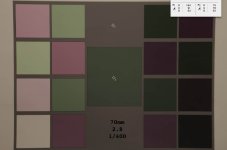
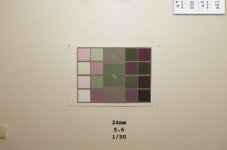
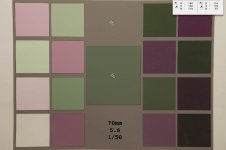
Here is the same comparison at f/5.6.
 

Attachments

  • 24mm f56.jpg
    24mm f56.jpg
    29.1 KB · Views: 0
  • 70mm f56.jpg
    70mm f56.jpg
    21.3 KB · Views: 0
I just shot a Musicvideo with a lot of fast Zooms.
In post I recognized a brightness loss about a half stop
on the longer end of my new 24-70mm Zoom.
Made CC really complicated.
Is that normal (I don't hope so!)

I'm afraid so, we have been testing all kind of lenses, for my S3D set up to shoot "Rape of a Beauty" and off course considered the possibility to have a tight budget we look at Still lenses, both Canon and Nikon, as we know both Epic and Scarlet will offer this mounts with full controls, but the results were the same, all zooms tested showed differences form end to end, especially considerable was some of the light fall off, and Pincushion and Barrel distortions during their zooming, making them almost impossible for a S3D set up, unless we really want to spend a tone of money and time in post to fix the extreme Disparities, or give our viewers huge headaches and never get the financing.

On the other hand the RPZ 18-85 shoed incredible quality and well controlled movement with surprisingly almost non existing Barrel and Pincushion distortion, making it ideal for S3D set up, but only when Parallax settings are wide, do to the size of the lens, and or when set up on a Images splitter rig.

Any way no still zoom lenses for me for shooting Movies, unless you use them as Vary Primes, and deal with the light fall off accordingly, which can still be a pain, having to re-meter the scene every time you zoom in and or out, but then again, my self I would not shoot with different focal using the same lights, unless they were okay off course which some times they are.

Also unfortunately this is some what more so an issue in some copies more then others, so if yours has lots of fall off, sale it and get a new one.

I have tested so many lenses before I got to find the kippers, that I wan't even tell you.
 
I'm not 100% sure as to why this is, but many lenses are slower at the long end. I have never seen one that is slower at the wide end.

I always figured it's because the physical aperture is must be larger at the long end for the same f/ stop, and that that wasn't possible.

Yes, I mis-spoke and stated it backward. Clearly I'm not as intimate with the particulars of how zooms are assembled or I wouldn't have made such an error of memory. Guess I should take this up with a book or two. :-) I have some Canon video lenses that close down up to 1 1/2 stops at the long end making them slower.

To the best of my rather poor recollection I had some much older zooms years ago that required special care at the long end. It was a mechanical thing I think... A danger of physical damage to the iris blades by mashing them into the mount or mirror... But I was a kid then, and now I'm a rambling, older guy. :blush2: Sorry Kim.
 
Last edited:
A qick and dirty test

A qick and dirty test

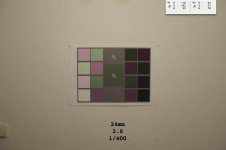
So I tried to do a little test by my own.
It's my first time doing this, so please be patient, I'm open for advice.
I shot my neatvideo chart, had nothing else.
The pictures are just Photoshop screenshots, to get the RGB values.

The first two pictures shot at 2.8 show a brightness loss at 75mm of about half a stop. The RBG values change about 8-12 points

The third and the forth picture shot at 5.6 just show a RGB change of about 3-5 points.

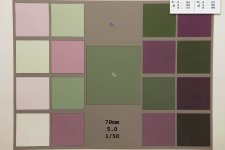
In the fifth picture I opened up a to a 5.0 what gives a RGB change of about 12-16.

I don't know how to do such a test the correct way. Please tell me.
I want to know if the brightness loss really gets less by closing down the appeture.

Bild 78.jpg

Bild 79.jpg

Bild 75.jpg

Bild 76.jpg

Bild 77.jpg
 
Always stop the lens down from wide open, I would expect the lens to be worst wide open & get better as stopped down, that's basically happening.
 
Yes I knew that in terms of image quality but not about appeture consistance on a zoom lens.
 
I am talking about image brightness, which is what this thread is about. Stopping the lens down, so backlash is taken up in the iris.......
 
It's the lens.

Over the last few months, more than one Canon dealer has discouraged me from buying the 24-70L, saying it doesn't deserve the "L" designation due to softness, distortion, and vignetting - which has been echoed by others. They've all told me to wait for the rumored IS replacement.
 
Just 0.02, common sense thoughts which you probably already took into account:
_ It seems you lit from overhead, so the higher you measure the higher the values you'll get.
_ Noise will give you slightly different values, so if you want such accurate measurements you'd have to get several measurements and average them out, quite a bit of work.
_ Make sure you measure off the originals or you'll also have to worry about compression artifacts which could give you wildly different readings close to high contrast areas.
 
It's an okay lens. I've been using it for a year on the Birger and it definitely ramps on the long end. I would say at least half a stop when at 2.8 and 70mm. It telescopes which sucks the most and overall is a little soft. It's decent but the 16-35 is better for those reasons. It would be pretty awesome if Canon brought out a 16ish-85ish 2.8 that solved some of those problems. I would sell 2 lenses and pay $2K.
 
In post I recognized a brightness loss about a half stop
on the longer end of my new 24-70mm Zoom. Is that normal?

No, it is definitely not normal. I traded my 24-70 for a 24mm f/1.4, but I'm certain that the 24-70 I had did not do this. I shot it in manual mode all the time, and I think I would have noticed a half-stop change every time I zoomed.

I think veiling glare is a more likely explanation. Music videos like to have a lot of flaring lights, and at 24mm you'll get more glare/flare from them then at 70mm. The flare is what increases the brightness and gave you the impression of ramping.

If you take an image of an even-toned subject with no sources of glare, I think you'll find that the f-number is indeed constant with zoom.
 
But Daniel, did you take a look at the quick tests Roberto and me shot?
 
It's the lens.

Over the last few months, more than one Canon dealer has discouraged me from buying the 24-70L, saying it doesn't deserve the "L" designation due to softness, distortion, and vignetting - which has been echoed by others. They've all told me to wait for the rumored IS replacement.

For the kinds of still work that I frequently do, it is one of only two lenses that I carry. The other is my favorite, the venerable 70-200L. The 24-70 isn't as sharp, but then I know of no other zoom that is. OK, it has a fall off of brightness at the very end, but we are talking about a half stop. It's still a fast lens, and for still work it is perfectly adequate.

Dan makes a good point. I'll admit that my own test was quick and dirty. I'll give it a more careful go later.

The fact that it does telescope was going to preclude it from getting any Cine use on my future Scarlet, so this fall off news isn't all that upsetting to me. It's good to know though. Thanks for pointing it out.
 
But Daniel, did you take a look at the quick tests Roberto and me shot?

Yeah, that doesn't look like flare. I must be wrong.

Another possibility is that the f-number is indeed constant, but this is a difference in vignetting. On full frame, there is a conspicuous bright center spot and rapid falloff at 24mm, but since you're using S35, most of the frame is taken up by the bright spot. At 70mm, the bright spot evens out and the falloff is smoother.
 
I reshot with a more careful approach and will leave you to your own conclusions. This was for brightness, so critical attention was not paid to focus.

I shot a medium grey paper backdrop and placed 20 targets diagonally across the center. I spot metered just above each target, and entered the average reading on the target for each of the 2 exposures. Camera distance remained unchanged.

I repeated x4:
24mm metered at 1/60 f4.0 8 shot at 1/60 f4.0 ISO 100
4265930343_bf77b73bce_o.jpg


70mm 1/60 f4.0
4265930319_60e79701da_o.jpg


70mm metered at 1/60 f2.8 5, shot at 1/60 f2.8 ISO 100
4265930277_6766692561_o.jpg


24mm 1/60 f2.8
4266676052_1815a3dd87_o.jpg
 
That's a really horrible lens IMHO, OK 70mm F4 but not much good anywhere else.

I reshot with a more careful approach and will leave you to your own conclusions. This was for brightness, so critical attention was not paid to focus.

I shot a medium grey paper backdrop and placed 20 targets diagonally across the center. I spot metered just above each target, and entered the average reading on the target for each of the 2 exposures. Camera distance remained unchanged.

I repeated x4:
24mm metered at 1/60 f4.0 8 shot at 1/60 f4.0 ISO 100
4265930343_bf77b73bce_o.jpg


70mm 1/60 f4.0
4265930319_60e79701da_o.jpg


70mm metered at 1/60 f2.8 5, shot at 1/60 f2.8 ISO 100
4265930277_6766692561_o.jpg


24mm 1/60 f2.8
4266676052_1815a3dd87_o.jpg
 
Back
Top