Welcome to our community

Be a part of something great, join today!

  • Hey all, just changed over the backend after 15 years I figured time to give it a bit of an update, its probably gonna be a bit weird for most of you and i am sure there is a few bugs to work out but it should kinda work the same as before... hopefully :)

OFFHOLLYWOOD rolls on world's first 4.5K 3D feature!

Frankly, (no offense) I've found that 3D viewing on set for anybody other that the stereographer can sometimes be a detrimental. It tends to slow things down because "people" tend to huddle around. It distracts people from thier jobs and most importantly sooner or later makes everyone think they are a 3D expert and sooner or later making the stereographers job much harder! hehe....

Is your stereographer pulling IO & convergence?
 
Congrats on what look like a fun feature.

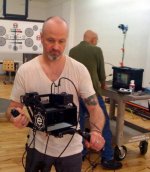
Excuse my ignorance but what are these things with the coils on them?
_MG_0792.jpg
 
Was the operator okay? :bigear:

The "big rig" you see in the pics with the REDs is the QUASAR rig from ET.

The ET NEUTRON is a small rig that we fly with SI2K mini-cameras - for steadicam and hand-held.

ET is building a rig called PULSAR - which will be slightly larger than the NEUTRON - but much smaller than the QUASAR - for use with the EPICs.

The NEUTRON in the photo is a prototype and when on steadicam there is wireless motor control for IO.
 

Attachments

  • SI2K_photo.jpg
    SI2K_photo.jpg
    42.4 KB · Views: 0
excited to see how things begin to flesh out, please update with stills when possible!
 
just a thought...

If you need a quick way to view 2-camera 3-D, just use 2 monitors and learn to CROSS-VIEW.

alternate, use two viewfinders, one for each eye.

the cross viewing method was (is?) used at teaching hospitals where stereo camera rigs are attached to stereo microscopes.

when i first saw the blue/red glasses i sort of panicked, thinking you were shooting for blue red anaglyph projection *shudder* but soon i realized its just for on-set viewing.
 
just a thought...

If you need a quick way to view 2-camera 3-D, just use 2 monitors and learn to CROSS-VIEW.

Well while that's true, unfortunately on a beamsplitter we cannot do that because the reflective camera's image is flipped and the last time I checked we still cannot flip the image on the RED LCD.

When we shoot parallel I freeview since the images are not flipped. It is a useful skill to develop.
 
Congrats guys!
 
How do you post something like this?
 

Depends on where you go and who's doing it. But basically, it's all about dealing with two streams instead of one. Editorial is handled different ways by different productions and facilities, but essentially what comes out of it is two EDL's, one for the left eye and one for the right eye. Both eyes are conformed and in most cases (not all) are loaded into a DI system that can pull both streams simultaneously and output them to some type of combiner that reformats them for whatever the display system requires. Color correction is handled in different ways by different systems and different colorists, but basically one eye is graded and that grade is copied to the other eye. The second eye might require additional work to match it as close as possible to the first eye if the cameras did not produce identical exposures (almost always the case, especially with mirror rigs as there is a bit of light loss, as well as the fact that lenses are not always a perfect match). Some systems allow a "ganged" grade once the base grade and matching is done, others require you to tweak one eye and copy the tweak to the other. Convergence is also adjusted as part of the DI process, basically by doing opposite X axis pans on each eye to put the desired convergence point "on the screen plane," followed by scaling to cover the image to the edges. In most cases, the colorist must work with the 3D glasses on so that the light loss through the 3D viewing system is accounted for, which is why if you take off the glasses at a typical 3D screening, the picture is much too bright and saturated. To produce various other deliverables (i.e., 2D versions, other 3D systems), different approaches are taken, including LUTs for basic color transformations, and additional grading passes for the various delivery systems. The deliverable for stereoscopic theaters is a digital cinema package that is essentially a 48fps stream with the left and right eye alternated, yielding two 24 fps image streams when decoded by the 3D system that feeds the projector.

If you want more details, feel free to ask.

Well there you have it Tom! :thumbup1:
 
Doesn't sound like I'll be doing that on my home PC anytime soon. :)
 
Doesn't sound like I'll be doing that on my home PC anytime soon. :)

There are ways and ways. I always believed 3D would be a far too complex affair for us ordinary people to achieve on our gear and means, but I can tell you that I was wrong. You can indeed edit and output 3D at home, I've been doing it for the past 3 weeks and the results have surpassed every hope I had. However, given the fact that there are levels of accomplishment and that I don't disagree with the above posters that to create 3D for cinematic exhibition is a bit more complex than what I've been doing, I can send you a PM instead describing what I've done in case you want to follow suit. That way I don't have to publicly contradict the opinions expressed above, which are accurate anyway, for the specific background being talked about.

So, if you're on the PC and have Adobe Premiere Pro and want to give 3D a shot, let me know and I'll give you a detailed description of what to do.
 
Back
Top