Welcome to our community

Be a part of something great, join today!

  • Hey all, just changed over the backend after 15 years I figured time to give it a bit of an update, its probably gonna be a bit weird for most of you and i am sure there is a few bugs to work out but it should kinda work the same as before... hopefully :)

canon 24-70 L f2.8

Interesting. The 50mm tested is the "non L" version. The front element is significantly smaller than the L 50mm ver which is 1/2 stop faster, which I'm sure your aware of. Yet another aspect to compare, but I'm done.

Goodnight.

Sure! but coming from two similar f1.4 fixed lenses you would expect to be almost the same, right?
I also notice less barrel distortion on the zoom than in the 50mm. That´s something that drives me nuts, all canon 50mm show considerable barrel distortion.
 
Wow! I find it fantastastic how much knowledge you put into this forum! Thank you all!

1. I love the 50mm 1.4 non-L lens. Was my first prime lens and my eyes fell off when I saw the sharpness of my first picture (ok... I'll show you later)

2. You probably know this: http://www.photozone.de/Reviews/overview


Have a great day!
 
How did you make that? Did you test them at the store to compare?

Buy 3 new ones, test on a Canon 1Ds MK II and then return the less sharp ones.

And how does it work to let it adjust by canon? Is that expensive?

You can join Canon Professional Services IF you have enough lenses and cameras to qualify. The Gold and Platinum levels are a great deal for the included services.

http://www.usa.canon.com/consumer/c...t&key=CPS_Member&keycode=CPS&fcategoryid=2647

FYI: I had a problem with my best 24-70mm and sent it to Canon. They fixed it but when returned it was not as sharp as before. I had to send it back and the 2nd time they did adjust it to be sharp wide open. I never ASSUME that any lens is sharp -- I always test -- new, used or even just repaired by Canon.
 
Had some time to kill this morning. Here are full frame (4k HD) versions, scaled to 200 pixels across. As you can see my gray card illumination is uneven. The light source is overhead and slightly off center to the left. The card is a cheap $5 model with visible paper grain and glares very easily. Most of the uneven lighting is the result of shininess.

4090387240_c64dc0b9df_o.jpg
 
Thanks for the tests David...your tests have confirmed that there is just a slight increase in T stop over F stop with the 24-70 versus primes - at least with your lens. My 24-70 performs similar to yours. If I'd have had the time I would have done the tests myself.

Before David did his tests, I posted this in my post #23 of this thread, I stand by it, and David's tests support it:

"I'm well aware of the difference between f stop and T stop. I'm not disputing that the 24-70 may have a higher T stop than 2.8 - what I am saying is that it has been a great lens for me and that nuance hasn't hindered my crew's shooting at all. If you're generalizing by saying that all 35mm stills zoom's T stop are significantly above their F stop, I disagree. Each zoom lens is different - and each individual lens within a lens make and model can be different."

Steve Murray then touches on the last point in my post - that individual lenses within a lens model can vary somewhat in performance. That's why all 30 of the 35mm still lenses I use on my RED cameras have been hand picked for their performance. I tested each lens on my REDs, and returned a few until I got good ones. Overall, only a few of my 35mm stills zooms showed unacceptable performance. But most of them did fine right out of the box. If they were used lenses, I simply sold them off, and bought another version of the lens. I had to do this with just a couple lenses out of the 30 I bought. It is obviously possible to get a bad 35mm still zoom - but in my experience that is a relatively small percentage of the lenses.

Steve,
long time no here.
As you know Im rehousing the 14-24 and the 24-70. After T stopping the 14-24 about 10 different units the actural T stop through entire zoom is T2.6 to T 2.9 so it is very safe to call this 14-24 nikor Ruby wide is a true T2.8
lens.
Stuart
 
Steve,
long time no here.
As you know Im rehousing the 14-24 and the 24-70. After T stopping the 14-24 about 10 different units the actural T stop through entire zoom is T2.6 to T 2.9 so it is very safe to call this 14-24 nikor Ruby wide is a true T2.8
lens.
Stuart

Hi Stuart,

Yes, I've heard very good reports on your Ruby re-housed Nikon 14-24. That doesn't surprise me on two counts - firstly, I own and regularly use a stock 14-24 and have a very high opinion of it, and secondly, I know you do very good lens work, because you've done some excellent lens work for me over the years. I haven't specifically bench tested it for such, but I'd estimate that my stock 14-24 doesn't have a very big difference between F stop and T stop - perhaps 1/3 stop at most. I'd also estimate that most stock Nikon 14-24 lenses don't have a big variance between their F and T stops. I think the 14-24 was a great choice for re-housing, and if I did a lot of cine-style shooting I'd probably buy one of your Ruby lenses.

I believe the 24-70 you are re-housing is the Nikon 24-70, not the Canon 24-70 which is the lens the guy who started the thread asked about - and the lens that David tested.

I've used the Nikon 24-70 many times and I have a high opinion of it. I think its a good choice for re-housing.

Its obviously cine style shooters who are interested in stills lenses being re-housing into cine lenses - so they can easily use their MB and FF units in their field workflow. Its also primarily cine style shooters who are interested in T stops versus F stops. But RED One, and even more so Scarlet and Epic, are convergence cameras where many people are converging from the stills, TV/video, and film industry. Traditional stills and TV/video people are used to using and trusting electronics, and with RED One a large percentage of them eye focus their cameras, don't use hand held light meters, and use stills and TV/video exposure technology like zebras and histograms to set exposure.

Cine lenses are obviously very attractive to cine-style shooters. But those of use who shoot hybrid 35mm stills and non-hardlined EFP styles have very little interest in cine lenses, matte boxes, follow focus units, hand held meters, or the difference in a lens between its F stop or T stop - but we obviously can tell quickly in real-world use if a 35mm zoom lens has a big difference in F and T as we use it in the field.

The cool thing about RED One, and Epic and Scarlet to come, is that those cameras can be lensed and accessorized as everyone needs, depending on their style of shooting, genres serviced, etc.
Steve
The 24-70 is nikon optics.
Stuart
 
The rack focus test made me want to check my sample. The zoom is set to 70mm based on my assumption that it might show imperfections
more than at other focal lengths. It is set wide open, though I probably should have set it to f/3.2 or a bit higher to limit the bokeh.
And I had one too many glasses of wine so forgive the vibration, music and randomness of the subtitles. I don't get out much. :)

Canon 24-70mm f/2.8 Rack Focus
(7.4MB)
 
Hey Stuart. Are the variances though the zoom range of a given unit, or from unit to unit?

Robert
To answer t stop question the lenses I'm talking about is Nikon .
I can set the iris to T 2.6 how ever when zooming to telephoto the T stop ramps a little much from T 2.6 -T2.9 3.0so I set the lens at T 2.8 and the most the lens will ramp is T 2.9-3.0. Hope this helps.
Stuart
 
I knew you are talking about the Nikon Stuart. I would love to have your second generation 14-24 for our project. I also look forward to reading about your 24-70 once you are done with it.

I guess that might be a good thing to do when you want to satisfy "PL buyers". And I suppose T2.8 to T3.0 is small enough to satisfy most PL buyers. It is a shame there wouldn't be a way to prevent the iris to rotate all the way to T2.6 while tele, but I imagine that would be a mind blowing job and making it accurate sample to sample would drive up the cost too much.
 
I recognized a shift in exposure of about a half stop between the focal lengths of the lens.
When zoomed in to 70mm the sensor gets a half stop less light, than with the wide 24mm.
Is that normal?
I wouldnt think so, but want to be sure.
Can that be fixed or do I need a new one
Thanks...
 
stills lenses to filter them in the way they were designed for - screw on filters.


Steve, how are you using polarizing filters that require slight adjustment by turning it left or right to adjust for the best cancelling of the sun reflection without MB?
Example:
Shots on the water in a sunny day
or see-through glass windows to show people inside or behind the window in the sun
or black or shiny objects in the sun
You have to take out, sun highlights or reflections by turning the filter around its axis.

Andrew
 
Good skrew on Polarizers normally have a rotationable front.
So you skrew it onto the lense but still can rotate the Filterglass.
There are also marks on it, to be able to reset.
 
I knew you are talking about the Nikon Stuart. I would love to have your second generation 14-24 for our project. I also look forward to reading about your 24-70 once you are done with it.

I guess that might be a good thing to do when you want to satisfy "PL buyers". And I suppose T2.8 to T3.0 is small enough to satisfy most PL buyers. It is a shame there wouldn't be a way to prevent the iris to rotate all the way to T2.6 while tele, but I imagine that would be a mind blowing job and making it accurate sample to sample would drive up the cost too much.

Roberto,
The second generation of the Ruby -14-24 is being delivered this month. Also the T stop will be set at T 2.8 at 14 mm and ramp to T 2.9 t3.
Also there will be screw in filter in front 102mm check out my web sight for more info. Www.focusoptics.com. Www.lensrepair.com
stuart
 
Sorry my english isnt good enough to understand youre question.
What does "as a last outmost one" mean?
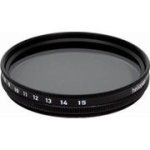
This is a circular Pol Filter I'm using by HELIOPAN.
The front (the part with the numbers) can rotate.
10000216063.JPG
 
All good screw on filters are stackable with threads on both sides.

(Outmost: "the one most to the outside" :thumbsup:)

Aren't polas absorption filters? I had a bit of ghosting with two polas (probably not the best) stacked on a Fader ND. I did also have a UV, so not 100% sure where the mild ghosting came from.
 
Still photo lenses are not marked in T-stops which is why they seem slower.
They are calculated f stops which can be a very different number.
The 24-70mm Canon is a nice lens optically, but it's mechanical construction is where you will find most of your problems. Because it is an auto focus lens it holds very loose tolerances that will surely be noticed when reversing focus direction or when zooming during a shot.

yes, but on a Birger, on when red releases their new Canon mount, follow-focus is a dream with thsi lens.
 
That's exactly what I am thinking. The inventor of magic lantern is for example working on a firmware, that allows using the auto focus via remote follow focus on 5DII. No extra gear for tousands$. Just a nice remote and some good AF lenses.
 
Back
Top