Welcome to our community

Be a part of something great, join today!

  • Hey all, just changed over the backend after 15 years I figured time to give it a bit of an update, its probably gonna be a bit weird for most of you and i am sure there is a few bugs to work out but it should kinda work the same as before... hopefully :)

Exposing Night Interiors/Exteriors?

Eric Haase

Well-known member
Joined
Apr 1, 2009
Messages
1,041
Reaction score
0
Points
36
Location
Los Angeles
Website
www.ericjhaase.com
Anyone have any tips for shooting night interiors/exteriors on RED ONE? For a moody night interior, I would want latitude in the shadows, which on the RED ONE means rating the camera ISO 200 or 160. (setting the light meter at 120 or 160 and leaving camera metadata at 320). It seems impractical to light night interiors (not to mention exteriors) at these light levels for a lens capable of T2.8.

I understand how rating the camera differently changes how much latitude you have in the highlights or shadows, as has been discussed on these boards. And I find that the camera's "basic" sensitivity is around 160 or 200, meaning that if you spot meter an 18% grey card under 3200K light and set your stop to that meter reading (while camera is set at 320 and viewing Build 20 REC 709), the exposure will yield about the same amount of latitude for highlights and shadows, while putting middle grey a bit under where it should be on the IRE scale. Incidentally, I have found that to get false color to read green (43-46 IRE) in Build 20 REC709 color space, you must put your light meter to 120 (leaving the camera ISO at 320). So, shooting an 18% grey card (lit to a reflected T4 under 3200K light) at a T4 will give you green false color if your meter is set to ISO 120 and the camera is set to ISO 320 viewing REC709 in Build 20. Try it and let me know if you get the same result.

If you rate the camera faster by changing your light meter to say 320, you will have more latitude in the highlights and less in the shadows. If you shoot that same grey card with your meter at 320, middle grey will be pushed down to around 27 IRE, leaving little room for latitude under it. So, shooting a moody night interior is extremely challenging with lenses only as fast as T2.8. Most of the information in a moody night interior scene will be maybe half a stop to one stop above key and under. At 320 on your meter and camera, this means that almost all of the information of your scene will be 27 IRE and under. It gets pretty noisy when most of the scene is at these levels, even with the new Build 20 color science.

How are people dealing with this issue? Faster lenses (T1.3, T2)? More light?

And finally, what does it really mean that Epic X will be ISO800? Because RED ONE is not really ISO 320. Maybe for day exteriors that rating will work fine because it puts all the latitude in the highlights- but you cannot get away with rating the camera ISO 320 for night exteriors which is when you really need it. Even shooting ISO 500 film on a night exterior there have been many times when I'm just getting by with enough light from the BeeBee light or LRX. On RED One, it seems you cannot light by meter on a night exterior for ISO 320- putting faces half a stop to a stop over key and having fill light be 3 and a half to 4 stops down.
 
Thanks for the reply. I understand what Graeme is saying. I have shot grey scales up and down in the different color spaces back on Build 17 and now Build 20 and graphed the viewfinder spot IRE values out to see exactly what each curve does relative to RAW and relative to each other and where these values fall in the false color scheme. I've looked at this data to see where the latitude is when I rate the camera at 120, 160 ,250, 320 etc.

But most importantly, I've lit night scenes with RED ONE and noticed it requires a lot of light. It does not feel anywhere close to ISO 320. Does anyone just put their meter at 320 and light a night scene with it? It seems to me this would yield disappointing if unacceptable results. Don't get me wrong- i LOVE my Red One and am looking forward to Epic as much as the next guy, but I just want to know what is meant by ISO 800-2000? I also would like to know what techniques people use with RED ONE when shooting night work to remedy the sensor sensitivity issue. Are there any processing tricks (apart from crushing the shadows)?
 
We are working up a better explanation and recommendation... bad day here.

Jim
 
Do you have something you can post Eric?

Perhaps some example of what you find unnaceptable on a night exterior, or just elaborate on this problem.

This whole RED is not really ISO 320 is boggling the hell outta my mind lately... Sad I can't just try it out.
 
Do you have something you can post Eric?

Perhaps some example of what you find unnaceptable on a night exterior, or just elaborate on this problem.

This whole RED is not really ISO 320 is boggling the hell outta my mind lately... Sad I can't just try it out.

I don't have any (bad) sample footage but I will shoot some and give you the specs.
 
To be honest, I rate the camera at 500 ASA, and light it like I would with film. Particularly with build 20 that's a no harm no foul situation. This is assuming that you are crushing your blacks to get a solid black level.

Nick
 
To be honest, I rate the camera at 500 ASA, and light it like I would with film. Particularly with build 20 that's a no harm no foul situation. This is assuming that you are crushing your blacks to get a solid black level.

Nick

Do you use your light meter to set the intensity of the lights and the stop on the camera?
 
No, I light it by the monitor with the camera set to 500 asa. I will tell my gaffer that we need to get to x number of foot candles for the keys, and he will prelight with a meter to get in the ball park. The camera is it's own best meter. I think that when set to 500 asa the camera behaves how I would expect a 500 asa film stock or video camera to behave. I use the same instruments that I would on anything else, and get comparable results.

I once showed up for a large night exterior for which we were already slightly under powered (2 x 4ks, a couple of 9 lights and a few 1200s and 575s to light about 2 blocks of street), when the director decided the whole scene would be much better in slow motion. I had to go to 800 asa, and this was back on build 17, and the stuff came out looking great, again, you just have to have solid blacks.

Nick
 
I also would like to know what techniques people use with RED ONE when shooting night work to remedy the sensor sensitivity issue. Are there any processing tricks (apart from crushing the shadows)?

A very simple and handy way to get a true extra stop: set shutter to 360º; thus you "double" exposure from the standard 180º. Unless you have running people, etc. you wouldn´t notice anything.
Guido
 
But most importantly, I've lit night scenes with RED ONE and noticed it requires a lot of light. It does not feel anywhere close to ISO 320. Does anyone just put their meter at 320 and light a night scene with it? It seems to me this would yield disappointing if unacceptable results. Don't get me wrong- i LOVE my Red One and am looking forward to Epic as much as the next guy, but I just want to know what is meant by ISO 800-2000? I also would like to know what techniques people use with RED ONE when shooting night work to remedy the sensor sensitivity issue. Are there any processing tricks (apart from crushing the shadows)?

Recently I've shot a commercial for cinema release. The task was a night interior/exterior scene featuring a guy entering a hotel lobby. I rated the camera 500 ASA which is about 1 stop underexposed to what I normally do. I had to do that otherwise the lights of the cars, the city lights in general, etc... were not bright enough. To support all those practicals I made sure that as many reflections were visible as possible. Positioning cars with lights on, wet-down, glass, etc... helped a lot. Additionally we used backlights and other accents, mainly practicals. Fill was about T 0.7 and lower. We had some parts were we met the needed T1.4 in light stripes that hit the talent's face just in the right moment, sometimes in a short moment even at almost T 2.8.

The result was working well for us. Noise was there but in no way distracting. Shooting wide open, especially at T 1.4 is always a challenge when talent or the camera (in our case steadicam, crane) is moving. We had soft parts, but the action and the story bought that. The 35mm print was again a great experience I already had before with other projects.

A year earlier I would have shot this one on 35mm. But not to be limited by stock is a freedom I don't want to dispense. On 35mm I would have shot this on T 1.4 as well, gaining probably more detail in the lower mids and of course in the highlights, but having the same focus issues.

We processed the footage at 250 ASA (320 ASA cuts off highlights), 5000K CameraRGB and RedLog. This way you can be sure to meet the sensor's specs closest.

I find the RedOne not particular fast, a Sony F-23 would have been the better choice. But you can shoot at 500 ASA if you have enough contrast and in the action important skintones meet approx. 320 ASA from time to time. Shining eye lights help a lot as well, anything reflective is a clever plan.

Hans
 
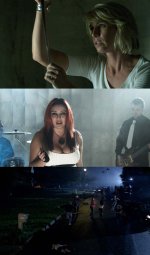
Forgive the jpeg compression, but you get the idea. 1st build 17 500 asa. 2nd build 20 500 asa. 3rd build 17 800asa.
 

Attachments

  • nick_500asa.jpg
    nick_500asa.jpg
    85.9 KB · Views: 0
First and last pic are from a feature that isn't released yet, middle one is from a music video that's still in post, so in short, no ;-) The music video was 500 asa because I had to do speed ramps, and needed the stop at 96 fps.

Nick
 
Thanks for the replies. It is interesting to hear such varied experiences. I'm going to do a simple test.

Light a closeup for RED ONE at 500 ISO on my meter- lighting it with contrast ratios as I would for film, which would look good to eye as well. Specifically, I will probably put caucasian skin tone keyed with a side or 3/4 frontlight reflected at a 2.8 2/3 or 4.0, fill at a 1.0 1/2 and some edge lights measuring with an incident meter at 2.8 or 2.0. I'll set the lens to a 2.8. I'll look at the image at camera ISO 320 and 500 in REC709 on Build 20 and examine the false color and report the results. I'll also post process the image these ways in RedAlert and try to dial in a curve to make the image look good.

If the camera were behaving like a 500 ISO medium one would expect the skin tone to look "normally exposed" or at the very least 40 IRE. If anyone has done anything similar I'd be interested to know your findings. From my previous testing I would think this image would be very underexposed and need to be brought up a lot in post processing, resulting in a lot of noise. But I want to at least give it a shot...
 
Back
Top