Welcome to our community

Be a part of something great, join today!

  • Hey all, just changed over the backend after 15 years I figured time to give it a bit of an update, its probably gonna be a bit weird for most of you and i am sure there is a few bugs to work out but it should kinda work the same as before... hopefully :)

Arri HMI 2.5k Question

Benjamin Johnson

Active member
Joined
May 15, 2009
Messages
27
Reaction score
0
Points
0
Our production company is looking at purchasing an Arri 2.5k HMI very soon here and are wondering if anyone can give some advice on different powering options. I understand that the most common route would be to have a bates end attached and simply rent or purchase a genny in order to power it on site. Are there any other methods of using house power or more portable generators out there that could power this beast? We have the money and are pretty set on purchasing this light but would appreciate any additional advice.
 
Terminate the ballast with a 60a bates so that
it is standard then make gags as you need. In your case a
M 220w twist lock to F bates would let you run the light
on a small Honda geni such as the 6500 or the dryer plug in a house.
 
very helpful Frank. thank you so much for your help and quick reply.
 
Options for Powering Arri HMI 2.5 on wall outlets

Options for Powering Arri HMI 2.5 on wall outlets

Our production company is looking at purchasing an Arri 2.5k HMI very soon here and are wondering if anyone can give some advice on different powering options. I understand that the most common route would be to have a bates end attached and simply rent or purchase a genny in order to power it on site. Are there any other methods of using house power …. out there that could power this beast? .

This is a loaded question because it really depends on whether you get a magnetic or electronic ballast, and whether the electronic ballast has Power Factor Correction (PFC) or not (Arri calls it ALF for Active Line Filter.)

I would recommend you pay the extra money for a multi-volt electronic ballast with Power Factor Correction (PFC) because it will give you the most options. A PFC circuit realigns voltage and current and induces a smoother power waveform at the distribution. As a result, the ballast uses power more efficiently with minimized return current and line noise. 2.5kw electronic ballasts with PFC (like the Power Gems (PG) 425CDP, the Power-to-Light (P2L) 425LVI, and Arri 2.5/4 EB w/ALF) typically have an operating range of 90–125 & 180-250 Volts. At 120V they will draw approximately 23 Amps. At 240V they will draw 11.5 Amps on each leg of a 240V single phase power supply.

These ballasts draw too much at 120V for a 20A wall outlet. But, fortunately there are a number of 240 volt outlets in a typical house, office, or industrial plant in this country that you can also use to power a 2.5 with PFC electronic ballast. The most common are air conditioner outlets, dryer outlets, range outlets, outlets for large copy machines in offices, and the outlets for motorized equipment in industrial plants. Many of these household and industrial 240V receptacles use a three wire system (no neutral) because they are designed to power single phase motors or heating elements that draw a perfectly balanced load and return no current because the single phase service legs are 180 degrees out of phase and cancel each other out. Where a 2.5kw HMI with PFC electronic ballast, operating at 240 Volts draws roughly 11.5 Amps on each leg of a single phase 240V circuit, its’ load is well within the capacity of these circuits. Where 2.5kw ballasts are typically wired with a 120V 60Amp Bates Plug (Stage Pin), you will need a 120V Female Bates to 240V adapter.
I keep an assortment of adapters because all these 240V receptacles use a different pin configuration.

The adapter I use most often, however, is a “Y” adapter of two standard household male Edison plugs to a female bates. When the male Edison plugs of this adapter are plugged into two standard u-ground Edison wall outlets that have been determined to be on separate circuits and opposite service legs (which is easy to do), the adapter feeds the ballast 240 Volts. This adapter is by far the most useful because, where you can't always count on there being a 240 outlet at every location, you can always count on getting 240 Volts out of two standard wall outlets if you know how.

The procedure to determine when two wall receptacles are on opposite service legs of a single phase service is as follows: first, plug two stingers into two separate wall outlets. Then meter between the “hots” (should be the thinner slot on the female receptacle) of the two stinger ends. If your meter reads close to 0 volts the two stingers are plugged into circuits that are on the same service leg. If your meter reads close to 240 (230-250) volts the two stingers are plugged into circuits that are on opposite service legs of a single phase service. If you don't read 240 volts, move one of the stingers from outlet to outlet, until you can find a combination that will read 240 volts. If you can't find a combination that works, and your meter will only read close to 208 volts, your location has a three phase service and you will never find 240 volts at that location. Not to dispair, a PFC electronic ballast will operate from 180-250V and so will operate at 208 volts as well.

Once you have found receptacles that are on opposite service legs of the service in this fashion, you can feed that 208-240 Volts to the ballast with the Y adapter. To make the Y adapter wire the hot (black wire) of one of the male Edison plugs to the hot of the 60A bates connector. Wire the hot of the other male Edison plugs to the nuetral of the 60A bates connector. Twist the two ground wires (green) together and wire it to the ground of the 60A bates connector. Cut the neutral wires (white) back and close off the ends with shrink wrap so that they can not make contact with any other wires in the housing of the 60A bates connector. Check that you have wired your connector correctly, and don’t have leaks between your conductors, using a continuity tester. If you have wired your adapter correctly you should read 240 volts between the hot and the neutral, and 120 volts between either the hot or the neutral and the ground of the 60A bates connector.

I do not recommend that you attempt to power 2.5 ballasts without PFC off of regular wall outlets in this fashion. First, this method does not tell you the ampacity of the two wall circuits you are metering, nor what other loads may be on the circuit already. One could be 20 Amps and the other 15 Amps. Where a 2.5kw on a non-PFC ballast will draw 17.5 Amps on each leg it will blow the 15 Amp circuit. You will however be able to operate a non-PFC electronic ballast off of most 240V receptacles like range plugs and dryer plugs with the appropriate adapter because these circuits are fused at minimally 30 Amps. Where most magnetic 2.5 ballasts only operate at 120V this method is not an option with magnetic ballasts because they will draw 33 Amps. Everything I have said so far holds equally true of operating 4ks.

The only way to power 120V 2.5kw & 4kw HMI magnetic ballasts on wall receptacles (without a tie-in) is from 240V circuits through a 240v-to-120v step down transformer. There is a lighting rental and sales company in Dedham MA by the name of ScreenLight & Grip (SL&G) that manufactures a 60A transformer/distro for the Honda EU6500is generators that they modify. Like it does with the enhanced 240V output of their Honda EU6500is Generator, their 60A transformer/distro will convert the 240 volts supplied by these industrial and household 240V receptacles to 120 volts in a single circuit that is the sum of the two single phase legs of 30/50 amps each. In other words, out of a “30A/240v” or a “50A/240v” circuit their transformer/distro makes a 60A/120v circuit that is capable of powering bigger 120V lights, like 2.5kw & 4kw HMIs with magnetic ballasts (even Quartz 5ks, mini brutes (5850W) or Six Light Mole Par (6000W)).

There are even benefits to be gained by powering 2.5kw & 4kw electronic ballasts (PFC or not) on 240V circuits through a 240v-to-120v step down transformer. For instance, you will be able to run additional large lights (like 1.2kws) on the same circuit if, rather than plugging the 2.5kw electronic ballast directly into the 240 receptacle (operating it at 240V) and monopolizing it, you plug it in through their 60A Full Power Transformer/Distro (operating it at 120 Volts), you will be left with 25 - 37 Amps to power additional lights on the same circuit. That’s a lot of additional power to waste by plugging the 2.5 directly into the 240V receptacle. And, since an electronic ballast “ramps up” gradually during the striking phase, you don’t have to leave head room as you would with a magnetic ballast. By operating the light through the Full Power Transformer/Distro you can more fully utilize the capacity of 240V circuit. For example, since the P2L 4/2.5 LVI ballast at 120V operates a 2.5k HMI luminary at 23 amps, you will still be able to power two additional 1.2kw HMIs (if operated by P2L 575/1200 ballast (11 Amps)), as well as a 800 Joker HMI (if operated by a P2L 800/1200 ballast (8 Amps)), off of the same circuit. That’s a lot of additional light to be gained by not plugging the 2.5 directly into the 240V receptacle. Where SL&G’s 60A Full Power Transformer/Distro enables you to maximize the number of HMI lights you can power from a 240 Volt wall receptacles (eliminating the need to tie-in in many cases), you should definitely consider it as one of the power options for your 2.5.

- Eileen Ryan, Boston Gaffer
 
Options for Powering Arri HMI 2.5 on generators (Part 1: The type of generator))

Options for Powering Arri HMI 2.5 on generators (Part 1: The type of generator))

Our production company is looking at purchasing an Arri 2.5k HMI very soon here and are wondering if anyone can give some advice on different powering options.….. Are there any ….. more portable generators out there that could power this beast? .

Again, this is a loaded question because again it really depends on whether you get a magnetic or electronic ballast, and whether the electronic ballast has Power Factor Correction (PFC) or not. Plus it depends on what type of portable generator you will use the 2.5 on. I'll address the issue of the generator first. Everything I have said above is also true when it comes to powering 2.5kw HMIs off portable generators with one major difference: the harmonic noise that magnetic and non-PFC electronic ballasts kick back into the power stream has an adverse effect on the power waveform of conventional generators where it does not on grid power. Normally, when you plug an HMI light into a wall outlet you need not be concerned about current harmonic distortion producing voltage distortions. The impedance of the electrical path from the power plant is so low, the distortion of the original voltage waveform so small (1-3%), and the plant capacity so large, that inherently noisy loads placed upon it will not affect the voltage at the load bus.

However, it is an all together different situation when plugging HMIs into a conventional portable generator. Given the large sub-transient impedance of conventional portable generators, even a small degree of harmonic noise being fed back into the power stream will result in a large amount of distortion in its’ voltage. Add to that, the likely hood that the percentage of the generator’s capacity taken up by non-linear loads will to be very high given its small size relative to typical lighting loads, and given the increasing prevalence of non-linear light sources in production. Finally, add that the original supply voltage waveform of a conventional generator is appreciably distorted to begin with, and you have a situation where the return of any harmonic currents by an HMI ballast will result in significant waveform distortion of the voltage at the power bus.

For this reason, when your lighting package consists predominantly of non-linear light sources, like HMI and Fluorescent lights, it is important to have power factor correction (PFC) circuitry in the ballasts and operate them on inverter generators. The combination of improved power factor and the nearly pure power waveform of inverter generators makes it possible to reliably operate larger lights like 2.5kw HMIs, or more smaller lights, than has been possible before on a small portable gas generator.

In the past, the primary factors limiting the use of HMIs on portable generators has been their inefficient use of power and the harmonic noise they throw back into the power stream. The power waveform below left is typical of what results from the operation of a 2.5kw non Power Factor Corrected HMI load (electronic ballasts) on a conventional portable generator. The adverse effects of the voltage waveform distortion exhibited here, can take the form of overheating and failing equipment, efficiency losses, circuit breaker trips, excessive current on the neutral return, and instability of the generator’s voltage and frequency. For these reasons it has never been possible to reliably operate more than a couple of 1200W HMIs on a conventional 6500W portable gas generator. Harmonic noise of this magnitude can also damage HD digital cinema production equipment, create ground loops, and possibly create radio frequency (RF) interference. The increasing use of personal computers, hard drives, and microprocessor-controlled recording equipment in production has created an unprecedented demand for clean, reliable power on set.

waveform_AVR-Inv_Pkg.jpg


ScreenLight & Grip (SL&G) has also developed a Gen-set that takes advantage of recent technological advances in HMI ballast design and power generation to create clean stable set power that is capable of operating larger lights (HMIs up to 6kw or Quartz lights up to 6kw), or more smaller lights, off of portable gas generators than has ever been possible before. For example, the power waveform above on the right, is the same 2500W load but with power factor correction operating on SL&G’s modified Honda EU6500is Inverter Generator. As you can see, the difference between the resulting waveforms is startling. Even though the load is the same, the fact that it is power factor corrected and the power is being generated by an inverter generator, results in virtually no power waveform distortion. For this reason, sensitive electronic production equipment will operate reliably and without damage. And, the generator is capable of operating larger, or more smaller, lights than has been possible before on a portable gas generator.

Where before you could not operate more than a couple 1200W HMIs with non-PFC ballasts on a conventional generator because of the consequent voltage waveform distortion, now you can load an inverter generator to capacity. And if the generator is one of ScreenLight & Grip’s modified Honda EU6500is inverter generators, you will be able to run a continuous load of up to 7500W as long as your HMI and Kino ballasts are Power Factor Corrected. For more details on how this is accomplished I suggest you read their very informative newsletter article on the use of portable generators in motion picture production which where I got these oscilloscope shots. Where the power issues discussed in the article have been vexing set electricians for years, I highly recommend that anyone responsible for generating power on a set, whether large or small, read this article. The article is available at
http://www.screenlightandgrip.com/html/emailnewsletter_generators.html

- Eileen Ryan, Boston Gaffer
 
Options for Powering Arri HMI 2.5 on generators (Part 2: The type of ballast))

Options for Powering Arri HMI 2.5 on generators (Part 2: The type of ballast))

Our production company is looking at purchasing an Arri 2.5k HMI very soon here and are wondering if anyone can give some advice on different powering options.….. Are there any ….. more portable generators out there that could power this beast?

As was the case with 240V wall receptacles, you have several options when it comes to operating your 2.5kw HMI off of a 6500W generator depending on the type of ballast and generator you use. Where electronic HMI ballasts are typically auto-sensing multi-volt electronic ballasts (with an operating range of 90–125 & 180-250 Volts), you can plug it directly into the 240V 4 pin twist-lock receptacle on the generator and it will operate at 240 Volts (where 2.5 kw ballasts are typically wired with a 120V 60Amp Bates Plug (Stage Pin) you will need a 120V 60A Female Bates to 240V 4pin twist-lock adapter to plug a 4kw ballast directly into the generator. ) Or, if the electronic ballast is power factor corrected (draws 23 Amps) you can plug it into the 30A/120V twist-lock receptacle on the generator’s power panel. If the electronic ballast is not power factor corrected (draws 35 Amps) you will not be able to run it off of the 30A/120V twist-lock receptacle without tripping it’s fuse.

Even though a 2.5 magnetic ballast draws approximately 26 amps you will not be able to run it reliably on the 30A/120V twist-lock receptacle on the generator’s power panel. That is because even though the twist-lock receptacle is rated for 30 Amps conventional 6500W generators are only capable of sustaining a peak load of 27.5 Amps per leg for a short period of time. Their continuous load capacity (more than 30 minutes) is 23 Amps per leg. And if there is any line loss from a long cable run the draw of a 2.5 magnetic ballast will climb to upward of 30 Amps. To make matters worse magnetic ballasts have a high front end striking load. That is, a magnetic ballast draws more current during the striking phase and then they “settle down” and require less power to maintain the HMI Arc. By contrast, an electronic ballast “ramps up”. That is, its’ current draw gradually builds until it “tops off.” For this reason, you must always leave “head room” on the generator for the high front end striking load of magnetic ballasts. And to complicate matters even more, the lagging power factor caused by the inductive reactance of the magnetic ballast kicking harmonic currents back into the power stream causes spikes in the supply voltage that can cause erratic tripping of the breakers on the generator or ballast. (for a more detailed explaination of why that is I, again, suggest you read SL&G’s newsletter article.) In my experience the load of a 2.5kw magnetic ballast is too near the operating threshold of a 6500W generator for it to operate reliably.

The only sure way to power a 120V 2.5kw (or even a 4kw) HMI magnetic ballast on a portable gas generator is from its 240V circuit through a 240v-to-120v step down transformer like the one SL&G manufactures for their modified Honda EU6500is. SL&G’s 60A Full Power Transformer/Distro will step down the 240V output of the generator to a single 60A 120V circuit that is capable of accommodating the high front end striking load, and even the voltage spikes, of either a 2.5kw or 4kw magnetic ballast at 120V. As was true of 240V wall receptacles, there are benefits to be gained by powering electronic ballasts through their 60A Full Power Transformer/Distro as well.

As was the case with 240V wall receptacles, you can maximize the power you can pull from a generator if, rather then plugging the 2.5kw electronic ballast directly into the 240 receptacle and operate it at 240V, you plug it in through SL&G’s 60A Full Power Transformer/Distro and operate it at 120 Volts. This way the one light does not monopolize the whole circuit. In the case of SL&G’s modified EU6500is you would still have 37 Amps left over to power additional lights through the transformer as well if your 2.5kw ballast has Power Factor Correction. And, as I mentioned previously, if you use only HMI and Kino Flo ballasts with Power Factor Correction you can load the generator more fully.

In the past we had to de-rate portable gas generators because of the inherent short comings of conventional generators with AVR and Frequency governing systems – especially when dealing with non-linear loads. The harmonic distortion created by non-PFC ballasts reacted poorly with the distorted power waveform of conventional AVR generators, and limited the number of HMIs you could reliably power on a portable generator to 75% of their rated continuous load capacity (65% of their peak capacity.) But now, that the power of inverter generators has virtually no inherent harmonic distortion (less than 2.5%), and power factor correction (PFC) is available in small HMI ballasts, this conventional wisdom regarding portable gas generators no longer holds true. An inverter generator can be loaded to capacity with PFC HMI and Kino Flo ballasts (which in the case of SL&G’s modified Honda EU6500is is 7500 Watts) and safely power sophisticated electronic equipment on the same supply.

The enhanced capacity of their modified Honda EU6500is inverter generator would be wasted if not for their 60A transformer/distro. Without the transformer/distro you could never fully utilize the full power of the generator because the load of a light would have to go on one circuit/leg of the generator or the other. For example, when plugging lights into the factory installed power outlet panel of a Honda EU6500is, you reach a point where you can't power an additional 800W Joker because there is not 8 amps (w/ a P2L PFC ballast) available on either one of the factory installed 20A outlets/leg of the generator. With their Full Power Transformer/Distro you can still add that 800 Joker because the Transformer/Distro not only accesses more power (7500 Watts) through a higher rated circuit (60 Amps), but it also splits the load evenly over the two legs (4A/leg) of the generator on that circuit. The end result is that the generator is capable of handling a larger load more easily because it is a perfectly balanced load.

Another benefit to using their Transformer/Distro is that it splits the load of what ever you plug into it automatically. Which means you no longer have to carefully balance the load over the generator's two 20A/120 circuits/legs as you plug in lights because the Transfomer/Distro does it for you. With their modified Honda EU6500is you simply plug in lights until the load wattage displayed on the generator’s iMonitor reaches 7500 Watts. An overload alarm on the iMonitor display will tell you if you inadvertently overload the Transformer/Distro. Now that you are able to fully utilize the generator's available power, you are able to power larger lights, or more smaller lights, than you could without their transformer/distro.

Finally, I would recommend that you purchase one of the dual wattage (2.5/4kw) 2.5Kw HMI Pars. Not only will the Par configuration give you more output but it will also be more versatile. When you need a lot of light for fill on day exteriors you can lamp it with a 4k globe and run it along with a 1.2kw Par on SL&G’s Gen Set. When you don’t need the punch of a 4k Par, like on a night exterior, you can swap the 4kw globe for a 2.5kw globe giving you more power to run additional lights on the generator. The 15 Amps you save by burning the smaller 2500W globe will power quite a few more lights. For example, as I mentioned in a previous post, I used one of SL&G’s modified Honda EU6500is Generators on a Red shoot to power a lighting package that consisted of PFC 1200, & 800 HMI Pars, a couple of Kino Flo ParaBeam 400s, a couple of ParaBeam 200s, and a Flat Head 80, in addition to a PFC 2.5kw HMI Par. Given the light sensitivity of the Red Camera, this was all the light we needed to light a large night exterior.

- Eileen Ryan, Boston Gaffer
 
…. can strong HMIs (like 2.5k, 4k,...) be powered off of a regular wall outlets in a typical house/building?

The answer to this question was already provided by Eileen Ryan in this thread:

fortunately there are a number of 240 volt outlets in a typical house, office, or industrial plant in this country that you can also use to power a 2.5 with PFC electronic ballast. The most common are air conditioner outlets, dryer outlets, range outlets, outlets for large copy machines in offices, and the outlets for motorized equipment in industrial plants. Many of these household and industrial 240V receptacles use a three wire system (no neutral) because they are designed to power single phase motors or heating elements that draw a perfectly balanced load and return no current because the single phase service legs are 180 degrees out of phase and cancel each other out. Where a 2.5kw HMI with PFC electronic ballast, operating at 240 Volts draws roughly 11.5 Amps on each leg of a single phase 240V circuit, its’ load is well within the capacity of these circuits. Where 2.5kw ballasts are typically wired with a 120V 60Amp Bates Plug (Stage Pin), you will need a 120V Female Bates to 240V adapter. I keep an assortment of adapters because all these 240V receptacles use a different pin configuration.

- Eileen Ryan, Boston Gaffer


- Guy Holt, Gaffer, ScreenLight & Grip, www.screenlightandgrip.com
 
i have a novice question:

can strong HMIs (like 2.5k, 4k,...) be powered off of a regular wall outlets in a typical house/building?

thank u

no question is a Bad one...Arri just put out NEW 1800 par and 1800 max
that are 70% more poop than their 1200's and will power off house 19.5 amps
good looking out ARRI

good luck
 
HMI Light?

HMI Light?


You have to be really careful when splitting 240 volt circuits with a “dryer drop” to power large 120V HMI ballasts as discussed in that thread. If the 240 volt circuit is a four wire system (the receptacle has four slots: one for ground, one for neutral, and two for hot), one can use a distro box that splits the two hot circuits as long as it is wired so that each circuit has a ground and neutral.

Where you run into trouble is when the 240V circuit uses a three wire system (the receptacle has three slots: one for ground, and two for hot, and no neutral.) Many older household and industrial 240V receptacles use a three wire system (no neutral) because they were wired for the sole purpose of powering single phase motors or heating elements that draw a perfectly balanced load and return no current. A perfectly balanced load doesn’t require a neutral because the single phase service legs are 180 degrees out of phase and cancel each other out – hence there is no return that would require a separate neutral (a later revision to the NEC required all 240V circuits to include a neutral.)

You run into trouble with this kind of circuit because your 120V HMI ballast will invariably pull an unbalanced load on your distro. That’s because under most production situations you can never perfectly balance your lighting load, especially when it in consists partly of a large HMI. If your load is not perfectly balanced the two 120V circuits that make up this 240V circuit will not have 100% phase cancellation and the extra current of the high leg will not have a safe return path because by necessity with a three wire system you have had to bond the ground and the neutral in the splitter box (after all what else can you do with the ground and neutral of your splitter box but to bond them when plugging into a three wire 240V circuit.) Not only is it unsafe, but bonding ground and neutral after the service side of a main service head is a violation of the National Electrical Code (NEC.) To quote Mike Holt, of Mike Holt Enterprises, Inc. (A Leading Electrician Training Program in FL): “The National Electrical Code requires a neutral-to-ground connection to be made at service equipment only and there shall not be any neutral-to-ground connection on the load side of service equipment [250-23(a), 250-24(a)(5)]” (full excerpt is available online)

The only safe way to pull power from three wire 240V circuits is to run your lighting load through a 240v-to-120v step down transformer. A transformer converts the 240 volts supplied by these industrial and household 240V receptacles back to 120 volts in a single circuit that is the sum of the two legs of the circuit. For instance, a transformer can make a 60A/120v circuit out of a 30A/240v dryer circuit that is capable of powering bigger lights, like a 5k. What makes it safe to use a step town transformer with three wire 240V dryer/range/motor circuits is that the transformer automatically splits the load of whatever you plug into it evenly over the two legs of the 240V circuit. Where there is no high leg, the loads on each leg of the 240V circuit cancel out and there is no return that would require a separate neutral.

And unlike 240V splitter distro boxes where you have to meticulously balance your load, a transformer greatly simplifies your set electrics by automatically splitting the load. As long as you plug lights in through the transformer, you no longer have to carefully balance the load over the two 120V circuit/legs because the transformer does it for you automatically. If you outfit the transformer with a 60 Bates receptacle, you can use 60A GPC extension cables, 60-to-60 Splitters, and fused 60A GPC-to-Edison Breakouts (snack boxes) to run power around set - breaking out to 20A Edison outlets at convenient points (rather than one central point.) The best part about using a transformer with a 240V receptacle in this fashion is that no matter where in the distribution system you plug in, the transformer automatically balances the additional load, so that you don't have to.

I use transformers to power bigger HMIs (2.5-4Kw) in situations where a tie-in is not an option and the budget doesn’t permit for a tow generator. Where the production budget is particularly tight, I use a package consisting of two transformers and a portable generator. I use one transformer to access more power through a 240V circuit on location to run lights inside; while the other I use to bring larger HMIs in the windows from outside. This approach eliminates the need for a dangerous tie-in or expensive tow generators, it also greatly reduces the amount of cable that has to be run.

For those who would like to see samples of what can be accomplished with this basic package, I have attached these links to production stills of the PBS and History Channel historical documentaries shot entirely, or in part, with just a couple of transformers and a Honda generator.

The History Channel’s “Unsolved History” episode “Presidential Assassins” : www.screenlightandgrip.com/html/unhisintro.html

American Experienes Typhoid Mary Biography "The Most Dangerous Women in America": www.screenlightandgrip.com/html/tmintro.html

WGBH’s Ben Franklin Biography “Franklin”:
www.screenlightandgrip.com/html/franklinintro.html

Or, use this link for more details about using step-down transformers on set: www.screenlightandgrip.com/html/hd_plug-n-play_pkg.html
By giving you access to more house power through common 240V house outlets, a transformer can quite often eliminate the need for tie-ins or generators.

- Guy Holt, Gaffer, ScreenLight & Grip, www.screenlightandgrip.com
 
Nice post...Thank you very much!!......
smileyhappy.ico

Thanks for your kind words. These power distribution issues have been vexing set electricians for years. If you haven’t already, you might want to read an article I wrote for our company newsletter that explains the electrical engineering principles behind these issues and how to resolve them.

BoxBook.jpg

This article is cited in the just released 4th Edition of Harry Box's "Set Lighting Technician's Handbook" and featured on the companion website
"Box Book Extras." Of the article Harry Box exclaims:

"Great work!... this is the kind of thing I think very few technician's ever get to see, and as a result many people have absolutely no idea why things stop working."

"Following the prescriptions contained in this article enables the operation of bigger lights, or more smaller lights, on portable generators than has ever been possible before."

The article is available online at http://www.screenlightandgrip.com/html/emailnewsletter_generators.html.

Guy Holt, Gaffer, ScreenLight & Grip, Lightng & Grip Rental in Boston
 
no question is a Bad one...Arri just put out NEW 1800 par and 1800 max that are 70% more poop than their 1200's and will power off house 19.5 amps good looking out ARRI good luck

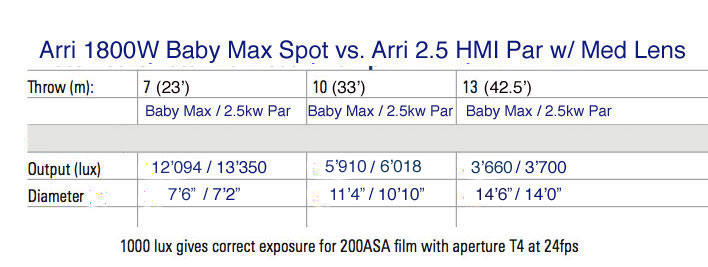
There is a lot of hyperbole like this flying around regarding the output of the new Arri M18 "Baby Max." Some people even claim it has the output of a 4k Par. As a Gaffer, Rental House Owner/Operator, and Arri dealer I have had the opportunity to work extensively with these heads. While it is difficult to compare a Par, Fresnel, and a Baby Max because they are such different lights, to shed some light on this debate I undertook tests using a common denominator and here is what I found.

Arri1800_2.5ParComp.jpg

Comparison between 2.5 Par w/ 20 deg. Med Lens (left), 1800 Baby Max in 20 deg. Spot (Center), and 1800W Par w/ 20 deg. Med Lens (Rght)


A med lens in a 2.5 Par is about equivalent to the wide angle of the Baby Max - 20 degrees. So I took photometric measurements of those two (see fist table below.) Where there is no easy way to find the 20 degree point on the spot/flood of a 4k Fresnel, what I did is find the point on the 4k Fresnel spot/flood where the beam diameter to 50 percent drop off was the same as on the Baby Max and took measurements there (see 2nd table below.)

ArriBabyMax_2.5_Comp.jpg

What I found was that 1800W Baby Max has a comparable output to a 2.5kw Par and 4k Fresnel, but with a light distribution and quality closer to a Fresnel than a Par. For instance, if you were to spot down the Arri 1800W Baby-Max to the same beam diameter as the 2.5kw Par with Medium Lens in the photometric table above, it would achieve an output comparable to that of the 2.5k Par. But, as is evident in the picture above and the photometric table below, the light distribution is more similar to that of a 4k Fresnel.

ArriBabyMax_4k_Comp.jpg

What accounts for the even light distribution is the Baby Max’s unique reflector which creates diverging rays to produce a crisp shadow from an open face fixture. And, since there is no light lost to a lens, the Baby Max has considerably more output than that of a par – but not nearly the output of a 4k Par.

ArriBabyMax_4kPar_Comp.jpg

Still, to have the output of a 2.5kw Par with the light quality of a Fresnel from an instrument that you can operate on a 20A circuit* is impressive. With a beam angle of 20 to 60 degrees, the Baby Max doesn’t have the long throw of a par with narrow lens, but then how often do you use a narrow lens. Most of the time I find I am using the wide or super wide lens and in that regard the wide of the Baby Max is considerably wider a field angle than the widest par lens (60 degrees vs. 40 degrees.)

While definitely not a substitute for a 4k par, the Baby Max’s unique reflector design enables it to achieve an output comparable to that of a 2.5kw Par, but with a light quality and spread comparable to a 4k Fresnel. While it is probably too late for Benjamin Johnson, anyone else looking to buy a 2.5 Par would be better served by the Arrimax 1800.

Guy Holt, Gaffer, ScreenLight & Grip, Lightng & Grip Rental in Boston

* There is also a lot of hyperbole flying around regarding plugging 1800w Baby Maxs into wall outlets. But, I will have to address that issue in a later post.
 
...Arri just put out NEW 1800 par and 1800 max that ... will power off house 19.5 amps....

I am afraid that Arri is guilty of a bit of hyperbole when they claim the Baby Max is “the brightest light that you can plug into the wall.” Lately, they have been footnoting that claim as follows: ““Into the wall” denotes a single, 20A 120VAC electrical outlet on a single circuit.” The reason for the footnote is that many wall outlets are on 15 Amp circuits, and those that are on 20 Amp circuits probably use receptacles only rated for 15 Amps. This is a problem because the Arri 1800W ballast has an Apparent Power of 2250VA which, has Sergio points out, means it will draw 19.5 amps at 115V. So, it will always trip the common 15amp house circuit and will trip a 20 Amp circuit if there is something else, like a computer or light, on the same circuit. Where you can't always know what else is on the same circuit, or even if it is a 20 or 15 Amp circuit, it is risky to plug the Baby Max into the wall.

The problem is that the draw of the 1800W Baby Max is just too close to the threshold to operate reliably. If there is any line loss from a long cable run, or increased resistance from an overheated plug end, the draw of the ballast climbs over 20 Amps and trips the breaker. It has been my experience that the stinger plug-ends overheat because most are only rated for 15 Amps. The increased resistance that results from the heat causes the voltage to the ballast to drop and so it has to draw more power to maintain the 1800W load. At 110V it will draw 20.5 Amps. The power drawn by the 1800W Baby Max is just too near the operating threshold of a 20A circuit for it to operate reliably plugged into a U-Ground Edison Outlet.

The same is true of operating them on the 20A circuits of portable generators. To the problem of line loss and overheating plug ends, you have the added problem that as you add load on portable generators their voltage output drops. It is not uncommon for a generator to drop 10-15 volts under full load. The 1800W ballast that drew 19.5 Amps at 115 Volts will draw 21.4 Amps at 105 Volts.

The Arri 1800W Baby Max works best on a real film distribution system (see http://www.cinematography.com/index.php?showtopic=47803&st=0&gopid=337322&#entry337322) where every circuit is 20 Amps, you know what is on the circuit because you are loading it yourself, and you are bringing the receptacle to the light because you are distributing the power yourself from a tie in or generator. When you can run a 100A whip and drop a Lunch Box next to the ballast you won’t have a problem. But, if your style of shooting requires that you run multiple stingers to plug into a wall or generator outlet, you will likely have problems with the plug ends or receptacle overheating.

I have found that the only reliable way to power a 1800W Baby Max on wall out-lets or on portable gas generators is from a 240V circuit through a 240v-to-120v step down transformer. A transformer will convert the 240V output into a single large 120V circuit that is more than capable of powering the 19.5A load of a 1800W Baby Max. And, if the transformer is outfitted with a 60A Bates receptacle, it will enable you to use a distro system that will allow you to move the generator off set (where it won’t be heard), minimize line loss over a long cable run, and provide plug-in pockets conveniently close to the ballasts.

HD_PP_Demo_Transformer-Distro.jpg

A Distro System consisting of a 60A Full Power Transformer/Distro, 2-60A GPC (Bates) Splitters, 2-60A Woodhead Box distributes power from a modified Honda EU6500is. Even though the generator is 100' away to reduce noise, plug-in points remain conveniently close to set.

To record sync sound without picking up any generator noise, all you need to do is add 200' of heavy gauge 250V twist-lock extension cable between the generator and the transformer. This is usually enough cable to place the generator around the corner of a building, or to run it out of a van or truck - which is usually all the additional blimping you need with the Honda EU generators. By using a single heavy-gauge feeder cable, you eliminate multiple long cable runs to the generator and the appreciable voltage drop you would have using standard electrical cords. Unlike 15 Amp U-Ground Edison plugs, the 30A/250V twist-lock plug ends won’t overheat and so won’t add resistance and won’t cause additional voltage drop that will cause the ballast to draw more power and trip the breaker.


HD_PP_Demo_Distro.jpg

60A GPC (Bates) Splitters and Woodhead Box.

To assure full line level (120V) on set, use a "boost transformer" like ours that is designed to compensate for the slight line loss you will inevitably have over an extended cable run. If you were plug it directly into the generator and feed the supply side (primary) of the transformer 240 volts, a "boost transformer" will give you 127 volts on the secondary side where you plug in your lights. This slight boost enables you to run 200’ or more of cable to get the generator further from set where you won't hear it, yet assure that the supply voltage on set does not drop below 120V and cause the 1800W ballast to draw more power and trip its’ 20A breaker. If the transformer is like ours and equipped with a 60A Bates you can use standard film distribution equipment like 60A Siameses, 60A Whips, and 60A Snack Boxes to run power to the light (breaking out to 20A Edison pockets next to the ballast), rather than having to run multiple stingers from the ballast back to the generator.

HD_PP_Demo_P2L.jpg

60A Woodhead Box running Power-to-Light PFC 800W ballast (left) and PFC 1200W ballast (right.)

If you want to be extra cautious, you can swap the Edison plug end on the ballast for a 60A Bates that won’t overheat under any circumstances. In our shop, when we lamp the M18 Baby Max head with the 1800W globe for a student production, we use a 60A Bates plug on the ballast. We do this in order to eliminate the possibility that an inexperienced student “electrician” will run multiple stingers to the ballast which is a recipe for disaster. Since we started doing this the number of late night emergency calls has dropped to zero. We use the 60A Bates simply because it is the next size up connector that is standard in distro systems. You could use a 30A/120V twist-lock connector when operating them on a generator, but 30A Twist isn’t very common in film distros, so you will have to run multiple ones all the way back to the genny, and where there is only one 30A receptacle on most portable genertors, you are limited to powering only one 1800W Baby Max. By contrast, if the generator is one of our modified Honda EU6500is generators, a transformer will convert the enhanced 7500W output of the generator into a single 60A/120V circuit that is capable of powering up to three 1800W Baby Maxs. And where the 1800W Baby Max has an output comparable to a 4k that is a lot of fire power on a portable generator.

A transformer will also enable you to run 1800W Arri Baby Maxs on “house power” from common 240v household outlets as well. Just like it does with a generator, a transformer will step down the 240V power of common high voltage household outlets to a single 120V circuit capable of powering multiple 1800W Baby Maxs. Common 240V sources found on interior locations include Range Plugs, Dryer Plugs, and special receptacles installed for Window Air Conditioners. By giving you access to more “house power” through common 240V household outlets, a transformer also enables you to run a real distro system without the need for a dangerous tie-in or expensive tow generator. The ability to run multiple 1800W Baby Maxs off of common 240V house receptacles, or the 240V receptacle of portable generators, is one of the best reasons that I can think of to use transformers on set.

For more detailed information on using transformers on set, I would suggest you read an article I wrote on the use of portable generators in motion picture production. Harry Box, author of “The Set Lighting Technician’s Handbook” has cited my article in the just released Fourth Edition of the handbook. In addition, he has established a link to it from the companion website for the Fourth Edition of the Handbook, called “Box Book Extras.”

BoxBookForumLinkGenSetMed.jpg

If you haven't yet read the article, or looked at it in a while, it is worth reading. I have greatly expanded it to be the definitive resource on portable power generation for motion picture production. Of the article Harry Box states:

"Great work!... this is the kind of thing I think very few technician's ever get to see, and as a result many people have absolutely no idea why things stop working."

"Following the prescriptions contained in this article enables the operation of bigger lights, or more smaller lights, on portable generators than has ever been possible before."​

You can log onto the Box Book Extras site at http://booksite.focalpress.com/box/setlighting/ with our pass-code "setlighting." Use this link for my news letter article on the use of portable gas generators in motion picture production.

Guy Holt, Gaffer, SceenLight & Grip, Lighting and Grip Rental in Boston.
 
Back
Top