Welcome to our community

Be a part of something great, join today!

  • Hey all, just changed over the backend after 15 years I figured time to give it a bit of an update, its probably gonna be a bit weird for most of you and i am sure there is a few bugs to work out but it should kinda work the same as before... hopefully :)

Shot 3-D with Beamsplitter

Joined
Aug 4, 2009
Messages
8
Reaction score
0
Points
0
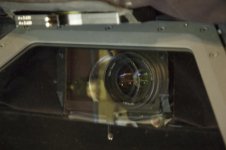
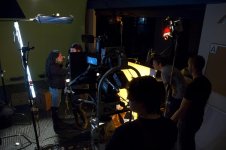
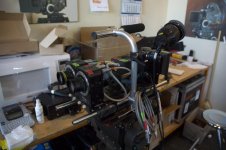
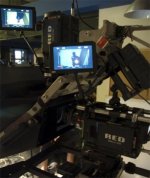
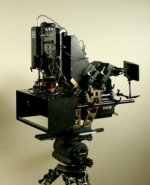
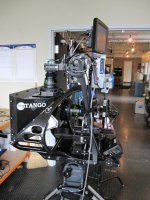
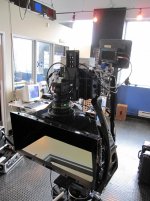
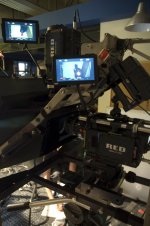
Here are some stills of a 3D beamsplitter rig we set up in Toronto to shoot some tests. We borrowed Bill White's rig and mounted reds on it. The last pic is of his SI rig which is used for handheld.

We tested the beamsplitters ability to set the interocular distance. We discovered that you really only need to use small distances like 2 and 3 cm if you are shooting macro. All the closeup shots on the actress looked best with a distance of 4.5 cm.
 

Attachments

  • RedBeamsplitter2.jpg
    RedBeamsplitter2.jpg
    85.3 KB · Views: 1
  • RedBeamsplitter3.jpg
    RedBeamsplitter3.jpg
    51.6 KB · Views: 1
  • RedBeamsplitter4.jpg
    RedBeamsplitter4.jpg
    89.3 KB · Views: 1
  • Dual-SI.jpg
    Dual-SI.jpg
    88 KB · Views: 1
This raises a question for me, I know I read somewhere (maybe CML-3D?) about the orientation of the cameras, and of the capture or write-off direction of the data from the sensor not being matched closely enough, and potentially creating problems, if the sensors (cameras) weren't oriented correctly...
so here we have 2 x different orientations (for the top camera).... which would be preferred?
 

Attachments

  • RedRig2.jpg
    RedRig2.jpg
    25.6 KB · Views: 0
  • Technica_3D_REDrig.jpg
    Technica_3D_REDrig.jpg
    20.4 KB · Views: 0
Hi there Chris,

With digital cameras like RED and SI-2K they have rolling shutters that move from top to bottom in a vertical wipe.

You included two photos; White’s rig on the left and ours (Technica 3D) on the right.

White's rig has the thru camera (bottom) in the normal orientation but the reflected rig (top) is basically upside down. To process the two images for a 3D pair the reflected image must be horizontally flopped and vertically flipped. It is an upside down mirror image. The reflected camera uses the bottom of the beamsplitter for it’s top of frame and the thru camera uses the top of the beamsplitter for it’s top of frame. The result is the thru camera has the shutter beginning at the top and wiping down. The reflected camera has the shutter starting at the bottom and wiping up (once the image is vertically flipped).

Our rig similarly has the thru camera in the normal orientation however the reflected camera is also oriented normally. The reflected image only needs a horizontal flop to correct it being a mirror image but is already correct vertically. The thru and reflected cameras both use the top of the beamsplitter for their tops of frame. Hence they both have a rolling shutter that begins at the top and wipes down toward the bottom.

Why is this a big deal? In a static scene it isn’t but when there is motion weird things begin to happen.

Imagine the helicopter below was captured in stereo with the White rig. One eye would look like this while the other would be distorted in the opposite direction. Not pretty and most likely painful. Technica 3D rigs are all constructed with this in mind.

helicopter.png


Joey
Technica3D.com
ElementTechnica.com
 
The Image splitter configuration is best suited, to my experience and preference, for close ups and taking those shot impossible to achieve with a parallel rig, allowing for the Interocular distance to be that of 64mm (2.5") or less, also used to make images appear much bigger then they really are.

The opposite is achieved with Stereoscopic rigs which use a parallel rig when the lenses are far apart form each other creating a Interocular distance far greater then that of 2.5" 4.5", the greater the Interocular distance the more the images will appear as if miniaturized, known as Dwarfism, technically tghe word is "hyperstereography" which is definitely great for artistically desired effects.

ciao
 
This raises a question for me, I know I read somewhere (maybe CML-3D?) about the orientation of the cameras, and of the capture or write-off direction of the data from the sensor not being matched closely enough, and potentially creating problems, if the sensors (cameras) weren't oriented correctly...
so here we have 2 x different orientations (for the top camera).... which would be preferred?

The second. The problem with the first is that the image in the vertically mounted camera is going to be flipped by the mirror. That means that the read direction of the properly oriented image (i.e., the "flipped flipped" image in post) is going to be opposite the direct taking camera. In other words, if you consider that the direct camera is reading from top to bottom, the vertical camera would, in effect, be reading bottom to top. Opposite skew will also present a problem for stereoscopy.
 
Thanks Mike, I had a similar private confirmation that the 2nd camera setup is less prone to cause stereo problems.
There's a couple of stereo films happening down-under so its good to keep an eye on it all..

Ketch... thanks for the answer... just missed the point of the question by a tiny bit... but all good though :001_smile:
 
The second. The problem with the first is that the image in the vertically mounted camera is going to be flipped by the mirror. That means that the read direction of the properly oriented image (i.e., the "flipped flipped" image in post) is going to be opposite the direct taking camera. In other words, if you consider that the direct camera is reading from top to bottom, the vertical camera would, in effect, be reading bottom to top. Opposite skew will also present a problem for stereoscopy.

Agreed,

Element technica, 21st century BX-2 and a few other beam splitters all oriented the top camera correctly, but many other brands still making this mistake. This is only an issue on cameras with a rolling shutter (RED, sony EX3, SI-2k and many more) This places each camera scanning on the same line as opposed to opposite ends of the frame. Drastically reduces the temporal disparity/distortion.

It is the proper way to orient a rolling shutter camera for 3D use on a beam splitter.

For our on set monitoring we use Specsoft's "3D Live". The "3dlive" has a flip function for this exact purpose. This way we can monitor in 3D on our DLP TV in the video village as we are shooting even when we use beamsplitters with the top camera mounted reversed.

Later in post you simply apply a flip to the left eye.....
 
Element technica, 21st century BX-2 and a few other beam splitters all oriented the top camera correctly, but many other brands still making this mistake. This is only an issue on cameras with a rolling shutter (RED, sony EX3, SI-2k and many more) This places each camera scanning on the same line as opposed to opposite ends of the frame. Drastically reduces the temporal disparity/distortion.

Swissrig? Is not or am I wrong?
swissrig_cam.jpg
 
Yes that is the swiss rig....same version I just finished shooting a project with....they have they wrong camera orientation. Along with many other issues/deficiencies. I don't feel comfortable listing the issues on a public forum. Especially since they have already announced their new version should address most of my problems with it.

Until the new version is available it is clearly inferior to many of the other rigs currently available. If I can shoot on something else I will.

swiss rig we used.....

DSC_6213.jpg
 
Thanks Pedro. I'll wait to see their new one and others rigs @ IBC.
Any suggestion?
 
I've tested extensively the new version of the rig (I suppose) because we don't encounter big problems caused by The rig itself.

The Image flip was correct (top of the frame consistent, just horizontal flip).

The Rig was solid, precise, tough.

The mirror was almost perfect, just slightly polarized, but I think that this is a problem that they are working out.

In just one shot, under direct sunlight, I've noticed a "moirè" pattern, probably caused by the Carbonium pattern inside the rig. With a simple french flag you can control the amount of light that hit directly inside the box, so you can solve the problem...

This is my experience, curious about yours...
 
Sort of on topic - Why not do exactly the same thing with the monitors? Take both RED LCDs, set up them up with a small beam splitter, and flip the monitor on the top so it reorients when you are viewing = 3D on-camera monitoring. Of course you can do this with smaller flat screen tvs for video village but it could become cumbersome, especially adding twice the cabling. Although, at least you are not having to run it through a program just to see if it works.
 
wait you can flip the image on a red LCD?? really ?

how? please educate me. If it is possible I'd love to know how.

-----

I saw the picture you posted in the other post of the new "carbon version" of the swiss rig. I talked to the rep today and he said they will have them here in LA within a few weeks. From the picture it still looks like they have the camera mounted in the incorrect position.....it looks alot like the old model....

As soon as I get one here and test it, I will post my review...
 
Interesting Pedro, however I have one question, seeing two rigs side by side at the IBC, one with the correct top-upside down top camera ,and one with the new smaller PS rig with the EX3's attached reverse like the swiss rig, at first I thought this was the wrong way, but then looking at the direction of the camera's; in the ET rig, the underside of the camera's are directed towards each other (90 degrees difference ofcourse) which is the right way. If you build an underslung rig like the swiss rig and LW PS rig the undersides are also directed towards each other, so my thought is that with an underslung rig that IS the right direction......
Makes sense ?
 
Red monitors do not flip.....I wish they did. Would make my job much easier. (we could crossview 2 monitors)

EX3 monitors have a button in the back of the viewfinder that flips the image. I know because I shoot the ex3 on a beamsplitter alot.
 
We are using the Transvideo 3D-view monitor for calibration, it does a very good job. Highly recommended.

Christer Engstroem
http://www.rezq.se

Red monitors do not flip.....I wish they did. Would make my job much easier. (we could crossview 2 monitors)

EX3 monitors have a button in the back of the viewfinder that flips the image. I know because I shoot the ex3 on a beamsplitter alot.
 
Yes that is the swiss rig....same version I just finished shooting a project with....they have they wrong camera orientation.


For the record, the rig you showed does not have the wrong camera orientation as far as the rolling shutter issue is concerned. The top of the frame is at the top of the mirror for both cameras... this is correct.

-Eric
 
New 3D Cameras at 3D camera company.

New 3D Cameras at 3D camera company.

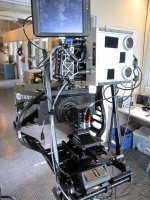
Paid a visit to Bill White at the 3D camera company. He has built some really nice rigs, and this is just one. I was really impressed with the fabrication quality with this mirror rig.

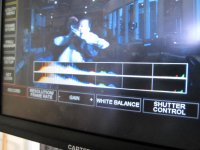
You can see in the close-up shot that the two cameras histograms are displayed so that one can match exposure on the 2 cameras. It's a 2/3 stop difference.

The white box is a windows machine which is powered by a block batt and controls the two SDI disks which capture the streaming data from the SI's. It feeds the touchscreen monitor camera feeds and data. The SI's are kept in sync via cable.

www.3dcameracompany.com
 

Attachments

  • IMG_3358.jpg
    IMG_3358.jpg
    93 KB · Views: 0
  • IMG_3366.jpg
    IMG_3366.jpg
    89.1 KB · Views: 0
  • IMG_3371.jpg
    IMG_3371.jpg
    98 KB · Views: 0
  • IMG_3380.jpg
    IMG_3380.jpg
    94 KB · Views: 0
Back
Top