Welcome to our community

Be a part of something great, join today!

  • Hey all, just changed over the backend after 15 years I figured time to give it a bit of an update, its probably gonna be a bit weird for most of you and i am sure there is a few bugs to work out but it should kinda work the same as before... hopefully :)

The image negative areas on Epic 645 and 617

Joined
Apr 21, 2009
Messages
20
Reaction score
0
Points
0
What are the image negative sizes on Epic 645 and 617 compared to 35 and 65mm film? With 35mm, I mean the full negative aperture.
Thanks
 
From the still photography world:

645 = 6x4.5 cm
617 = 6x17cm

The actual film area is a bit smaller depending on the specific camera. They used 120 size roll film which if I remember correctly, was a bit larger than 70mm.

There were many formats that used the same roll film, 6x4.5, 6x6, 6x7, 6x8, 6x9, 6x12, and 6x17
 
4-perf 35mm Full Aperture (Super-35): 24.84mm x 18.67mm

8-perf 35mm Full Aperture (VistaVision): 37.72mm x 24.92mm (still photography dimensions are 36mm x 24mm, called Full-Frame 35mm now)

5-perf 65mm (Super Panavision / Todd-AO): 52.48mm x 23.01mm

15-perf 65mm (IMAX): 70.41mm x 52.63mm

According to Wikipedia:
http://en.wikipedia.org/wiki/645_film

645 still photography: 56mm x 41.5mm

617 still photography: 168mm x 56mm
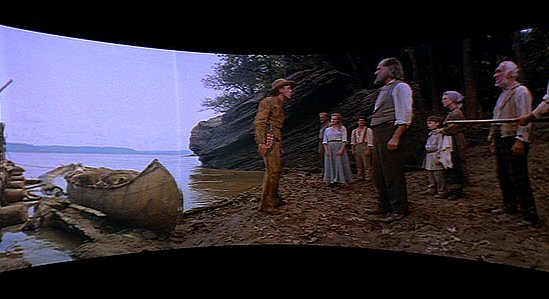
 
That's a 3:1 ratio... more of a special venue system situation, like for ride films, unless you want to crop it to 2.40 : 1, which is a theatrical standard.

There used to be wider aspect ratios -- 3-projector Cinerama was 2.66 : 1 and Ultra Panavision 70 was 2.7 : 1. Both gone really by the mid 1960's.

I once went to the Navy museum in Washington D.C. where they had a big curved screen showing regular 70mm cropped from 2.20 : 1 to 3:1 for a fake Cinerama effect, it was a doc about life on an aircraft carrier.

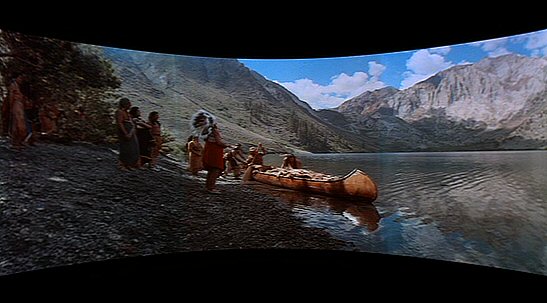
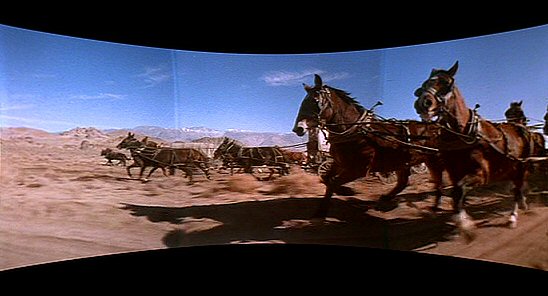
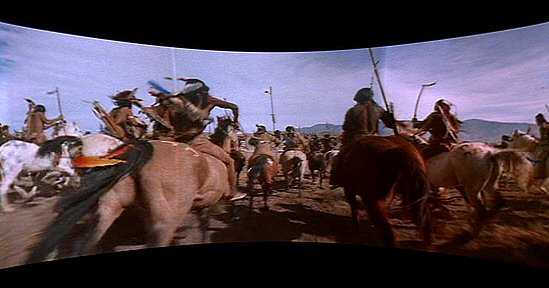
These frames were from the old DVD of "How the West Was Won", shot in 3-camera Cinerama:

htwww1.jpg


htwww2.jpg


htwww3.jpg


htwww4.jpg


I distorted the frames to simulate the effect on a giant curved screen presentation. The new DVD/Blu-Ray is a restored version that looks fantastic, and has an optional "Smilevision" version with the effect above.
 
Great.
Do large format sensor like IMAX and Red Epic 645 and 617 have a hard time obtaining full deep focus? I mean, even when mounted with short spherical lenses. If yes, is this an issue with 5-perf 65mm as well?

As an industry professional, which digital camera(s) do you like most? Aside from Red, that is. Do you have any experience with the Sony HDC-F950? If yes, what do you think of it compared to Red One?

Thanks for your time.
 
Basically the larger formats have, from a practical working standpoint, less depth of field once you get into lower light photography where stopping down is less of an option.

But a lot of IMAX photography is naturally outdoors, plus tends to emphasize wide shots using wide-angle lenses. What's the point of shooting for a huge screen if all you are going to do is frame everything in a close-up?

Take a look at "The Dark Knight" -- the opening bank robbery scene was shot in IMAX and there's some tight close-ups where the focus is very shallow. But they pulled it off. There are some nighttime action scenes also shot in IMAX too. And they used the IMAX format for a lot of great wide shots.

So you can deal with it.

5-perf 65mm is similar to 35mm anamorphic in terms of depth of field -- basically because you have to double your focal lengths to get the same view as in 35mm spherical. So a 40mm becomes your wide-angle lens for a master shot rather than a 20mm lens, for example. Hence the old rule of trying to light to at least an f/4 when shooting anamorphic, though a lot of people ignore that rule. Again, look at "The Dark Knight", there are many scenes shot at f/2.8. You just need to hire some good focus pullers and give them the time needed to get marks and measurements, etc.

The F950 is a 2/3" camera like the F900 or F23. It was used for "Revenge of the Sith" among other movies. It produces a nice 4:4:4 HD image.

It's very basic: you can adjust depth of field by manipulating the f-stop, and if that's not possible, you deal with it, whether it's too shallow or too deep. There is no right or wrong amount of depth of field, and there will always be some types of shots where the focusing is hard -- and some where the focusing will be easy.

Now if a director said "I want to shoot a nighttime action scene in low light on a large format camera" then I'd tell him the pros and cons and how we could deal with it. But given the choice myself, I'd factor in whether I wanted to deal with the shallower focus or not. This happens all the time when I'm doing a 2.40 movie and trying to decide whether to push for shooting on anamorphic. If there is mostly just night work, I may decide that the downsides to anamorphic outweigh the benefits. I think these higher resolution formats tends to work best in wide shots and daytime shots where the viewer can really see the difference. Tight shots at night, well, you can often get away with less resolution and you may be wanting more depth of field to work with.
 
Back
Top