Welcome to our community

Be a part of something great, join today!

  • Hey all, just changed over the backend after 15 years I figured time to give it a bit of an update, its probably gonna be a bit weird for most of you and i am sure there is a few bugs to work out but it should kinda work the same as before... hopefully :)

What Screenplay/Story-Telling book to buy?

Roberto Lequeux

Well-known member
Joined
Jan 3, 2007
Messages
5,403
Reaction score
0
Points
0
Location
Los Angeles
The name of the thread says it all... I need to continue learning and I am looking for a nice book to be able to kick back and relax with.

I am hoping for a book that can stand alone, meaning one that covers everything in a comprehensive and exhaustive manner, hopefully without being a dull read.

Any suggestions?


Here is a list of suggestions in a FAQ over at DVXuser, perhaps one of these?

Syd Field: Screenplay
http://www.amazon.com/gp/product/044...lance&n=283155

Robert Mckee: Story
http://www.amazon.com/gp/product/006...lance&n=283155

Christopher Vogler: The Writer’s Journey
http://www.amazon.com/gp/product/094...lance&n=283155

David Trottier: The Screenwriter's Bible
http://www.amazon.com/gp/product/187...lance&n=283155

Denny Flinn: How Not To Write A Screenplay
http://www.amazon.com/gp/product/158...Fencoding=UTF8
 
you can get "story" on itunes for pretty cheap if you like audiobooks
 
I really like Vogler, it's basically Joseph Campbell's "Hero With a Thousand Faces" but condensed and applied more directly to scriptwriting.

I'd also recommend Aristotle's 'Poetics', Blake Snyder's 'Save the Cat'
 
story - is pretty good. so is Lajos Egris - the art of dramatic writing (or something like that). No book has it all.

Syd field doesnt really say much except some obscure form of 3 act structure.... which he later defines as 4 acts sorta... a big turning point in middle of act 2...

Mckee, Egri a whole different ball park.
 
McKee's 'Story' is an excellent book about story and the Intricacies of narrative.

Campbell's HWTF is an excellent book, although better than that is Christopher Bookers 'Seven Basic Plots'. These books are really about 'Story' rather than script structure.
http://www.amazon.co.uk/gp/product/0826452094/ref=sib_rdr_dp

My two favourite all in one script books are:

How to write the hot script by Eliott Grove,(http://www.amazon.co.uk/Raindance-W...6362/ref=sr_1_1?ie=UTF8&qid=1230126031&sr=8-1).
If there is one book to read that tells you everything about script structure et al. This is it. Written by the founder of Raindance film festival and film school. An excellent book you can use a guide to writing your script step by step...

Talking of which the other best book is: Anatomy of Story by John Truby. Truly a step by step approach.
http://www.amazon.co.uk/Anatomy-Sto...=sr_1_1?ie=UTF8&s=books&qid=1230126122&sr=1-1

As a side note also. The book Alternative guide to scriptwriting is a a good one too.
http://www.amazon.co.uk/Alternative...4775/ref=sr_1_2?ie=UTF8&qid=1230126208&sr=1-2
 
Alternative Scriptwriting is great, and I would also second "Save The Cat", if you're looking for more of a guide to writing a script that will get sold. "Story" is always a good place to start.

I personally got my start with a book called "crafty screenwriting" that I think was a great beginner's guide. http://www.amazon.com/Crafty-Screen...bs_sr_1?ie=UTF8&s=books&qid=1230142045&sr=8-1

Also, something that you might note, I would actually try to write a screenplay first, see what happens, then when you get stuck (or finish with a mediocre script) go to a book, and it's insight will be much more applicable because you've been in the trenches.
 
If you decide to get Syd Field's books, I'd skip over Screenplay and go for The Screenwriter's Workbook and The Screenwriter's Problem Solver. Just looking at the reviews on Amazon, it's obvious that his writing doesn't appeal to everyone, as it is repetitive, but I found it hammered in important points. I'd agree with the other comments: no one book will cover everything and everyone will respond best to a different authour.
 
My opinion, don't waste your time and money with Syd Field. It's sort of like saying that a car is made up of an engine and four tires. If that wows you, get Syd Field.

You'll get the fundamentals and the advanced from Aristotle, Truby, Mckee, and Egri. Also "The Power of Film" by Howard Suber. Most screenwriting websites suck. Except this one: http://www.wordplayer.com/ Read through the articles, etc. Written by working professionals.
 
Story by McKee is mostly just a well done combining of Aristotle, Joseph Campbell and Lajos Egri, but it's worth seeing how he does it, just dont take it as gospel truth (grain of salt and all that sort of thing)
 
Ok... so it sounds like "Story" might be a good safe bet to get started but I am still taking suggestions plus this thread could be useful to others as well of course so please don't stop the conversation because of me.

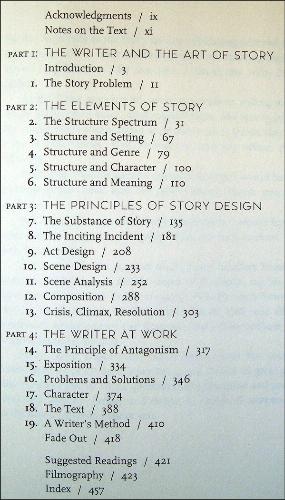
Looking at "Story" in Amazon I found the table of contents I sounds like I would really like part 4:

1993eb6709a0ca5fd3d54110.L.jpg


I have a few structure texts that I like so the in depth analysis of the antagonism or a nice chat about exposition could be a very interesting read. I guess I would like a smart and logical dissection of these important aspects.
 
Its interesting to read Aristotle but its like reading a proverb. You know it already he just says it nicely. Poetics is incomplete and really states the obvious. A bit like Mckee. You realise after reading the book you knew it all already, however its nice to have it told back to you, for confirmation.

By the way 'Story' covers very little in the way of script formatting and how best to physically write a script.

Elliott Grove's book is the best for that without a doubt (http://www.amazon.co.uk/Raindance-W...=sr_1_1?ie=UTF8&s=books&qid=1230213018&sr=8-1)
 
I would recommend "Adventures in the Screen Trade" by William Goldman. Mr. Goldman has written so many incredible scripts (Butch Cassidy, Stepford Wives, Princess Bride, just to name a few) and his book is a fast, engaging read. It's not purely a technical manual, but rather a chronicling of his experiences in Hollywood and a look into his creative process.

I also think it's beneficial to read as many scripts as possible. Study the ones you like for inspiration and read a few that you think missed the mark and try to understand why they weren't very good. There are tons of resources with full length screenplays; try Scriptcrawler http://www.scriptcrawler.com and the Internet Movie Script Database http://www.imsdb.com to start.

Best of luck!
 
The best 'book' for formatting is just to buy Final Draft and then look at a few Hollywood screenplays, any questions beyond that are really esoteric
 
Its interesting to read Aristotle but its like reading a proverb. You know it already he just says it nicely. Poetics is incomplete and really states the obvious. A bit like Mckee. You realise after reading the book you knew it all already, however its nice to have it told back to you, for confirmation.

By the way 'Story' covers very little in the way of script formatting and how best to physically write a script.

Elliott Grove's book is the best for that without a doubt (http://www.amazon.co.uk/Raindance-W...=sr_1_1?ie=UTF8&s=books&qid=1230213018&sr=8-1)

I'll politely disagree, I think Aristotle's Poetics in amazing, only certain passages fall into the 'obvious' category. For instance, the whole part about the imitation desire and what drives base human satisfaction from story is something I've yet to see any scriptwriting book talk about.

Often the greatest truths seem like things we already knew but had to be told them first.
 
I've read many books and seen many videos and seminars. They are are all helpful in their own way but you need to get structure figured out and then move on. No one ever walked out of a movie and said... damn what a structure.

I've spoken with professional readers and they'll tell you they read perfectly structured and formatted pieces of crap all day long.

Try Writing For Emotional Impact by Karl Iglesias.

I also like anything by Jeff Kitchen

or Martell.. http://www.scriptsecrets.net/products/book.htm

If you're into action, suspense or thriller get Martell's book when you can. His last book is currently $90 used on Amazon 'cause it's out of print. I've got it, and sure enough it's great.

Also, listen to the Creative Screenwriting Magazine Podcast.
 
I think that you're already getting this, but I think it's important to note that no one screenplay book will cover everything, and no screenplay book will substitute for sitting in front of a white screen for 3 hours.
 
I had to add my two cents here, I read a lot of material, I have to say I first look for a sound structure. Structure does not mean predictable. Field's will give you a great foundation for that. Film has a grammer, we have been conditioned over our personal history of enjoying movie's. It's automadic, if you write contrary to it. You do so at great risk. I would never tell another artist how or what to write, unless they are working for me. If you were writing for me I'll hammer you on it until you comply or die.

Lew Hunters book is more of an artful approch, so those would be the two guys I would looked to first. Then read a book called Writing Treatments That sell. Then the real work begins. Always start with a treatment. It will keep you focused and I will keep the story tight. Remember when your writing, you write for the re-write, don't get trapped looking back on what you have written, just push through to the end. By writing a treatment first you can do what I've said. Then attack the secound draft. Once that is done get a group of real actors, and then do a table read. It will blow your mind how differant it sounds too you. When you do this let the actor have freedom to play the role as they see it. If their performance fits your intent your good to go to polish. If not you have a lot of work to do. Either way it is well worth the time.

The only other thing I can tell you is write in seven acts, it's easier and your story is more dynamic. I have a post somewhere on here about my method to writing. Search my screen name and 7 acts it has served me well hope it helps. Just remember when your writing there are no budgets, just freedom to do what you see in your head. After it's done getting on the page, then worry about the cost of tv stage.
Forgive typos I'm on the Iphone on my way to Texas.
 
This book comes out in Jan 09. It is written by a good friend of mine. Norm Hollyn heads up at the Editing Track at USC School of Cinema. We co-edited the last feature I produced and I continue to learn from him. I have seen his Sundance Film Festival presentation where he does a 1.5 presentation on some of the topics covered in this book. I can't wait to get the book so I don't have to keep taking notes all the time... ;)

The Lean Forward Moment: Create Compelling Stories for Film, TV, and the Web:
http://www.amazon.com/Lean-Forward-...bs_sr_1?ie=UTF8&s=books&qid=1230239514&sr=8-1


Michael
 
if you peak Spanish, I recomend a book called "Como Mejor Un guion" great book. I am not sure if you can get it here.. I got it in Spain.. from a film book store in Madrid call 8 1/2..
 
Back
Top