Welcome to our community

Be a part of something great, join today!

  • Hey all, just changed over the backend after 15 years I figured time to give it a bit of an update, its probably gonna be a bit weird for most of you and i am sure there is a few bugs to work out but it should kinda work the same as before... hopefully :)

Rode NTG-3 vs. Sennheiser 416

Yannick Hagman

Well-known member
Joined
Jul 26, 2007
Messages
767
Reaction score
0
Points
0
Location
Switzerland
If you own the NTG-3 your help is needed.

Soundprofessional Tsvisser from Scarletuser offered a professional comparison among these two mics. I believe it would be a very crucial test for many as these two mics have a price difference of $400.

He is based in Hawaii for the rest of the year and doesn't own the NTG-3. If somebody could send it to him, he offers to send it back right after the test for free, wherever you're based - which is very kind of him.

Or maybe you know of a Hawaii based soundhouse that would participate on such a test for free.

Thanks in advance.
 
Have him contact me directly and we'll set him up. We're shooting a variety of tests with the RODE NTG-3, both indoor and outdoor. We'd love it if he'd be game for sending in a few samples back with the mic.

Guy Cochran
 
Our unscientific side-by-side test this morning with a 416 using a Sound Devices Mix Pre was a bit of a shock. To our ears (and there were four or five of us) the mics were sonically identical in almost every way. Cosmetically, the mic could almost pass for a 416 if not for the unique pattern on the interference tube end cap and feels just the slightest bit heavier. We knew that the folks at Rode were going after a piece of the premium shotgun mic pie with a new product but, at MSRP $700.00 USD, this mic is quite a revelation and a value. $750-$800 USD is the going rate for a used MKH416 in good shape. I can see this being a great option for those who want to buy a MKH416 or MKH60 and just don't have the means. Or, as a back up for pretty much everyone. The RODE NTG-3 passed the RFI tests with flying colors against every type of RF and Cell Phone interference we threw at it. On the scope the two mics looked 99% the same.
 
Thanks for sharing Scott. 99% holy cow! I guess the real test if it sounds the same is, how will an NTG-3 sound after it's been abused for 10 years at a rental house. Any chance you might be able to put up a sound sample?
 
Question is: will the NTG-3 be as robust under wet weather conditions as the MKH416? And how is the S/N compared to each other?
 
Not used the NTG-3, but used a NTG-1 under very humid, warm and extreme cold and always worked fine.
 
Where do you see the $299 price for the blimp? B&H has it for $400 (pre-order).
 
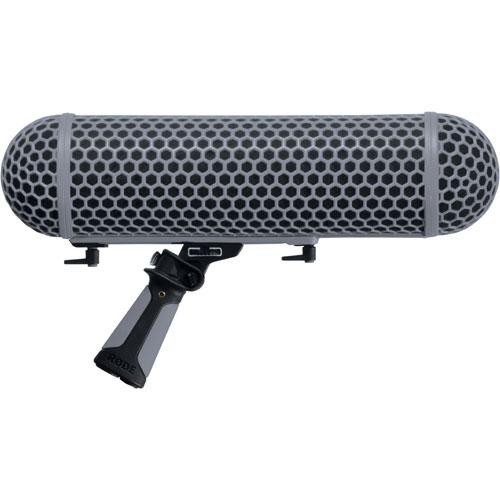
I've got Rode NTG-3 today and also interested in the Rode Blimp Windscreen and Suspension System.

579335.jpg


B&H price USD 299.00
 
Congratulations. The Rode stuff is very good; the only difference betweeen them and Sennheiser is that Rode is a much younger company. but they turned the studio recording market upside down with their early products and I hope they repeat their success in the film world.

My only regret is that I've recommended them to some videographers, and now they don't pay to hire my other mics any more because the Rode is plenty good enough for most purposes.
 
Our unscientific side-by-side test this morning with a 416 using a Sound Devices Mix Pre was a bit of a shock. To our ears (and there were four or five of us) the mics were sonically identical in almost every way. Cosmetically, the mic could almost pass for a 416 if not for the unique pattern on the interference tube end cap and feels just the slightest bit heavier. We knew that the folks at Rode were going after a piece of the premium shotgun mic pie with a new product but, at MSRP $700.00 USD, this mic is quite a revelation and a value. $750-$800 USD is the going rate for a used MKH416 in good shape. I can see this being a great option for those who want to buy a MKH416 or MKH60 and just don't have the means. Or, as a back up for pretty much everyone. The RODE NTG-3 passed the RFI tests with flying colors against every type of RF and Cell Phone interference we threw at it. On the scope the two mics looked 99% the same.

Hi Scott,

My ears were a little different.


NTG-3 - New Shotgun Mic from Rode

Ty Ford

A $699 USD street, the new Australian-made Rode NTG-3 seems extremely well-placed for its price and performance. Like the Sennheiser 416, the NTG-3 is an RF-condenser that combines a somewhat sophisticated RF circuit with the capsule to reduce the deleterious effects of high humidity. Tricky to design, but worth the effort. That design element has contributed greatly to the 416’s “bullet proof” reputation and should do the same for the NTG-3.

FEATURES
The RF environment is growing significantly more hostile, though, and Rode seems to have taken shielding a bit farther than Sennheiser did back in 1974 when the MKH 416 came to market. Attention to the mechanical and electronic lay out of the NTG-3 including the surface mount technology (SMT), PCB layout, component selection and dual chamber design of the internal brass tube that appears to separate most of the circuitry from the tunable RF section and capsule, all contribute to RF resistance and mic performance.

The upper chamber and part of the lower chamber of the internal metal tube in which the circuitry and capsule sit is completely covered by a thin grounded metal mesh. Just behind the capsule a rubber o-ring in a small groove and one closer to the tip snug the internal metal tube inside the slotted outer tube. The internal tube runs the full length of the outer tube for increased shielding. A small foam plug a little over a half inch thick sits within the top of the internal tube to reduce popping. The extended upper section of the internal tube, above the capsule, has two rows of precision holes drilled on opposing sides covered with a thin fabric to mechanically filter the sound once it has already been filtered by the slots on the outer tube.

Rode also adds some further insurance by integrating their longer pin 1 ground pin into a very well designed grounding scheme. The XLR connector is not stock. The base is machined from solid brass. The ground pin is permanently mounted into that case. Pins two and three are isolated via Teflon bushings. All pins are gold-plated.

The Rode NTG-3 employs a line gradient supercardioid capsule. Output impedance is 25 Ohms. Sensitivity is listed at -30 dB re 1 Volt/Pascal (31.6 mV @ 94 dB SPL) +/- 2 dB @ 1kHz, EIN noise is 13 dB-A and it can withstand 130 dB SPL. The 416 and NTG-3 share the same 13 dB-A selfnoise and sensitivity. At about a quarter inch longer and about the same weight as a 416, the NTG-3 weighs less than six ounces. Its matte champagne finish is not reflective.

It’s not unusual to have to roll the low end off on a 416 these days unless you’re in the middle of nowhere or in a studio. Sanken rolled off the bottom a bit with their CS-3e and Rode follows suit with the new NTG-3, so there’s not quite as much in the upper bass or lower midrange on the NTG-3. That makes the NTG-3 sound slightly crisper and brighter. More so when used very close. As you back it off, though, normal air diffusion makes any high-frequency differences between the two mics pretty unnoticeable. However, the fact that my 416 is over fifteen years old may suggest that it may not be as bright as it once was. Regardless, with a zep and a furry, of course, you’ll lose a bit of top end.

IN USE
The NTG-3 pattern is a little wider than the 416, with more gently sloping shoulders. This translates into a more forgiving pattern for two-shots, but you’ll also hear a bit more ambience. My 416 has a little spot about ninety degrees off axis where there’s a slight return of high frequencies. The NTG-3 does not. Both mics sound about the same from the rear. The NTG-3 sounded fine on my K-Tek carbon fiber boom with a Rycote Softie suspension mount. The NTG-3 had less low frequency boom handling noise, mostly because the 416 noise had more LF content due to its response.

After not picking up any interference with my Verizon cell phone sitting next to the NTG-3, I made a point of taking the NTG-3 to the mall with my location recorder and headphones to visit T-Mobile, the Apple store and AT&T. There was no interference, even with phones operating right next to the NTG-3. I was using Whirlwind Accusonic +2 cable and connectors. The shield was not tied to the XLR shells.

SUMMARY
The Rode NTG-3 appears to be a very solid piece of gear. The efforts to eliminate RF are noted and appreciated. I like the unique and very handy padded metal storage tube. The foam windbreaker and simple mic clip all add value to the package. I think you’ll be seeing NTG-3s show up in more kits soon. At the moment, I can’t see why not. Nice job Rode.

Technique, Inc. © copyright 2008

Ty Ford is on permanent loan from Radio World and Pro Audio Review. He may be reached at www.tyford.com.

FAST FACTS
Application: Film, ENG/EFP audio.

Key features: Designed to withstand today’s harsh RF environments.

Price: $699 USD Street.

Contact:
Rode
www.rodemic.com
 
Anyone know how the NTG-3 compares to the Sennheiser ME-66?

It is far superior to any $150 mic. If you are at all familiar to the Sennheiser MKH416 (a $1200 USD) mic and it has been discussed on this forum that it is at least its equal if not besting it, then you will know it beats any sub $200 mic.
 
Here it is an indoor/room test I did today with Rode NTG-3 connected to TRS 1/4-inch input to get the phantom power 48V out from M-Audio Micro Track II that is line out wired at REC mode to RED1.

In that way you'll be able to record at the two devices simultaneously M-Audio Microtrack II and RED1 (at one channel).

Have a look at the pictures below where you can also find a link to the footage with a sound from the test.

Rode_NTG3_01.jpg

Rode NTG-3 with Rode Dead Cat windshield, Avid/M-Audio MicroTrack II, Sennheiser HD 25-1 II headphones, Leica Summilux-R 50mm f/1.4 on RED1.

Rode_NTG3_02.jpg

Rode NTG-3 with Rode Dead Cat windshield, Avid/M-Audio MicroTrack II, Sennheiser HD 25-1 II headphones, Leica Summilux-R 50mm f/1.4 on RED1.


Rode_NTG3_03.jpg

Rode NTG-3 with Rode Dead Cat windshield, Avid/M-Audio MicroTrack II, Sennheiser HD 25-1 II headphones, Leica Summilux-R 50mm f/1.4 on RED1.

RodeNTG3_MAudioMTII_1KH264.jpg

Short clip with a part taken from YouTube's BBC Cutlure Show w/ Christopher Doyle talking about handheld use of his camera.

1K footage with a sound from the test 42.8 MB>>>

The sound comes from the small JBL loudspeakers that you can see at the footage.
 
Back
Top