Welcome to our community

Be a part of something great, join today!

  • Hey all, just changed over the backend after 15 years I figured time to give it a bit of an update, its probably gonna be a bit weird for most of you and i am sure there is a few bugs to work out but it should kinda work the same as before... hopefully :)

O.M.G. Are you serious?!?

Roberto Lequeux

Well-known member
Joined
Jan 3, 2007
Messages
5,403
Reaction score
0
Points
0
Location
Los Angeles
Just a little waste of time... just to have something to chat with you guys over the weekend since things around here have been so quiet:


from an other forum:
> 3K resolution for $2,500 base price. It certainly knocks the socks of the
> competition in this regard.

Perhaps if you are going to film with it, but at this price point
99.9999999% of people are going to video so the 3k marketing ploy means
little. It's simply overkill marketed as "better". The RED fanboys will love
it, but are thinking more with their brain stem than frontal lobe.

Sort of like the difference in getting a 1080 TV set over a 720. Nice but
useless for the most part as you are already at the contrast range that is
beyond what your eyes can discern
, but it sure sounds sexier to say 1080
than 720.


This is complete crap... I mean... OMGZ... can you seriously tell me that you work in the industry but can't tell the difference between 720p and 1080p?!?!
 
So as to avoid a flame war over there I won't mention where the conversation is. However, since I got this stuff sent to me to my e-mail, I gave myself the liberty of posting it here to laugh at the guy, openly.

Looks like the original poster should be happy with his cell phone camera...

Well said.
 
Even if you were outputting your immediate deliverable to 1080p, who wouldn't want to start at 3K (straight off a larger sensor), edit/grade at 3K if there's a reasonable workflow for it, then downscale for final export, and retain a somewhat future-proof master?

There's all sorts of reasons for 3K, or, to put it another way, all sorts of reasons to acquire and post at a higher resolution than your final output will be.
 
Oh, man. And is there any camera that can acquire a greater contrast range than the human eye can see?

Even if one came to exist, how would we know? Ask an eagle?
 
yes sure, there are some blind people in the industry, he he
 
Looks like it comes from a non-public forum, as there is only one reference to it on Dr. Google, and that is this very thread.

I was just wondering if it was a amateurish wanna-be forum (which I hope) or a more serious indy forum - in which case I think that indeed someone should put them straight. Certainly won't be me :)
 
I was just wondering if it was a amateurish wanna-be forum (which I hope) or a more serious indy forum - in which case I think that indeed someone should put them straight. Certainly won't be me

Sadly, you couldn't be further... as in all the way on the other extreme. There are always two extremes and the sweet spot is in the middle. Allow me to contribute to this thread by attempting to illustrate:

Don't-know-better < Us > Head-up-my-ASS
. . . . :weight_lift: . . . . . . :matrix: . . . . . . :greedy:

I wanted to reply to his personal e-mai account and give him a piece of what's floating around in my mind, but I am being a grown up, well... just about :sarcasm: and I am only going to talk behind his back without saying his name.
 
Have a look at this fascinating attempt to guesstimate the resolution of the human eye:

http://www.clarkvision.com/imagedetail/eye-resolution.html

Looks like you'd need a 576 megapixel sensor to match the visual data the brain perceives from the eye (the eye plus brain assembles a far higher resolution image than possible with the number of photoreceptors in the retina due to some funky processing).

Stick two EPIC 617's together and you're almost there!
 
This is complete crap... I mean... OMGZ... can you seriously tell me that you work in the industry but can't tell the difference between 720p and 1080p?!?!

Once you get a certain distance - say, more than 4 or 5 times the screen height - from the display, nobody can. Especially if we're talking about broadcast formats, where 1080 is usually interlaced. That's not crap, it's fact. Fox even did some studies a few years ago, when they were deciding on their eventual HD broadcast format, that showed that most viewers couldn't tell the difference between standard definition (if sourced from progressive images) and HD if both were displayed on 16x9 monitors and viewed from a distance of more than 5 times the display height.
 
3K RAW Bayer would be better for conversion to 1080P 4:2:2 or 4:4:4 than a 2K RAW Bayer camera. You have to figure that a 3K RAW camera like the Scarlet doesn't mean it equals 3K of measurable resolution, more like 2K, hence why you want more pixel resolution if using a single Bayer-filtered sensor to end up with a good HD picture (1.9K).

3K single sensor camera should compete well with 3-chip 1080P cameras.
 
Once you get a certain distance - say, more than 4 or 5 times the screen height - from the display, nobody can. Especially if we're talking about broadcast formats, where 1080 is usually interlaced. That's not crap, it's fact. Fox even did some studies a few years ago, when they were deciding on their eventual HD broadcast format, that showed that most viewers couldn't tell the difference between standard definition (if sourced from progressive images) and HD if both were displayed on 16x9 monitors and viewed from a distance of more than 5 times the display height.

All very true. I set up a new Sony Bravia receiving digital broadcast from an antenna. When the stations are tuned, a display window shows the format and most of the local stations were actually broadcasting wide screen 480i during the 11 o'clock news cycle. Letterman and the Late show shifted to 1080i.

I have to explain to clients sometimes why despite the fact that their 1080p 50" plasma is razor sharp up close they can't read an excel spreadsheet on it from 20' away.
 
3K RAW Bayer would be better for conversion to 1080P 4:2:2 or 4:4:4 than a 2K RAW Bayer camera.

3K single sensor camera should compete well with 3-chip 1080P cameras.

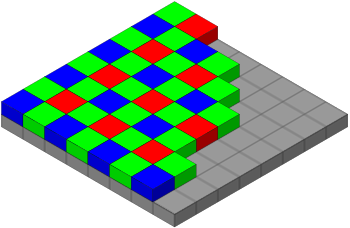
Yes, this I'm confused about. How is the xxx K RAW Bayer measured? If I look at the explanation of the Bayer sensor it looks like it have 3 times more "pixels" on the sensor then, the resulting "de-bayered" image will have.

http://en.wikipedia.org/wiki/Bayer_filter

350px-Bayer_pattern_on_sensor.svg.png


..and the word "Bayer" should mean "Divide with 3".
But, this sort of make the REDONE a 1.2K camera?

When film resolution is referred to 4K is mentioned, not 4K RAW .. or?

Cheers!
 
RAW to RGB

RAW to RGB

I'm sorry you have to go back to Bayer to RGB math school. :red_bandana:

But I will give you the bottom line - RGB resolution ~ 80% stated RAW resolution.

i.e 5K RAW ~ 4K RGB

4K RAW ~ 3.2 K RGB

so 3K RAW ~ 2.4 K RGB i.e more than a "full resolution HD " 1080p camera.

and 2K RAW ~ 1.6 K RGB

This is still similar to a "full resolution HD " 1080p camera (in theory 1.9 K RGB) as you can't realize true 1080p without introducing aliasing.

(Yes this is a simplified answer, the full details / factors have been discussed before.)
 
Hi Stuart,

Thank you for your answer, but the more I google, the more it looks like 50% is more accurate. Then, I have no idea how you have build the camera :) But by an very unscientific test I did just now I would say the image looks 1:1 when I scaled an 4K RAW R1 image 50%.

I used RedAlert 3.50 for the de-bayer, is there better ways?

http://www.kenrockwell.com/tech/bayer.htm

Cheers
 
Janne, the measured resolution of a RED One system of lens, OLPF, bayer Mysterium sensor and REDCODE RAW compression is ~78% of the linear resolution as Stuart has stated. Ken's page is useless. That's not a comparison, but a farce. Sorry.

Are there better ways? Not currently. See my posts on this to read more.

Problem is that there's this thing called aliasing. Have too much of that and sure, you're image looks tack sharp, but it also destroys the image. The key is to have so many pixels, so much resolution, that you don't have to try to make it so sharp and get aliasing issues, while still recording vast amounts of real detail. And that is what we do here.

Graeme
 
How do low light levels affect these types of RAW/BAYER/RGB conversion factors? I notice that low light tends to wreak havoc on perceived resolution in most of my shots.
 
Low light tends to look lower resolution an all cameras just because of the noise at lower light levels.

Graeme
 
Once you get a certain distance - say, more than 4 or 5 times the screen height - from the display, nobody can. Especially if we're talking about broadcast formats, where 1080 is usually interlaced. That's not crap, it's fact. Fox even did some studies a few years ago, when they were deciding on their eventual HD broadcast format, that showed that most viewers couldn't tell the difference between standard definition (if sourced from progressive images) and HD if both were displayed on 16x9 monitors and viewed from a distance of more than 5 times the display height.

LOL.. but are you seriously going to consider that everyone sits at that distance? And do you only consider that we are talking about TV broadcast? There are other things out there, like Blu-Ray, 1080p on-demand type services are popping up last time I heard.
And do you know how many of the Red buyers aim at making movies? Cause I am sure it is much higher than the average...

But even still, when you watch TV, even SD 480 4:3 whatever the format and pixel count... that there is TV images and great TV images... the bigger the initial picture the sharper the output... everyone and their mother knows that. Overkill? It depends on the project and how much you care about it... to lump up all Red users like that speaks of other more personal motivations behind the statement.

I'd like to know how those tests that Fox performed were carried out... was it a test to see if they should opt for 1080i or 720p out of their cameras? Which cameras? Newsroom cameras? Sitcom cameras? What cameras? What sensor? Cause unless they were native 1920x1080 cameras with detail filled frames for comparison... something that didn't ruin the shot too much with bad compression...

Even more, start with a bigger sensor, one big enough to eliminate most of the noise after downsampling and the 1080p continues to get better and better than the 720p...

Also, keep in mind that the e-mail said 1080... NOT... 1080i... and Red cameras don't have a sticker that says "only to be used for TV broadcast, preferably by people looking to compromise" it would instead have a sticker that read something like "Red, compromise NOT spoken here".

I am sorry if I rant on and on.... also, I am not a DoP or experienced post-master of any kind, but to speak like that dude did in his e-mail he should have made sure to tread lightly and speak in carefully picked absolutes.

And what about DNR?! What about DoF? What about the ability to do a TON more in post with RAW images?????

And if that was a post that should be read in the context of a thread then he should learn how to use his computer and keep his rants away from my e-mail box.


Again... sorry if I sound upset, but I am just sick of people trying to knock us down.
 
Back
Top