Welcome to our community

Be a part of something great, join today!

  • Hey all, just changed over the backend after 15 years I figured time to give it a bit of an update, its probably gonna be a bit weird for most of you and i am sure there is a few bugs to work out but it should kinda work the same as before... hopefully :)

Looking for low-cost HMI solution.

Chris Pickle

Well-known member
Joined
Mar 18, 2007
Messages
392
Reaction score
0
Points
0
Website
www.savinggracethefilm.com
Not sure if this is the correct sub-forum for this question, but we're looking for a lower cost solution for a couple of 1200w HMIs.

I know we could buy a couple of new Arri, and I've also heard that Desisti can be a bit less expensive.

Should we only look at electronic ballast?

And a total newbie question--what's the difference between Fresnel and Par? I know the Fresnels have a lens and the Pars have a back reflector? But ....

Any sources for used in decent shape?

Thanks,
Chris
 
Not sure if this is the correct sub-forum for this question, but we're looking for a lower cost solution for a couple of 1200w HMIs.

I know we could buy a couple of new Arri, and I've also heard that Desisti can be a bit less expensive.

Should we only look at electronic ballast?

And a total newbie question--what's the difference between Fresnel and Par? I know the Fresnels have a lens and the Pars have a back reflector? But ....

Any sources for used in decent shape?

Thanks,
Chris

Hi Chris,
Fresnel is a fixed lens lamp while Pars have a choice of lenses, spot, medium,wide. Pars can be more expensive than Freznels.
Some companies have stopped making Magnetic ballasts
and RED guys have reported problems with them. Arri and Powergem
electronic ballasts seem to be popular and easy to service in my area.
Power gem provide ballasts for a wide range of HMI's form different
companies. Adapter cables are the go here. Electronic ballsts are mostly
dual operational, 575/1200watt, 2.5K/4K, and so on. Because of this they
tend to be a little expensive.
Happy hunting, Mezmo
 
I can't completely get around the Jokerbugs. They offer nice wattages, they have respectable output, totally household power friendly, the ballasts are small and lightweight, but I find them to be amongst the clumsiest fixtures I've handled so far. The weigh distribution in the lamphead is just stupid. All in the front. (The Bug-A-Beam HMI Leko Death Star Super-Ray kicks ass though.)

Cinemills / Filmgear makes very interesting fixtures at a decent price depending on where you live or if you can find a supplier. A friend of mine was looking into tungsten fresnels and KinoFlo-like fixtures, but shipping made the price as high as the original brands which suppliers held in regular supply.

Unless you plan on doing offspeed, magnetic ballasts should be fine as far I know... but I'm no flicker expert.
 
I can't completely get around the Jokerbugs.

I think Jokers are great lights, and have some very innovative accessories. My one problem with Jokers is that their ballasts are not Power Factor Corrected. Their poor Power Factor causes them to use power inefficiently and the harmonic currents that they kick back into the power stream can have a severe adverse effect on the power waveform of some generators. Since the poor Power Factor of Jokers is commonly overlooked because of their small size, I would like to take this opportunity to explain it in detail and show how it might impact Chris’s decision.

If we look at the technical specifications for Joker Buglites, we see that the ballast that the Joker 800 uses has a Power Factor of .56. What that means is that it draws 12.5 Amps rather than the 7 Amps you would think using Ohm’s Law (W=VA.) The difference between the actual current drawn by the bulb, 12.5 Amps, and the 7 Amps a 800W bulb should draw using Ohm’s Law (800W/115V=6.956A), is the difference between what is called “Apparent Power” and “True Power.”

If, in this case, you were to measure the actual current (using a Amp Meter) and voltage (using a Volt Meter) traveling through the cable supplying the Joker 800 ballast and multiply them according to Ohm’s Law (VxA= W) you would get the “apparent power” of the bulb (115V x 12.5A = 1437W). But, if you were to instead, use a wattmeter to measure the actual amount of energy being converted into real work (light) by the ballast you would get the “true power” of the bulb which in this case is specified by the manufacturer as 800W. The ratio of “True Power” to “Apparent Power” is called the “Power Factor” of the light.

A favorite analogy electricians like to use to explain Power Factor is that if Apparent Power is a glass of beer, Power Factor is the foam that prevents you from filling the glass all the way up with beer. When lights with a low Power Factor are used, the distribution system must be sized to supply the Apparent Power (beer plus foam), even though only the True Power (beer) counts. With a Power Factor of .56, you must take into account that the Joker 800 ballast draws considerably more power (1437W) for it’s true power output of 800W.

Used on wall outlets, this relatively inefficient use of power is negligible because the power draw of the Joker 800 fits easily in a standard wall circuit. However, the greater Apparent Power of lights with a poor Power Factor must be factored when using portable generators. For instance, you would think that you could operate a Joker 800 on a simple two stroke 1000W generator from Walmarts. But, in fact, you would overload the generator because the “continuous load” rating of the All Power America 1000W Generator sold at Walmart is only 850W and the actual load of the Joker 800 is 1437W.

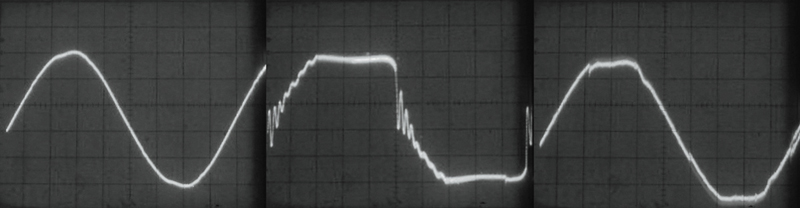
The greater Apparent Power of Lights with a poor Power Factor is not the only consideration when operating them a generator. When you use lights sources like HMIs, Kinos, CLF lamp banks, and even LEDs, on generators it matters not only what type of ballasts the light uses, but also what type of generator you use to power it. The harmonic currents that ballasts with poor Power Factor, like the Joker 800 electronic ballast, kick back into the power stream can have a severe adverse effect on the power waveform of some generators.

Normally, when you plug a HMI, Fluorescent, or LED light into a wall outlet you need not be concerned about the current harmonics generated producing voltage distortion. The impedance of the electrical path from the power plant is so low, the distortion of the original voltage waveform so small (1-3%), and the plant capacity so large, that inherently noisy loads placed upon it will not affect the voltage at the load bus.

wwaveform_elec_ballast.jpg

Left: Grid Power w/ 1.2Kw Arri non-PFC Elec. Ballast. Center: Conventional AVR Power w/ 1.2Kw Arri non-PFC Elec. Ballast. Right: Inverter Power w/ 1.2Kw Arri non-PFC Elec. Ballast.​

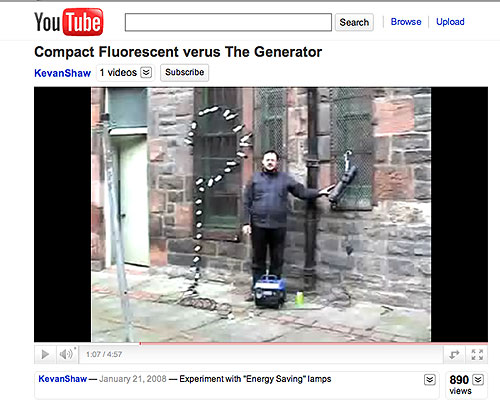
However, it is an all together different situation when plugging non-Power Factor Corrected HMI, Fluorescent, or LED ballasts, into conventional portable generators. Given the large sub-transient impedance of conventional generators like Walmart’s 1000W generator, even a small degree of harmonic noise being fed back into the power stream will result in a large amount of distortion in its’ voltage. Add to that, the fact that the original supply voltage waveform of a conventional generator, like Walmart’s 1000W generator, is appreciably distorted to begin with, and you have a situation where the return of any harmonic currents by an HMI, Fluorescent, or LED ballast will result in significant waveform distortion of the voltage at the power bus (see oscilloscope shots above.) The waveform distortion caused by these harmonic currents can have a severe adverse effect not only the generator, but also other electronic equipment operating on the same power. There is a video on You-Tube by a Lighting Designer by the name of Kevan Shaw that illustrates just this, but with CFL bulbs which have a similar Power Factor.

CFL_vs_Gen_Dem.jpg

In his You-Tube Video, “Compact Fluorescent verses the generator,” (available at http://www.youtube.com/watch?v=LeCqreRMzKM) Kevan Shaw compares the effect of equal wattages of CFLs and Incandescent lights on a small portable generator. In his test, he first operates a 575W ETC Source Four Leko with Quartz Halogen bulb on an 850W two stroke conventional gas generator without problem. However, when he tries to operate an equivalent wattage of CFLs (30-18W bulbs) the generator goes berserk. Only after turning off half the CFL Bulbs does the generator operate normally with a remaining load of 15 - 18W CFLs (270 W.) What accounts for the erratic behavior of the generator in this video under a smaller load of CFLs? It is a combination of the poor Power Factor of the CFL bulbs (.5) and the harmonic currents they generate.

Even though the 15 CFL bulbs have a True Power of 270W (15 x 18W = 270W ), the Watt indicator on Kevan's generator indicates that they draw twice that in Apparent Power (535W), or have a Power Factor of .5 (270W/535W =.504.) The fact that CFL bulbs consume double the energy (Apparent Power) for the 18 Watts of light (True Power) they generate, is only half the story here. Kevan Shaw’s video also clearly demonstrates the severe effect that loads - like CFLs, HMIs, Kinos, & LEDS - with leading power factor can have on the governing systems of conventional generators.

When Kevan turns off the 18W CFL bulbs one at a time until the generator stabilizes, he is not only demonstrating that 15 – 18W CFL bulbs has roughly the same Apparent Power (535W), according to the generator’s Watt meter, as a 575W incandescent light; but, also that the maximum Leading Power Factor load a 850W conventional generator can operate satisfactorily is 270 Watts (15 – 18W CFL bulbs). Looked at from another angle, 576 Watts of Apparent Power with a Leading Power Factor (16 - 18W CFL bulbs) overloaded the generator, while 575 Watts of Apparent Power with a Unity Power Factor (the 575W Quartz Leko) did not. What accounts for this difference? Since the load is almost the same (576 & 575 Watts of Apparent Power respectively), the only factor that can account for the generator going berserk with the equivalent load of CFL lights is the harmonic currents that they generate, that the Quartz Leko does not. Without a doubt, Kevan Shaw’s video is a clear demonstration of the adverse effect that harmonic currents have on the governing systems of conventional generators.

For the same reason that Kevan Shaw was not able to operate more than 270 Watts of CFL bulbs (15–18W bulbs) with a Power Factor of .5 on his 850W generator, Chris would not be able to operate a Joker 800 on a 1000W conventional generator. The adverse effects of the harmonic currents that non-PFC ballasts generate, so graphically demonstrated in Kevan’s video, limits the total amount of Leading Power Factor loads, as compared to Unity Power Factor loads, that can be reliably operated on conventional generators

The poor Power Factor of HMIs, Kinos, CLF lamp banks, and even LEDs, have been vexing set electricians for years. Use this link for an article I wrote for our company newsletter that explains the electrical engineering principles behind these issues and how to resolve them.

BoxBook.jpg

This article is cited in the just released 4th Edition of Harry Box's "Set Lighting Technician's Handbook" and featured on the companion website
"Box Book Extras." Of the article Harry Box exclaims:

"Great work!... this is the kind of thing I think very few technician's ever get to see, and as a result many people have absolutely no idea why things stop working."

"Following the prescriptions contained in this article enables the operation of bigger lights, or more smaller lights, on portable generators than has ever been possible before."​

The article is available online at http://www.screenlightandgrip.com/html/emailnewsletter_generators.html.

Guy Holt, Gaffer, ScreenLight & Grip, Lightng & Grip Rental in Boston
 
Back
Top