Welcome to our community

Be a part of something great, join today!

  • Hey all, just changed over the backend after 15 years I figured time to give it a bit of an update, its probably gonna be a bit weird for most of you and i am sure there is a few bugs to work out but it should kinda work the same as before... hopefully :)

Is there a flicker issue using magnetic-ballast HMIs with the RED?

You'd be surprised how many people have built things like what you just described. No reason not to, other than the obvious compromises.

I built a set of knock-off Kino's for $250 a piece... ballasts are cheap and flickerless these days, and you can by high CRI florescent bulbs cheaper than Kino bulbs... they worked fine.
 
Well the two HMI 1200 Pars just sold...for a total of over $5000.00. That is twice what I thought they would bring.

Is it the same as with Zeiss primes and such, the numbers of Red cameras out there needing all sorts of production equipment, etc. driving prices up?

Just wondering (wish I had more 1200 Pars...although I will hold onto my Zeiss collection)
 
Demand is good, while it drives the prices up intially, the supply should catch up to meet demand. That's why there is an un-naturally high population ratio of chickens & cows to say, owls & mountain lions. An un-naturally high population of film related gear such as HMIs wouldn't hurt my feelings.

About the board with the 100 bulbs: It's about "throw" distance. FAYs are similar in that they took 9 PARS and put them together and they work great. They're been around since the 50s. FAYs have throw.

The HMI / shutter posting by Cool lights needs to be a sticky.
 
Hi all. . .

There must be some reason (except effort and "aesthetics") why this isn't done:

Say we take a 4x4 piece of plywood. Say we mount 100 "bare bulb" sockets to the plywood (10 strips of 10 sockets). Say we put a switch on each strip. Say we put 100 14W compact fluorescent bulbs in the sockets. Bulbs are available in several different temperatures.

What have we created? A 100 bulb, 1400W fluorescent "fixture" with the light output of 6000 watts of tungsten? Or a worthless, unusable piece of experimental junk?

What say we?

Thanks much.

Stephen

Not worthless but something that has its own uses and its own strengths and weaknesses. Not the equivalent of just 6000w tungsten but the equivalent of (maybe 6000w depending upon how efficient the small ballasts are in the base of the bulbs) tungsten behind diffusion which limits its throw and is emanating from a large surface area so therefore very soft. You can't make the fluorescent bulbs hard no matter what you do. If you had a big enough one, you'd have something similar to a Fisher light but a cool version. Great for car commercials for instance where you want smooth and even lighting. No need for a fan either like with a fisher light.
 
which plug in....? for which software application?
could be useful.

I just sent an email to find out, I am pretty sure all of the editing was done in Final Cut.

Not aware of a deflicker plugin for Final Cut Pro, but...

http://www.granitebaysoftware.com/Product_gbdeflicker.aspx

...this is an After Effects PC only plugin that is used for removing flicker in timelapse sequences. I haven't used it personally but, judging from the video tutorials on the site, it should work on HMI flicker.

If the Granite Bay plugin being PC only is a deal breaker, The Foundry's Tinderbox 1 DeFlicker plugin work on OSX, but you have to buy the whole bundle of 20 plugins - not cheap!

That plugin is sweet! Should be built right into Ae.
 
I'm sure it HAS been done, somewhere

I'm sure it HAS been done, somewhere

Say we take a 4x4 piece of plywood. Say we mount 100 "bare bulb" sockets to the plywood (10 strips of 10 sockets).

I'm sure it has been done. But then you've got to build a case for it, etc. That's the great thing about Kinos (and some others) - they are self-contained and to some degree self-encased. I could go out and build something similar, but it would be very expensive to try to custom build what Kino and others have done, and if it wasn't expensive it probably wouldn't last very long, or be heavy as hell.

"Throw" isn't the only criteria. What a lamp like this does is provide a very broad source that will fit in a very small space, without putting out a lot of heat. On Dumb and Dumber we used Jay Yowler's custom "Wall of Light" (24 tubes I think - a predecessor to his BFL) when we were backed up against the antique paneling in the bar at the Stanley Hotel. Talent could pass by a couple feet away and be well lit, and we didn't fry the finish on the paneling. The light array took a while to put together (lots of tubes with little space between them), but it could be carried and managed pretty easily.
 
That plugin is sweet! Should be built right into Ae.

I think that plugin is designed to remove the flicker effects *between* different frames, and perhaps not *within* the same frame. Methodology, does exist however, that can even take care of within-frame flicker effects.
 
Hi all. . .

There must be some reason (except effort and "aesthetics") why this isn't done:

Say we take a 4x4 piece of plywood. Say we mount 100 "bare bulb" sockets to the plywood (10 strips of 10 sockets). Say we put a switch on each strip. Say we put 100 14W compact fluorescent bulbs in the sockets. Bulbs are available in several different temperatures.

What have we created? A 100 bulb, 1400W fluorescent "fixture" with the light output of 6000 watts of tungsten? Or a worthless, unusable piece of experimental junk?

What say we?


watch out, I have done it, they MUST be HIGH CRI bulbs or you will get muddy images!

my 2 cents worth just sayin
 
"worthless, unusable piece of experimental junk"

The green spikes in the CFL's are awful. I have not personally found any that are worth a damn. Not saying they don't exist, just saying I haven't found any (and I buy a lot of them).

The board would have to be painted white, and you would have to use it a considerable distance from your subject to avoid multiple shadows. Also HEAVY! YOur better off spending the $400 to make it, and the 6 hours of your time buying a nice used light off ebay.
 
It seems like a ready made light using common CFLs would be okay for use on a small green screen set up? green spikes... who cares?

I also want to get back to the original question about the k5600s - Cools seem like good price per punch but it also seems like the k5600s have flexibility in their head design that would allow you to use them in a few different ways...no? perhaps a combo of both?

There was discussion of head noise with an electronic ballast. Can anyone say one way or the other if it is an issue with Cools or k5600s?
 
I see some HMIs on Ebay …, but they are older Arrisun units with magnetic ballasts. Is there a flicker issue with these units when shooting 23.9 or 24fps? Are there any other issues with the magnetics that I should be aware of?

I won’t address the issue of flicker and frame rate/shutter angles because it is well established elsewhere in this forum that there are safe windows that are flicker free as long as the power supply is stable.

What I would like to add is that, based on recent research done by a Boston Gaffer I work with by the name of Guy Holt, if you don’t have access to the newest Power Factor Corrected (PFC) electronic ballasts, you are better served by using the older magnetic ballasts on an inverter generator (like the Honda EU6500is) over non-PFC electronic ballasts on conventional AVR generators (like the Honda EX5500 or ES6500.) I know this is contrary to the conventional wisdom, so I will explain his findings in more detail.

When electronic square wave HMI ballasts came on the market, they were at first thought to be the solution to all the problems inherent in running HMI lights on small portable generators. By eliminating the flicker problem associated with magnetic ballasts, they also eliminated the need for the expensive and ultimately unreliable AC governors required for flicker free filming with magnetic HMI ballasts and portable gas generators. Since they are not frequency dependent, it was thought at first that electronic square wave ballasts would operate HMIs more reliably on small portable generators – even those without frequency governors.

For this reason, as soon as electronic square wave ballasts appeared on the market, many lighting rental houses replaced the more expensive crystal governed portable generators with less expensive non-synchronous portable generators. The theory was that an electronic square wave ballast would operate reliably on a non governed generator and allow filming at any frame rate, where as a magnetic HMI ballast operating on an unreliably AC governed generator allowed filming only at permitted frame rates.

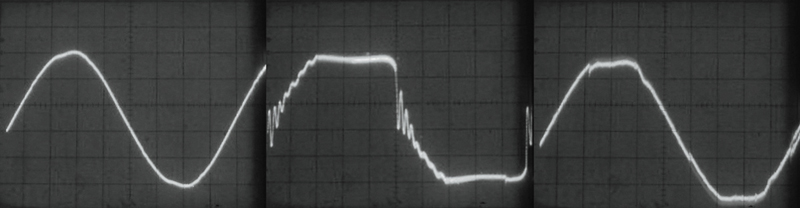
In practice, electronic square wave ballasts turned out to be a mixed blessing. Part of the problem with operating electronic HMI ballasts on portable gas generators in the past has to do with the purity of the power waveform they generate. With an applied voltage waveform distortion of upwards of 19.5%, conventional AVR generators (like the Honda EX5500 or ES6500) do not interact well with the leading power factor (current leads voltage) of the capacitive reactance created by electronic square wave HMI ballasts. The net result is harmonic currents are thrown back into the power stream, which results in a further degradation of the voltage waveform and ultimately to equipment failure or damage.

The oscilloscope shots of the power waveforms below is from an article Guy wrote for his company newsletter on the use of portable generators in motion picture lighting and is typical of what results from the operation of a 1200W HMI with non-power factor corrected ballast on grid power (left), on a conventional AVR generator (Honda EX5500) (middle), and inverter generator (Honda EU6500is)(right.) The adverse effects of the harmonic noise generated by non-PFC electronic ballasts and exhibited here in the middle shot, can take the form of overheating and failing equipment, circuit breaker trips, excessive current on the neutral wire, and instability of the generator’s voltage and frequency. Harmonic noise of this magnitude can also damage HD digital cinema production equipment, create ground loops, and possibly create radio frequency (RF) interference (for more details use this link.)

wwaveform_elec_ballast.jpg


​
As is evident in the oscilloscope shots below of a 1200W magnetic HMI ballasts on grid power (left), on power generated by a conventional AVR generator (middle), and power generated by an inverter generator (right), the lagging power factor caused by the inductive reactance of magnetic ballasts has by comparison only a moderately adverse effect on the power waveform. Outside of causing a voltage spike in the inverter power, magnetic ballasts actually show a positive effect on the already distorted power waveform of the Honda EX5500 conventional generator. For this reason magnetic ballasts work better on conventional generators with frequency governors than do non-PFC electronic square wave HMI ballasts.

wwaveform_mag_ballast.jpg

These oscilloscope shots show that if you don’t have access to the newest PFC electronic ballasts, the older magnetic ballasts are in fact cleaner running on portable gas generators than non-PFC electronic ballasts. And, where inverter generators like the Honda EU6500is do not require crystal governors to run at precisely 60Hz, you can operate magnetic HMI ballasts reliably on them. In addition, the smaller magnetic ballasts (575-2500W) offer the distinct advantage of being less expensive and draw less power (once they have come up to speed) than the commonly available non-PFC electronic equivalents (13.5A versus 19A for a 1.2kw.)

Of course there are downsides to using magnetic ballasts. One down side is that you are restricted to using only the safe frame rates and shutter angles. Another downside to magnetic ballasts is that you can’t load the generator to full capacity because you must leave “head room” for their higher front end striking load. When choosing HMIs to run off portable generators, bear in mind that magnetic ballasts draw more current during the striking phase and then they “settle down” and require less power to maintain the HMI Arc. By contrast, an electronic ballasts “ramps up”. That is, its’ current draw gradually builds until it “tops off.”

For example, even though a 2.5 magnetic ballast draws approximately 26 amps you will not be able to run it reliably on the 30A/120V twist-lock receptacle of a 6500W generator. As mentioned above, magnetic ballasts have a high front end striking load. So, you must leave “head room” on the generator to accomodate the strike. And, even though the twist-lock receptacle is rated for 30 Amps, conventional 6500W generators are only capable of sustaining a peak load of 27.5 Amps per leg for a short period of time. Their continuous load capacity (more than 30 minutes) is 23 Amps per leg. And, if there is any line loss from a long cable run the draw of a 2.5 magnetic ballast will climb to upward of 30 Amps. To make matters worse, as we saw in the oscilloscope shots above, the lagging power factor caused by the inductive reactance of the magnetic ballast kicking harmonic currents back into the power stream causes a spike in the supply voltage that can cause erratic tripping of the breakers on the generator or ballast. (for a more detailed explanation of why that is I, again, suggest you my newsletter article.) In my experience the load of a 2.5kw magnetic ballast is too near the operating threshold of an unmodified 6500W generator for it to operate reliably.

HD_PP_Demo_Transformer-Distro.jpg

PFC 2.5 & 1.2 HMI Pars, PFC 800w Joker HMI, Kino Flo Flat Head 80, 2 ParaBeam 400s, and a ParaBeam 200 powered by a modified Honda EU6500is through a 60A Full Power Transformer/Distro​

The only sure way to power a 120V 2.5kw (or even a 4kw) HMI magnetic ballast on a portable gas generator is from its' 240V circuit through a 240v-to-120v step down transformer like the one Guy’s company, Screenlight & Grip, manufactures for their modified Honda EU6500is. Their 60A Full Power Transformer/Distro will step down the enhanced 7500W output of their modified Honda EU6500is generator to a single 60A 120V circuit that is capable of accommodating the high front end striking load, and even the voltage spikes, of either a 2.5kw or 4kw magnetic ballast at 120V. For details about the benefits of using step down transformers with portable generator, read his article. It is available at www.screenlightandgrip.com/html/emailnewsletter_generators.html.

Eileen Ryan, Gaffer, Boston
 
Back
Top