Welcome to our community

Be a part of something great, join today!

  • Hey all, just changed over the backend after 15 years I figured time to give it a bit of an update, its probably gonna be a bit weird for most of you and i am sure there is a few bugs to work out but it should kinda work the same as before... hopefully :)

Red and the infraRED

There's speculation all over this thread. The IR problem doesn't seem
to be huge problem(IMHO) from what I've seen. Just something that needs to be noted if you're using strong NDs. I'd like to hear more about the Pancro solution and if that works fine.

It's not only outside . Take a bright red subject, an apple, or a red gelled lightsource. Shoot it. See what it does on your monitor or in Redcine. It's magenta.
 
It is a problem... most of us have just never put our finger on what it was. Somewhat fuzzy, loCon, strange color balances... The problem also exhibits itself with little or no ND - just not as obvious - On the plus side, we should be able to shoot women's underpants through their clothes.
 
Mick,
I think that your example has more to do with the limits of the rec709 color space than IR. However a red gelled tungsten light does throw off a LOT of IR.

I suggest everyone read my first post in the thread very carefully. I think we need to be very patient with RED on this issue. It's a VERY hard thing to deal with, and physics is against you on all sides. My original post was not to bash RED into fixing it, it was to make everyone aware of the issue. I have total confidence that Red is working as hard as they can.

For those that think this is only an issue when you use ND, YOUR WRONG. Watch this movie as I pass a 486 filter over the scene, No other filtration was used. http://www.freedomfromgravity.com/work/red/ir/A001_C011_080125_nofilter_24.mov
In a IR rich environment this can effect even clean footage.

All this aside THIS CAMERA IS AMAZING! An issue like this is no deal killer, I've seen some amazing footage shot on the Red, footage that just couldn't have been captured with any other camera you can own.

Go out, shoot great stuff, learn it's limitations, and learn how to predict them so your never caught off guard. Just like Cinematographers have been doing for the last 100 years.

Also: Ariana, I'm personally offended that you think this thread is full of speculation. I've tried very hard to make things as scientific and explained as possible.
 
Mike, thanks for all your research and contributions!

What happens if you have a 486 filter attached to the lens and put an ND in front of that? Any nasty side effects? I'll be using Zeiss ZF primes, so the B+W 486 filters will work great for me. I'm just concerned with the off chance we'll have a sunny day here in the PNW and I'll need my ND's.
 
Also: Ariana, I'm personally offended that you think this thread is full of speculation. I've tried very hard to make things as scientific and explained as possible.

Sorry Mike, I didn't mean to offend you. I was speaking in generalities.

I do think there is speculation about the details. ie. do the pancros work, what's the IR sensitivity of the sensor, what filter would block all the IR, a 486? I would guess that none of us are experts on IR or sensors and we are speculating about the causes, effects and solutions with empirical results and not the science behind it.

One last speculation from watching people here on reduser...
Those whose camera numbers are coming up latch onto one thing and try to stir up a frenzy so it gets fixed before their camera arrives. Once they get the camera, they're happy and find solutions to the minor problems. Big dramas turn into minor problems with workable solutions.

Then there's a whole other group of people that demand a certain problem get fixed but are the least likely to be buying a camera. I don't understand that one.
 
Mike,
BEST. POST. EVER.
I feel like a complete moron for not having solved this one. I ordered up custom 4x5 and 6x6 NDs from Tiffen (1.5 and 1.8) to augment my normal sets (.3-1.2) Somehow my sunlit exteriors were a little "off". Could not figure out this one.
And silly me, I assumed that the internal IR filter was 100% effective. Never would have thought to test this.
I wish that the boys at Red had a tip sheet somewhere listing some simple do's and don'ts specific to this camera; acceptable panning speeds and the IR sensitivity seem to be issues that we've all had to "discover" and work out ourselves. C'mon, Red Team, share! we're all big boys and girls. We still love the camera. Is there anything else we need to know? ;)
Mike, thanks again. I have Stan Wallace at the Filter Gallery on the case. I'll keep you posted.
Cheers,
Harry
 
Yes Mike, the red gels will pass most infrared, it's the green end that will help block the effect. Too bad that the ND infra red pass effect wasn't a little more even/constant, because what I see of your samples, a light green filtration might get you back in the ball park. Not so much as a CC point of view; more of an IR blocking one. It might be worth seeing if the light green end of the rosco gels ("minus red") have any effect on the IR transmission without skewing your color out of the ball park. Still, even with the gels optical equivalent, this might be a lame patch at best.
 
Yep, I got hosed by this with my very first exterior footage shot through a 1.8ND/F4/~8200FC. I couldn't figure out why my image was so washed out. Then I switched to a .3ND and shut the iris down to compensate and I got a perfect exposure of my Macbeth chart. I'll add snapshots in a couple hours.

M
 
Hmm...why didn't Red catch this in internal testing prior to releasing any cameras? Shouldn't this have popped up in the shooting of 'Crossing the Line', the two Steven Soderbergh movies and even simply Jarred and Jim's internal tests?
 
Shawn,

Well since I wasn't at any of those shoots I can't say if they did or didn't have any of these problems. If you don't know what your looking for it can be a very hard thing to diagnose.

Point in case: I just got off the phone with a rental tech at the place we did the tests, she had just gone to a Phantom seminar and reminded me the Phantom doesn't have any IR filtering at all. It totally clicked in my head why I had some similar issues with the Phantom a few years ago. I have shot with the Phantom a bunch, but it never even occurred to me they wouldn't be filtering IR. ( i hear it's coming)

again: If you don't know what to expect it's very hard to diagnose.
I just happen to have gone through this with other camera systems, and was able to spot it in my footage.

I'm sure Red did a fine job with their internal filtration. It's just that in some circumstances it's not enough. Just like a T3 zoom isn't always fast enough, or why my Volvo will never beat an Indy car on the track. We are working against physics here and it's just tough. You need to know the limitations of your tools and make workarounds, or solutions.
 
I wouldn't blame just the Red team here; the camera's been out and used quite a bit without anyone bringing this up until very recently. As far as I know, I'm the only person who's published a shot showing the actual spectral response of red, even if it was a rather crude setup, and not sensitive to very small amounts of IR which can cause the problems we've been talking about.
http://www.bealecorner.org/red/test-080108/page2.html#Test_6
back in January... it got some limited interest here on reduser- I think most people didn't understand it. (not sure I do completely either).

If you shoot with daylight color temp. lights indoors, I think the effect is pretty minimal. Even if you shoot tungsten light (lots of IR) the effect depends on exactly what materials you're shooting. I think in many cases some color-correction will make things look fine, even if its not exactly the way it would look without IR contamination. If you shoot through heavy ND, it depends on which ND filters you use and if your shot looks soft, maybe you would blame the ND filter or something else rather than excess IR at the sensor.

By the way, Rosco makes a hot mirror in large and custom sizes, but I think it's intended for light fixtures and not cameras, so the optical quality likely isn't good enough that use.

http://www.rosco.com/us/filters/protect.asp

IR/UV FILTER (HOT MIRROR)
IR/UV filter is a clear glass filter designed to pass visible light while reflecting the infrared and near UV energy. Perfect for museum and architectural applications. Available in 2" x 2", 1.95" round, 5.25" round, 6.3" round, 8.25" round and custom sizes.
 
Jbeale, thanks for those tests.

I have a Rosco 5.25" round hotmirror for my SourceFour. I tested it and it didn't do anything good, In fact it left an odd color shift. However since I didn't purchase the filter new it's possible I got an inferior "heatshield" one.

I also agree that before you blame IR for soft shots you need to take a look at every other possibility. However if you look at the last video in my first post you caa see that by the time you cut most of the Visible light the focus shift can be quite severe.

These guys have Hot Mirrors up to the 4x4 size available now.
http://www.betterlight.com/accesoriesPrice.html
 
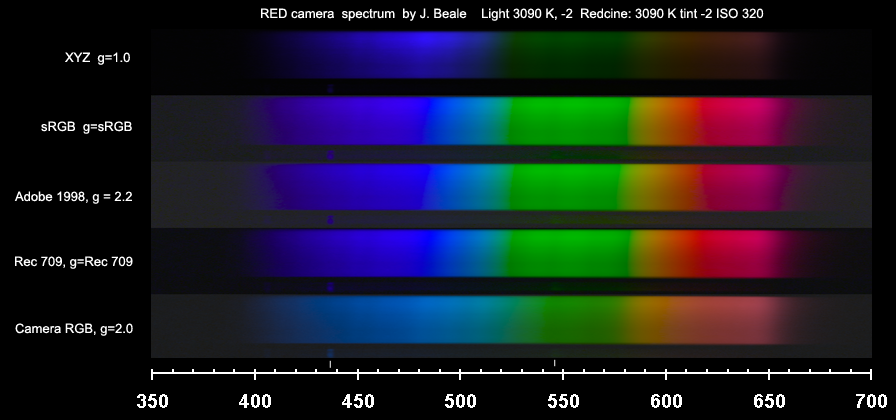
On second thought, are we really talking about IR (infrared) or are we talking about actual deep, but visible red light, for example 650 nm. ?

Because according to my test below, the "Red" camera sees 625-650 nm light as magenta, not red, regardless of the color space choice you make in RedCine. That's not an IR problem, it's an issue with how the R,G,B bayer-pattern filters on the sensor absorb (or don't absorb) visible light; or at least, that's my understanding.

Red-Spectra-composite.png
 
That's not an IR problem, it's an issue with how the R,G,B bayer-pattern filters on the sensor absorb (or don't absorb) visible light; or at least, that's my understanding.

Or the red color shift could be how Red is doing sensor -> color space mapping. If they are using linear transformations (say matrices), then I tend to think that not all colors are mapped correctly.
 
True, the camera doesn't give you direct access to the individual R,G,B channels so I do not know what the true response curves are. I'm just guessing about them, based on the behavior of the outputs I am able to see from Redcine. Some years ago I used a spectroscope on some consumer videocameras. I did not see the red->purple shift from 600 nm -> 650 nm, they just show increasingly dark red. The exception was a Digital-8 which I modified to show color even with the IR filter out. That did start to look purple, and then blue but not until about 750 nm.

Other random details- you may note that the Green-Blue transition point is different between the Sony TRV900 and Canon GL1 cameras. That's a function of the dichroic prisms they used and it's one reason the colors from the two could never be exactly matched for all colors at once, regardless of what color matrix you choose, because the G and B channels are integrating over slightly different parts of the spectrum.
 
It is indeed a IR issue, as it clearly is seeing beyond the visual spectrum and recording information through a 87 filter.

The colorimetry of the Red is mapping it to magenta.
 
However if you look at the last video in my first post you caa see that by the time you cut most of the Visible light the focus shift can be quite severe.

Is this focus shift something that can be seen through a good viewfinder but would render a tape measure reading inaccurate? Or is it literally, you can't see it, you can't measure it - you're screwed.

If we had an IR blocking filter for the lenses is this something that would be helpful to leave on at all times or is there a downside to that?
 
That's a function of the dichroic prisms they used and it's one reason the colors from the two could never be exactly matched for all colors at once, regardless of what color matrix you choose, because the G and B channels are integrating over slightly different parts of the spectrum.

Thanks for the details and the images. I must say you are using very methodological approaches.

If different cameras use different areas in the spectrum for integration, are they not adjusting the co-efficients of their transformation accordingly to get the right output?
 
It is indeed a IR issue, as it clearly is seeing beyond the visual spectrum and recording information through a 87 filter.
The colorimetry of the Red is mapping it to magenta.

Yes, your experiments look like they are showing genuine IR sensitivity. The best way to confirm it is to go into a lab with calibrated instruments, my optics stuff is mostly home-built. Anyway, I wonder if there are two separate things going on here: 1) some IR sensitivity and 2) non-standard colorimetry, for some part of the visible red spectrum going to magenta, where it should stay red (eg. my images above).
 
Thanks for the details and the images. I must say you are using very methodological approaches.

If different cameras use different areas in the spectrum for integration, are they not adjusting the co-efficients of their transformation accordingly to get the right output?

You can do that for "average" spectra, and it is done to some degree (although Canon and Sony cameras seem to have different looks by default). But if you think about every possible spectral function, it is mathematically impossible to exactly match every color on two different cameras if your R,G,B spectral ranges don't match. You can only match a subset of colors with any given color mapping. At least that's what the math predicts; from a practical point of view, that has also been my experience with cross-cutting canon & sony cameras. You can get kind of close, but you can never really match up all the colors.
 
Back
Top