Welcome to our community

Be a part of something great, join today!

  • Hey all, just changed over the backend after 15 years I figured time to give it a bit of an update, its probably gonna be a bit weird for most of you and i am sure there is a few bugs to work out but it should kinda work the same as before... hopefully :)

Prime, Zoom Lenses, Digital Sensor & Dust!

sandesh

Banned
Joined
Dec 29, 2006
Messages
16
Reaction score
0
Points
0
Before the digital sensors, the discussion between prime lens and Zoom lens was limited to Sharpness, F-stop and weight. But a new factor called 'Dust' comes into considration with the digital sensors. As everytime you change the prime lens there is a definite probability that you are dust on the sensor.

I have all the prime lens: Nikkor 28,35,50,85,105,300; During my recent production of short film with 35mm adapter. We changes the lenses manytime. Sometime according to plan or somtimes just to try. Also I have noticed that you cannot really control the environment during the production frenzy.

I have read some articles for D-SLR that you should not try to clean the sensor at home send it to the company.

Issues:
1. How to avoid the sensor getting dirty during change of lens.
2. If the Zooms are used, will they be as good as primes.
3. How do we clean the sensor.
4. will there be some mechanisim on the sensor that will allow it to clean it self (Like some D-SLR).

With the Red I am seriously thinking about buyng Zooms. Can I get some feedback as to how you guys are planning to deal with it.

What are you guys thinking / planning... what is the Red planning?
 
I've used a lot of DSLRs, but the two that i have extensive use with, the D2x and the Fuji S3, have very different dust problems.

The Fuji always has dust on the sensor. I change lenses a lot, and i'm pretty careful about doing it quickly and cleanly, but ive come to expect that the fuji will PROBABLY have a few small pieces of dust in most pics. I just clean it in photoshop.

The D2x on the other hand almost never has this problem, AND it has a higher pixel density.

My understanding is this is because the fuji CCD keeps a static charge across it while its on, ATTRACTING dust to it, while the nikon CMOS has a much lower charge across it.

RED is built with a CMOS, which might be a big help. Donno, just a theory.

As for sending off your camera to be cleaned, digital cameras need to be cleaned too often for that. I use these, and they work great:

http://www.bhphotovideo.com/bnh/con...s&Q=&sku=242758&is=REG&addedTroughType=search
 
Nikon is CCD also.
 
Will there be some sort of glass to protect the sensor or not?
 
Sure - a IR / OLPF. I guess you mean another glass though - I don't think so - not enough room.

Graeme
 
Nikon is CCD also.

Actually, the D2X is one of the only Nikon bodies with a CMOS sensor (the D2H also has a CMOS-like sensor). Interestingly, Nikon chose the 12.48 million pixel sensor made by Sony instead of one of their own JFET-LBCAST sensors.

I change lenses frequently on my Canon body, and haven't had any trouble at all with sensor dust. The key is changing quickly and in a low-dust, low-wind environment. That's easy in the studio, much harder in the field.

The RED will be lacking the protective mirror and mechanical shutter an SLR has. If there's no other type of protective glass, what will be the best way to clean the Mysterium when it does start to collect a little dust?
 
Thanks for the Nikon info. I didn't know that those models used a CMOS. Interesting!

I change lenses on my Canon 20D a fair bit, and don't have much bother in the way of dust. I maybe have to clean the sensor every few months or so or even less frequently.

IR is infra-red filter. OLPF is optical low pass filter, or anti-alias filter.

For sensor cleaning - not sure precisely what we'll recommend, but I'd guess that a nice sensor brush like you use with a DLSR should work just fine.

Graeme
 
Graeme, Any talk of one day including a self cleaning sensor like the ones found in the new Canon 400D, Nikon 80D and the sony? I think it just sends an ultra sonic wave across the sensor and catches any dust that might fall.
 
I don't know, however, I did read one review of the Canon's and they said it didn't work. Given that the Canon has a pixel dirt map, to electronically remove dirt, I suspect that they don't think the ultrasonics work either :-) Or is it a "belt & braces" approach?

Graeme
 
Well, that's what the review said. Perhaps it works in other camera implementations better? I think we should develop miniature windscreen wipers that clean the sensor - that'd be fun :-)

Graeme
 
Based on my experience, DSLR
1. DSLR are mostly used by owners themselves
2. Mostly the lens change is not so frequent
3. Also they can choose not to change lens in uncontrolled situation.
4. Many of them have moved to zooms for DSLR.

RED is exactly opposite, used by DPs, rental, Lens maybe changed for each shot, even if shooting outside..

Graeme, the RED camera body/design cannot be changed. I guess... Was dust one of the considerations for RED designs... Like a moving ND filter. Is it too late?


Here are some links for sensor cleaning links and products...
http://www.delkin.com/products/sensorscope/index.html
http://www.luminous-landscape.com/essays/sensor-cleaning.shtml
http://www.bythom.com/cleaning.htm
 
I generally carry 3 lenses with me, leaving specialist and large lenses at home. I swap between the 3 out in the field, or whereever I'm shooting, and certainly not what I'd say a contolled condition...

Graeme
 
I do the same with my D50 ( its $0.6k vs ~$20k)...
On second thought... Maybe I am thinking too much... :-)
What the heck... lets make some RED movies...

Sandesh
 
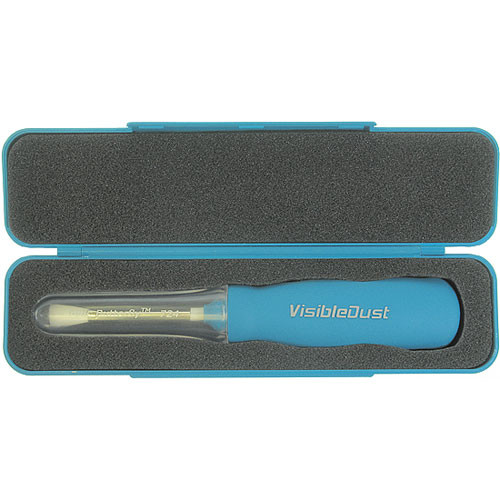
I use this and it works like a charm, no chemicals no mess and no dust. But the D2x is a dust champ. I barely ever need to use it.
432542.jpg

http://www.bhphotovideo.com/bnh/con...s&Q=&sku=432542&is=REG&addedTroughType=search
 
Wouldn't the brush cause microscopic scratches in the glass? Thereby causing the picture quality to become diffuse over time?
 
I guess RED will suggest some method of cleaning the $20K camera...
OR maybe change design to add a filter ...which you swing away while shooting...
OR even better..... A new ZOOM 18mm -200mm f2.8
 
Wouldn't the brush cause microscopic scratches in the glass? Thereby causing the picture quality to become diffuse over time?

These are vrey gentle synthetic fibers designed just for cleaning sensors, so no, I don't think that would happen.
 
Back
Top