Bruce Allen
Well-known member
But when we shoot raw we aren't really "post wb'ing" are we? If we shoot a gray card under a tungsten light that is rated at 3200K and it turns out to be actually 2800K, by aligning the waveforms of all three sensors in RCX with the eyedropper on the card, we are not "post white balancing" as much as we are discovering the true color temp of the light. After all, with raw, WB is only metadata.
Now, if we do the same procedure but shoot the grey card under an LED rated at 5000K, the eyedropper will align the three (RGB) waveforms again - to give a true WB temp - but it might also change the tint value based on other colors present. So, I am thinking the tint adjustment will somewhat (but not perfectly) compensate for the color spike. Again - not the same as having a light with an even, full spectrum output but how far off would it be?
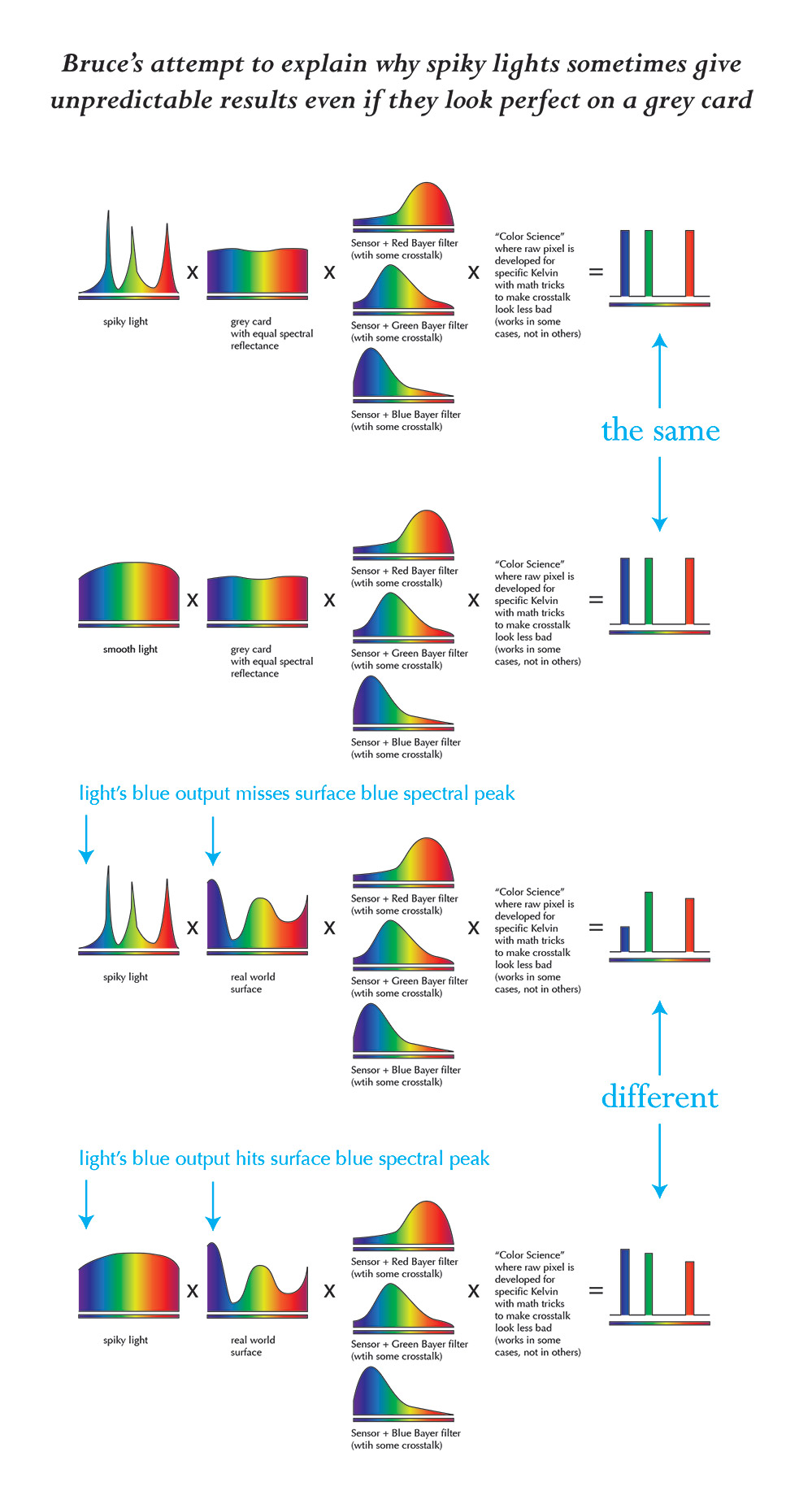
There are 4 variables at work here:
1. the spectral emission of the light
2. the spectral reflectivity and absorption of what you're filming
3. the spectral response of the combination of the lens, the camera sensor and the Bayer filter (how pure it is, what spectrum bands it lets through, crosstalk, etc)
4. the post color processing
So given the same light, how "far off" the color is would vary depending on the subject matter, the camera and the color post-processing. Too many variables to give you an exact answer, sorry!
For example: human skin has a pretty complex spectral response. The surface has a certain spectral graph, and blood has another! (technically oxygenated and de-oxygenated blood differ too) We are super-evolved to spot these changes because you can judge something like a person's health from it. If you had a camera that missed subtle tones in human skin anyway, maybe you wouldn't notice the difference. If you used another camera and processing chain, maybe through pure bad luck the spectral responses would line up in a really upsetting way. Then there's makeup, etc.
On the other hand, a ColorChecker / Macbeth chart has pretty nice-looking big sine-waves for the color. So it will probably handle weird lighting better.
http://www.keyesphoto.com/KdktechMacbethGraph.html
Interestingly, the ColorChecker / Macbeth chart's skin patch is rather different to real skin, but a pretty good attempt:
http://www.babelcolor.com/main_level/CC_light-skin_spectral_type.gif
You can see some spectral reflectivity values for real skin types here:
http://www.image-engineering.de/index.php?option=com_content&view=article&id=544&Itemid=145
They also point out how completely different the green of a palm tree is to either of the greens on the ColorChecker!
Anyway, this is why those guys doing big feature films do tests using subject matter and equipment and workflow closest to what they need. Too many variables to figure out a generalized answer! Except that spiky is bad. And human art can overcome most issues so also don't worry too much.
Bruce Allen
www.boacinema.com