Welcome to our community

Be a part of something great, join today!

  • Hey all, just changed over the backend after 15 years I figured time to give it a bit of an update, its probably gonna be a bit weird for most of you and i am sure there is a few bugs to work out but it should kinda work the same as before... hopefully :)

Solar Eclipse

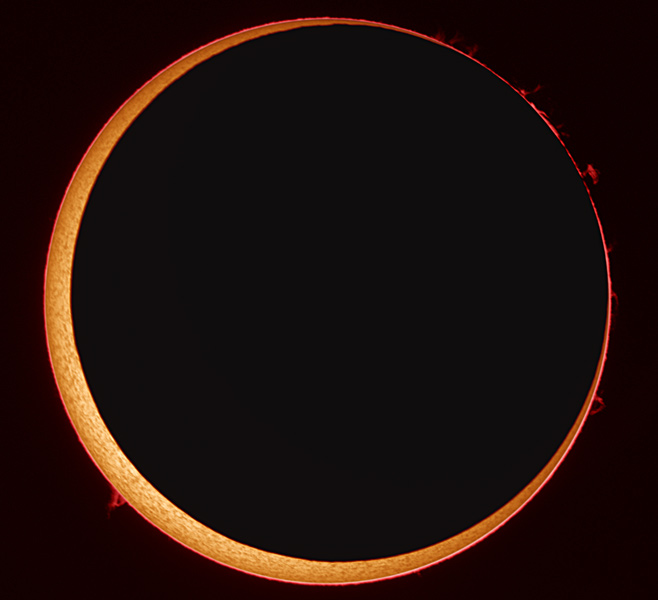
I've managed to get the unobstructed peak of the Solar eclipse:

Eclipse_2012_05_21_peak.jpg


But the rest of the event was pretty cloudy...:

Eclipse_2012_05_21_partial_spots.jpg


But in many ways the clouds added to the drama...

Shot on Scarlet in 5K HDRx @ 6 FPS through Canon 800mm f/5.6L and Baader Solar Filter...
The motion footage is a part of a feature I am working on, so unfortunately no QT's (for now)...

Peter

PS: And yes, those are sunspots, I clean my sensor on regular basis... ;o)

Eclipse_2012_05_21_Sun_spots.jpg


Very cool shots man. Always like to see sun spots captured from the ground. But this was kind of the reason why I decided on not shooting with a solar filter. I wanted to see the flames when the sun and the moon came together.
 
Very cool shots man. Always like to see sun spots captured from the ground. But this was kind of the reason why I decided on not shooting with a solar filter. I wanted to see the flames when the sun and the moon came together.

I've always wondered, since those flames are really just a optical flaring, if they could be recreated through some grading/filtering (not adding with CG). I will give it a shot in DaVinci...
What I would like to see are the actual flames - the coronal ejections - but for that we need full eclipse, not annual... Will try to get that on the next one - but will need to travel out of Japan, there is not another eclipse in our lifetime here...

Cheers

Peter
 
You guys who see clouds more than two times a year-- I envy. This is yesterday's transit with a surprise jet transit. Brother-in-law who is a physics professor, calculated the jet, photographed from Vegas was likely 50-60 miles away-- well into California.

70-200mm Canon with a 2X III tele-extender and a Baader continuum solar filter.
 

Attachments

  • A002_C007_0605TU_S000.0000207-poster.jpg
    A002_C007_0605TU_S000.0000207-poster.jpg
    40.8 KB · Views: 0
I've always wondered, since those flames are really just a optical flaring, if they could be recreated through some grading/filtering (not adding with CG). I will give it a shot in DaVinci...
What I would like to see are the actual flames - the coronal ejections - but for that we need full eclipse, not annual... Will try to get that on the next one - but will need to travel out of Japan, there is not another eclipse in our lifetime here...

Cheers

Peter

I'm pretty sure the flames you see in the clip I posted are the same flames you see during a total eclipse. Same idea applies to what your seeing. They aren't optical effects any more so than flames are optical effects in a fire.
 
What you see in Andrew's film is most certainly NOT 'optical flaring.' What Andrew captured is the Sun's corona according to my 3 min. spent at Google.
 
You guys who see clouds more than two times a year-- I envy. This is yesterday's transit with a surprise jet transit. Brother-in-law who is a physics professor, calculated the jet, photographed from Vegas was likely 50-60 miles away-- well into California.

70-200mm Canon with a 2X III tele-extender and a Baader continuum solar filter.

The chances of that! way cool.


2012-06-05 by tehbendean, on Flickr
 
You can clean sunspots? THey don't ruin your camera?

I've managed to get the unobstructed peak of the Solar eclipse:

Eclipse_2012_05_21_peak.jpg


But the rest of the event was pretty cloudy...:

Eclipse_2012_05_21_partial_spots.jpg


But in many ways the clouds added to the drama...

Shot on Scarlet in 5K HDRx @ 6 FPS through Canon 800mm f/5.6L and Baader Solar Filter...
The motion footage is a part of a feature I am working on, so unfortunately no QT's (for now)...

Peter

PS: And yes, those are sunspots, I clean my sensor on regular basis... ;o)

Eclipse_2012_05_21_Sun_spots.jpg
 
You can clean sunspots? THey don't ruin your camera?

Nope, the implication was that the "dirty spots" on the sun surface are the actual sunspots (http://en.wikipedia.org/wiki/Sunspot) - not a dirt on my camera sensor, since I keep my sensor clean and check it regularly. Once your sensor is damaged by sun, laser or any other strong source of light, there is nothing you can do...
 
I'm pretty sure the flames you see in the clip I posted are the same flames you see during a total eclipse. Same idea applies to what your seeing. They aren't optical effects any more so than flames are optical effects in a fire.

What you see in Andrew's film is most certainly NOT 'optical flaring.' What Andrew captured is the Sun's corona according to my 3 min. spent at Google.

Andrew, to be able to see the coronal ejections - you need a total eclipse. During the annular eclipse even if the ring is really tiny - the light from it overpowers the coronal ejections and you are not able to see them without specialist filters / sensors (different spectrum then visible light). Even with the HDRx we are far cry away from the dynamic range needed to capture these... And in our case the ring was rather thick, which makes it that much more complex of a situation...

This is what the coronal ejections look like:

annular_seip.jpg


x2flare4.gif


Any, even faint hazy cloud will provide optical distraction to the path of the sun rays - which appears as "flames". Once combined with the actual lens flare - this results in rather spectacular images - which is what you have captured Andrew. My intention is in no way to take away from the beauty of your shots. I am simply wondering whether such effect could be achieved in post without CGI, purely by using filtering on a image, that's all...

Peter
 
Andrew, to be able to see the coronal ejections - you need a total eclipse. During the annular eclipse even if the ring is really tiny - the light from it overpowers the coronal ejections and you are not able to see them without specialist filters / sensors (different spectrum then visible light). Even with the HDRx we are far cry away from the dynamic range needed to capture these... And in our case the ring was rather thick, which makes it that much more complex of a situation...

This is what the coronal ejections look like:

annular_seip.jpg


x2flare4.gif


Any, even faint hazy cloud will provide optical distraction to the path of the sun rays - which appears as "flames". Once combined with the actual lens flare - this results in rather spectacular images - which is what you have captured Andrew. My intention is in no way to take away from the beauty of your shots. I am simply wondering whether such effect could be achieved in post without CGI, purely by using filtering on a image, that's all...

Peter

In the video I posted those are most certainly flames from the sun or coronal ejections. I would suggest you watch the video again and at full screen to see that these are not optical flares in any way. In face what you posted further proves that what is seen in the video is in fact the surface of the sun and the flames rising off of it.
 
In frickin sain supper cool Andrew. Did you have any tracking device to buy you more time tracking with the sun??
That was EPIC

This is what is so cool about the Epic. I shot in 5K and cropped the image to 2K for the first and last shot. The one in the middle is around 3K.
 
Back
Top