Welcome to our community

Be a part of something great, join today!

  • Hey all, just changed over the backend after 15 years I figured time to give it a bit of an update, its probably gonna be a bit weird for most of you and i am sure there is a few bugs to work out but it should kinda work the same as before... hopefully :)

Epic vs Alexa Producer Arguement

David, your take on this is a bit misleading though. The reflective or transmission values of display media does not directly correlate to its ability to display the full tonal range of values from a camera. Ansel Adams did not have these "issues" at all: they were very different issues. Taking a spot meter reading off of a print says little about the paper's ability to hold/represent the values contained within the negative that was printed. I have printed negs that have held around 17 stops of separation and printed them on papers that show about one stop reflective value between blacks and whites. Just like the neg that holds 17 stops of scene values, these values are not represented with 17 stops of transmission values - obviously.
A glossy paper might yield a reflective value greater than a matte paper, but the matte paper might at the same time better represent the media's values of the original scene.

I don't disagree with your point, we are making the same point. Representing wide dynamic range values in a narrow dynamic range space. But you do not get the full separation of those values as they existed in the original view. You are shifting the actual scene values to preserve relevant visual detail in the more limited space. Paper will hold around 5 stops, a standard printed video greyscale chart shows this, 1/2 stop values over a 5 stop range.
 
Generally you want the original to have a wider dynamic range than the display method or else it is hard to color-correct the image -- it becomes like shooting slide film, which had the same gamma as a projectable print made from a negative. In the days of film, the other reason was that duplication of film elements generally added contrast so you wanted a lower-contrast original.

But today, for aesthetic reasons, we play with the dynamic range, compressing wide scenes into narrower ranges, sometimes flattening out narrower scenes, etc. all to create a look and to match shots to each other, so we need a wide range to work from. Also, if we want to mimic film negative, which has a S-shaped log curve response to light, flatter in the bright highlights and deep shadows with a long roll-off into white or black, we need a wide dynamic range to work from.

If display devices showed 15-stops of DR we'd probably want cameras that captured 19-stops of DR. Since a lot of distribution and display methods show about 10-stops of DR, we want cameras that capture at least 14-stops of DR, something like that. You get the logic. It's like oversampling, but for DR instead of resolution.
 
Any standards compliant video codec of whatever flavor you care to choose is limited to driving a defined signal range between the darkest visible black detail and peak white, shown on a waveform monitor as 0-100 IRE. You can calculate it like this. 20*log 100 = 40dB total DR between 0-100 IRE. Divide by 6dB/stop and you get about 6.7 stops max linear DR, period. You can divide that by however great a bit depth for a digital format you care too but that just gives finer gradations within the same maximum range. There are no consumer display technologies on the market today that will give you more than that and most actually deliver less. Don't believe me? Throw a SMPTE color bar image up on a properly calibrated TV monitor and read the range between the darkest visible pluge bar and the peak white square with a spot meter. Try spot meter reading screen values of a projected image in a theater and you will have a hard time finding one that can show 5 stops DR much less 7.
We mostly find this a pretty satisfactory and comfortable range for a viewing experience. The question becomes how and when we compress the much broader DR and gamut modern sensors are capable of delivering into the limits of our viewing formats. Nothing new about this, Ansel Adams had the same issues with getting the most out of his negatives when making prints. It is about preserving the most relevant ranges of details and values to meet the creative intent of the image.
The difference between recording Bayer raw sensor data and encoded video is the difference between capturing the full gamut and dynamic range the sensor is capable of or capturing a compressed representation of that range according to some engineer's or manufacturer's idea of what that representation should look like.
Raw capture for motion is still in its infancy as a technology. A serious still photographer might spend hours tweaking the raw data of one image to arrive at what he considers the best representation of his artistic intent. Doesn't seem like there is much time devoted to that part of the raw workflow yet for most motion work. I know there are colorists and effects people who are great artists in their own right and you do see some of this happening at the high end with the best work, but the idea hasn't penetrated very far into more mundane video centric production communities.

Pixel peeper numero uno. You are.
As far as i'm concerned Redfilmlog debayered only looses a bit of color and gamma fidelity once transferred to an 4444 10 to 12 bit codec. Once that codec is dropped into a 32bit linear light space colors light and gamma are enhanced, Greyscale gradations are smoothed out, de-banded, and fresh new colors can be added. This is the practice today. No single audience member save colorist and cinematographers can tell the difference. Who really wants to sell to those guys. For the most part, we all thrive on the color and resolution gamut limitations of display and exhibition mediums.
So back on to the sheer clarity, fidelity and sharpness of a Red 4k resolution camera produced image does not suffer any noticeable loss once transferred to 2k by a Red-Rocket. And for some reason un-beknoweth to me its even sharper without a rocket. We know Red can build that module in their sleep. Every NAB we expect them to announce a Pro-res-Module....... fill in the blanks__________________________________________________________________. duh.

Its very easy to toss an R3D file on a timeline and start editing, but we don't live in an edit only world. We know they can do it they gave us hi res quicktime proxies which many on here we happy to use as finished product. And that was in 2007. 3 quicktime proxies without any modules alongside R3d's. I don't see why we can't get Prores 4444 12 bit proxies.
 
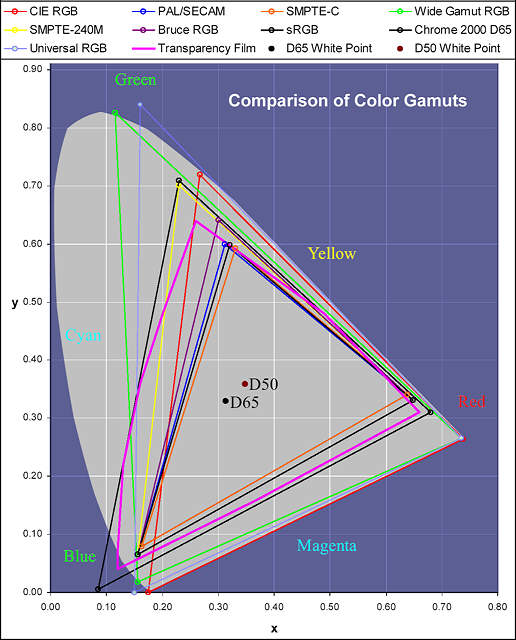
Here is a CIE chart showing the color gamuts of common media formats.
Sachs_gamut_chart_2_640.jpg


Here is the CIE XYZ color space gamut chart.
325px-CIE1931_rgxy.png


Now I can't speak for Red, but Adobe DNG raw cameras capture in CIE XYZ color space. The actual gamut captured is only limited by the performance of the sensor itself.

So if you are trying to convince a producer to go with raw capture and workflow over video capture and workflow, raw has two major advantages: Full linear capture of the sensor dynamic range and full capture of the sensor color gamut unconstrained by whatever finishing format the footage will wind up in.

As a visual artist you have more creative room to develop unique looks and textures starting from a linear raw RGB workspace. The various log curves, whether Red's, Sony's, or Arri's provide useful shortcut, but they also limit your creative range

I was blown away by the range of different textures and looks in the still frames Gunliek posted in the 24 hours with Epic thread. Any of those could be used as a visual style for a movie or TV production, Few of them would be possible starting with an encoded video file of any kind.
 
Thanks to everyone for the many suggestions to my situation. After meeting with the producer and showing him the Epic and its features, I'm sad to report back that he's decided to stay with the Alexa for this package of spots. He really loved the camera, his only reservation was the unknown (for him) and added steps necessary to work with the R3D files in his Avid (and beyond). I guess his comfort level with the Arri workflow was to much of an obstacle to overcome.

It sure would be nice to have a module which could record RAW, and DNX/Pro Res simultaneously. That would make this whole discussion unnecessary in the future.
 
Here is a CIE chart showing the color gamuts of common media formats.
Sachs_gamut_chart_2_640.jpg


Here is the CIE XYZ color space gamut chart.
325px-CIE1931_rgxy.png


Now I can't speak for Red, but Adobe DNG raw cameras capture in CIE XYZ color space. The actual gamut captured is only limited by the performance of the sensor itself.

So if you are trying to convince a producer to go with raw capture and workflow over video capture and workflow, raw has two major advantages: Full linear capture of the sensor dynamic range and full capture of the sensor color gamut unconstrained by whatever finishing format the footage will wind up in.

As a visual artist you have more creative room to develop unique looks and textures starting from a linear raw RGB workspace. The various log curves, whether Red's, Sony's, or Arri's provide useful shortcut, but they also limit your creative range

I was blown away by the range of different textures and looks in the still frames Gunliek posted in the 24 hours with Epic thread. Any of those could be used as a visual style for a movie or TV production, Few of them would be possible starting with an encoded video file of any kind.

Thanks for the charts and explanation it sort of makes sense to me. However in the real production world we experiment during pre-production with raw files before we actually go shoot. We create looks the creative team agrees on in redcine, then send the metadata to the camera. This way throughout production we have a consistency in our overall looks. Once we are in post we just transcode using those metadata settings straight to DPX or Prores. AS you can see this is where the module fits in the pipeline favorably, will kill two birds with one stone.
We can produce a 1k, 2k, and 4k program simultaneously for immediate and future uses. 1 out of every 1000 redusers will see their film in 4k this year, but in a few years we could all be able to see our productions in 4k because we will have the edl's, Aces, cdls, aaf's, metadata, footage etc.
Now you see how important a module is for eliminating the debayer trans-code step.
We already know all the limitations steps involved with working with prores 4444 12 bit, tiffs and DPX's. Debayering and trans-coding with Redcine-X is a very tedious and potentially disastrous guessing game. Its far safer to shoot tests, create looks for camera and shoot freely according to the meta parameters you've set for your show. Since you are shooting raw simultaneously you can always go back to your archived r3d's and re-work them in RCX. This is the same formula the Alexa and f65 work on. Even the silly announced C500000 works with this principle.

Producers are demanding this from us, so we in-turn are demanding it from Red. Producers would rather buy Alexas at 3 times the price of Epic-x's just justified as a one time expense that saves time.

We fully understand Red's strong long standing position and idealist philosophy on this matter.
True!!!! we want 6k, we want 15 to 18 stops DR, we want lightweight form factor ergonomics, we want to be able to communicate with our camera manufacturer for excellent camera service, most importantly like all thing Red, we want Red to reserve the right to change their philosophy and give us what we've been begging for since 07 a prores module..........

I think we need to start a Pro-res petition thread.
 
Generally you want the original to have a wider dynamic range than the display method or else it is hard to color-correct the image -- it becomes like shooting slide film, which had the same gamma as a projectable print made from a negative. In the days of film, the other reason was that duplication of film elements generally added contrast so you wanted a lower-contrast original.

But today, for aesthetic reasons, we play with the dynamic range, compressing wide scenes into narrower ranges, sometimes flattening out narrower scenes, etc. all to create a look and to match shots to each other, so we need a wide range to work from. Also, if we want to mimic film negative, which has a S-shaped log curve response to light, flatter in the bright highlights and deep shadows with a long roll-off into white or black, we need a wide dynamic range to work from.

If display devices showed 15-stops of DR we'd probably want cameras that captured 19-stops of DR. Since a lot of distribution and display methods show about 10-stops of DR, we want cameras that capture at least 14-stops of DR, something like that. You get the logic. It's like oversampling, but for DR instead of resolution.

Super explanation as usual, that clarifies notions even for those of us who already more or less understand this. You would make an amazing University professor. If ever you become one on the side, count me in as back-to-school. :-)
 
Pixel peeper numero uno. You are.
As far as i'm concerned Redfilmlog debayered only looses a bit of color and gamma fidelity once transferred to an 4444 10 to 12 bit codec. Once that codec is dropped into a 32bit linear light space colors light and gamma are enhanced, Greyscale gradations are smoothed out, de-banded, and fresh new colors can be added. This is the practice today. No single audience member save colorist and cinematographers can tell the difference. Who really wants to sell to those guys. For the most part, we all thrive on the color and resolution gamut limitations of display and exhibition mediums.
So back on to the sheer clarity, fidelity and sharpness of a Red 4k resolution camera produced image does not suffer any noticeable loss once transferred to 2k by a Red-Rocket. And for some reason un-beknoweth to me its even sharper without a rocket. We know Red can build that module in their sleep. Every NAB we expect them to announce a Pro-res-Module....... fill in the blanks__________________________________________________________________. duh.

Its very easy to toss an R3D file on a timeline and start editing, but we don't live in an edit only world. We know they can do it they gave us hi res quicktime proxies which many on here we happy to use as finished product. And that was in 2007. 3 quicktime proxies without any modules alongside R3d's. I don't see why we can't get Prores 4444 12 bit proxies.

Colors are not added. There is no know color upscaling device that actually adds information. Also, in some scenes, the difference will be very, very obvious.
 
Producers are demanding this from us, so we in-turn are demanding it from Red. Producers would rather buy Alexas at 3 times the price of Epic-x's just justified as a one time expense that saves time.

We fully understand Red's strong long standing position and idealist philosophy on this matter.
True!!!! we want 6k, we want 15 to 18 stops DR, we want lightweight form factor ergonomics, we want to be able to communicate with our camera manufacturer for excellent camera service, most importantly like all thing Red, we want Red to reserve the right to change their philosophy and give us what we've been begging for since 07 a prores module..........

I think we need to start a Pro-res petition thread.

True, true, would be really nice if RED would make this for us, i know they see the future different, but i'm working with a lot of people NOW, who don't really care for the future and make a choice now, and that is Alexa most of the time just because of the ease of use in post. The only thing RED has to do to challenge the Alexa is just make this module...That's it :)
 
If display devices showed 15-stops of DR we'd probably want cameras that captured 19-stops of DR. Since a lot of distribution and display methods show about 10-stops of DR, we want cameras that capture at least 14-stops of DR, something like that. You get the logic. It's like oversampling, but for DR instead of resolution.

That's true up to a point. At some point though a scene just doesn't have any more dynamic range to offer. I think we can all agree that most scenes just fit within about 15 stops of dynamic range anyway without much tweaking. And that even if we could display those 15 stops would probably want to compress it artificially so that the human eye can actually see it. It would look weird for instance having two actors lit at completely different exposures even if the camera could capture it. And the eye would flare out if you had a bright window behind a dimly lit actor.

Of course I'm not arguing that we're actually approaching the limit of useful dynamic range. One really great argument I do see for increased dynamic range beyond 15 stops is that it frees you from having to add extra optical elements like ND in order to adjust your shutter or aperture. I also look forward to extreme dynamic range capture for better filtration simulation. Why bother with optical pro-mist if you have the full 20 stops of dynamic range.
 
Thanks for the charts and explanation it sort of makes sense to me. However in the real production world we experiment during pre-production with raw files before we actually go shoot. We create looks the creative team agrees on in redcine, then send the metadata to the camera. This way throughout production we have a consistency in our overall looks. Once we are in post we just transcode using those metadata settings straight to DPX or Prores. AS you can see this is where the module fits in the pipeline favorably, will kill two birds with one stone.
We can produce a 1k, 2k, and 4k program simultaneously for immediate and future uses. 1 out of every 1000 redusers will see their film in 4k this year, but in a few years we could all be able to see our productions in 4k because we will have the edl's, Aces, cdls, aaf's, metadata, footage etc.
Now you see how important a module is for eliminating the debayer trans-code step.
We already know all the limitations steps involved with working with prores 4444 12 bit, tiffs and DPX's. Debayering and trans-coding with Redcine-X is a very tedious and potentially disastrous guessing game. Its far safer to shoot tests, create looks for camera and shoot freely according to the meta parameters you've set for your show. Since you are shooting raw simultaneously you can always go back to your archived r3d's and re-work them in RCX. This is the same formula the Alexa and f65 work on. Even the silly announced C500000 works with this principle.

Producers are demanding this from us, so we in-turn are demanding it from Red. Producers would rather buy Alexas at 3 times the price of Epic-x's just justified as a one time expense that saves time.

We fully understand Red's strong long standing position and idealist philosophy on this matter.
True!!!! we want 6k, we want 15 to 18 stops DR, we want lightweight form factor ergonomics, we want to be able to communicate with our camera manufacturer for excellent camera service, most importantly like all thing Red, we want Red to reserve the right to change their philosophy and give us what we've been begging for since 07 a prores module..........

I think we need to start a Pro-res petition thread.

OK, that makes a lot of sense. Hadn't thought about it that way.
 
Back
Top