Welcome to our community

Be a part of something great, join today!

  • Hey all, just changed over the backend after 15 years I figured time to give it a bit of an update, its probably gonna be a bit weird for most of you and i am sure there is a few bugs to work out but it should kinda work the same as before... hopefully :)

Dark Shadows - Aspect Ratio Question

Dominik Muench

Well-known member
Joined
May 23, 2008
Messages
2,301
Reaction score
1
Points
38
Location
Gold Coast - Australia
Website
www.instagram.com
Hi Guys,


finally got around to seing the new tim burton movie dark shadows yesterday, loved bruno delbonnels lighting but what I found odd was the choice of aspect ratio, the cinema I watched it at showed the movie in a 1,85 ratio, which for a movie of this magnitude seems a bit strange to me. why not 2,4:1 ? the only reason I could think of was to favor the production design and actually show off more of the sets. Does anyone have more information about this ? im really curious.
 
Almost all of Tim Burton's movies have been 1.85 with very few exceptions. You can show off a set in either 1.85 or 2.40 (or even 1.33), it just depends on how vertical versus horizontal the design is.

1.85 is a more "classical" ratio than 2.40, which probably suits Tim Burton's sensibilities as an illustrator better.
 
PG-13 animation = bring the family = 1.85:1

I'm sure I'm forgetting some awesome 2.35:1 animated features.
 
loved bruno delbonnels lighting but what I found odd was the choice of aspect ratio, the cinema I watched it at showed the movie in a 1,85 ratio, which for a movie of this magnitude seems a bit strange to me. why not 2,4:1 ?
I believe this was a case where they were concerned about picture height, which has more impact in 1.85. Bear in mind that most American multiplexes use the same left-to-right screen size for different films, so a 2.40 film will essentially be "letterboxed" in most theaters. Burton's Batman films were also 1.85; other directors looking for picture height, like Spielberg with Jurassic Park, made the same choice.

The surprise for me was that Dark Shadows was shot on film! It's definitely got a look -- very desaturated and muted. It's very dramatic when Eva Green comes into the movie, because many of her scenes have lots of saturation (particularly when she has the bright red convertible and wears the red dress). The production design on the movie is outstanding, everything you would expect.

Aspect ratio is just one of many choices available to the cinematographer. None is necessarily good or bad -- it's just a choice. I say it's like picking a frame size for a canvas; you still have to fill the canvas with art.
 
thanks for the quick reply guys.

you're right as usual david, the sets in that movie have very high ceiling heights and I guess the aspect ratio helped to show of the vastness of the mansion where most of the story takes place.

Marc: wow would not have guessed film. I absolutely loved the colours and the lighting, it seemed they used some sort of softening/diffusion filter for a lot fo the scenes as well.
 
You can always intellectually justify 1.85 or 2.40 -- I remember that the director of "Waterworld" chose 1.85 because he said that a boat on the ocean was a vertical subject, but soon after that, Ridley Scott chose 2.40 for "White Squall", probably because boat or not, the ocean itself is a horizontal subject. Truth is that if you want to frame a vertical boat in 2.40, you just back up the camera...

People are essentially vertical subjects and thus a person tends to fill a taller frame better than a horizontal one, but a horizontal frame shows off the area on each side of the person better (and shows groups of people better.) Like I said, you can make most aspect ratios work for you.
 
As was his barely watchable remake of "Planet of the Apes," shot in anamorphic Panavision.

Thanks, I missed that one. So his only two 2.40 movies were shot in 35mm anamorphic Panavision.


Keep in mind that Guillermo Del Toro is another director who only shoots 1.85, which again suits his graphic comic book sensibility in terms of compositions.
 
The subject of vertical height in the frame is fascinating....it was the central theme in the article on WUTHERING HEIGHTS in this month's American Cinematographer. The film-makers decided to go with a 1:33:1 ratio, because the director wanted EVEN MORE height than normal...in order to always keep the sky and weather in frame, and add a distinct tone to the film.

Considering the rave reviews, I'm guessing it worked!

Very cool idea...
 
The subject of vertical height in the frame is fascinating....it was the central theme in the article on WUTHERING HEIGHTS in this month's American Cinematographer. The film-makers decided to go with a 1:33:1 ratio, because the director wanted EVEN MORE height than normal...in order to always keep the sky and weather in frame, and add a distinct tone to the film.

Considering the rave reviews, I'm guessing it worked!

Very cool idea...

Just saw WUTHERING, loving that 1.33:1 aspect.
 
I once heard a lecture by Jerry Lewis, who made a strong case for about 15 minutes that comedy worked better in 1.85. (I mastered several of Blake Edwards' films, all shot in 2.40, including two Pink Panther movies and S.O.B., and composition was problematic in all of them.) Lewis' theory was that you couldn't get a good close-up in scope, and that comedies depended heavily on close-ups. Hard to argue with that.

I've seen great action films done in 1.85 and also 2.40, and I'm not sure it matters as long as everything is deliberately composed and designed for each format. I do think certain kinds of films, like Westerns and science-fiction battle films, work better in 2.40 -- but there are so many exceptions, you never know.

What does baffle me is when people arbitrarily choose to shoot just an ordinary romance film or intimate human drama in anamorphic 2.40, when nothing in the movie really warrants it. To me, the limitations of anamorphic -- the issues with depth of field, lens weight, slightly lower sharpness (compared to spherical primes), and vignetting -- aren't always an advantage. I concede it's totally an aesthetic choice.
 
To me, the limitations of anamorphic -- the issues with depth of field.

what DOF issues are there with anamorphic lenses as compared to spherical ones if u dont mind me asking ?
 
What does baffle me is when people arbitrarily choose to shoot just an ordinary romance film or intimate human drama in anamorphic 2.40, when nothing in the movie really warrants it. To me, the limitations of anamorphic -- the issues with depth of field, lens weight, slightly lower sharpness (compared to spherical primes), and vignetting -- aren't always an advantage. I concede it's totally an aesthetic choice.

There are all sorts of comedies -- action-comediies for example -- that work in 2.40 widescreen, "Ghostbusters" for example. Woody Allen did "Manhattan" in 2.40 as well.

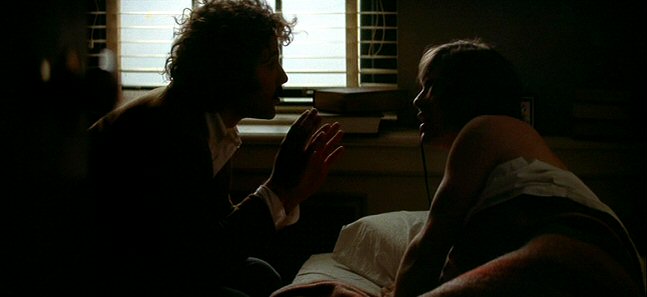
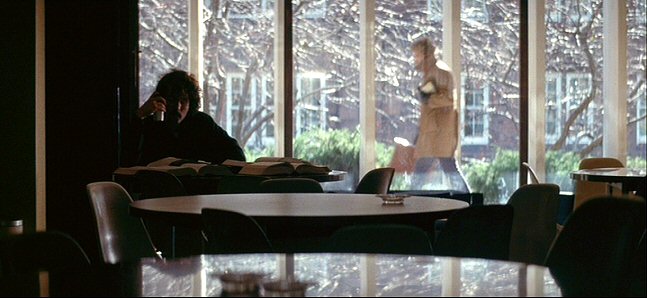
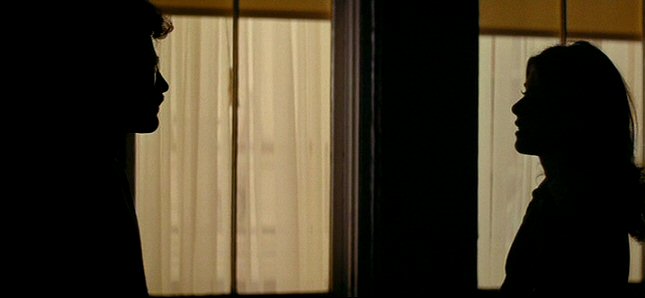
Take a look at an intimate film like "The Paper Chase":

paperchase8.jpg


paperchase9.jpg


paperchase10.jpg


There are many reasons why one might choose 2.40 in these situations:

(1) You can create more modernist off-balance compositions with lots of negative space to suggest isolation, loneliness, etc.
(2) You are playing against convention by presenting an ordinary effort by the character as an epic, heroic struggle
(3) You can surround a figure with more of the room around them (horizontally)
(4) You can compose group shots that are tighter while still holding more people in the frame, for example, at a dinner table you can hold two characters in chest-up shots in one 2.40 frame.

As for shooting with anamorphic lenses, the technical argument would be that in 35mm film, you're going to get less grain for a 2.40 image compared to cropping the same film stock in Super-35. The aesthetic argument would be more if you felt that the shallower focus was dramatically interesting, or the unique flares.
 
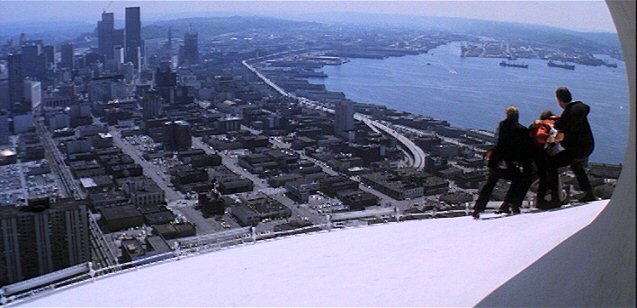
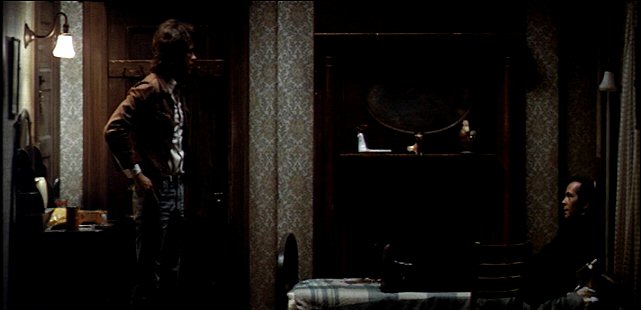
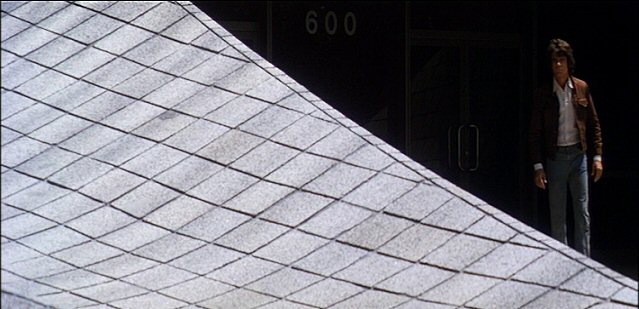
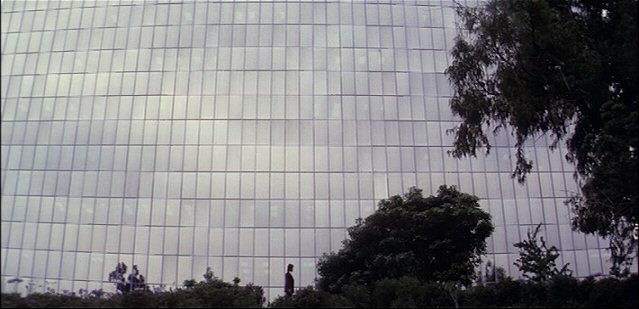
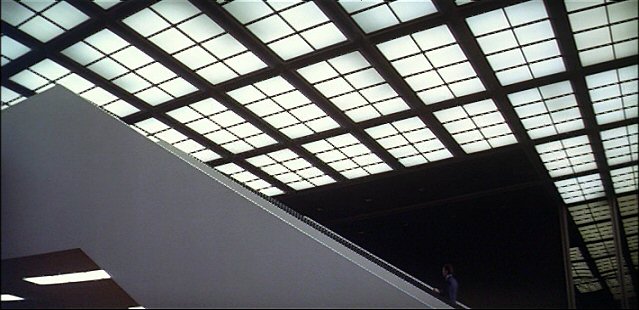
As for the more "modernist" compositional design possible with 2.40, creating a sense of urban angst, isolation, oppression of architecture, etc. look at "The Parallax View" shot by Gordon Willis:

parallaxview1.jpg


parallaxview3.jpg


parallaxview4.jpg


parallaxview6.jpg


parallaxview7.jpg


You can also see the effect in a smaller 2.40 movie like "Klute". But in "Parallax View" you have a similar effect of 2.40 as in a western or epic, the smallness of man against the landscape, suggesting a heroic struggle against larger forces.
 
You also have to remember that it is being distributed in IMAX theaters as well (just saw it last night in IMAX and it was awesome!) IMAX has a higher vertical height than regular theaters, so 1.85 takes up more screen space than 2.40 in IMAX.

I remember watching The Dark Knight in IMAX and I was bothered when the aspect ratio changed from being shot on 65mm back to 35mm. Even if you have to blow up the 35 more it'd still look better than quickly cutting back to widescreen.
 
Back
Top