Welcome to our community

Be a part of something great, join today!

  • Hey all, just changed over the backend after 15 years I figured time to give it a bit of an update, its probably gonna be a bit weird for most of you and i am sure there is a few bugs to work out but it should kinda work the same as before... hopefully :)

A Dangerous Method - Tilt Shift Lenses

Lorenzo Levrini

Active member
Joined
May 11, 2011
Messages
30
Reaction score
0
Points
0
Big fan of Peter Suschitzky's work with tilt shift lenses on A Dangerous Method to keep both characters sharp in shots in depth. The most obvious example is during the psychoanalysis scenes where Jung sits behind the patient and we are looking back at them both.

Anyone know what he used for this? I imagine if you were going to adopt this as such a common motif in a feature you would get a tilt-shift adaptor for use with your regular prime set, although I've never used something like this. Or do you think he had specific tilt-shift primes in his package that he would put on for those shots?
 
Most common method is to use one of the ARRI tilt-focus lenses (Panavision has something similar):
http://archiv.arri.de/prod/cam/tfocus.htm
You get a 24mm, 45mm, and 90mm.

More extreme effects tend to need a split-diopter filter.

Clairmont also rents a bellows system and a set of lenses.

I've found that when using the ARRI tilt-focus lenses for deep focus effects that it still helps to light and shoot at a deeper stop.

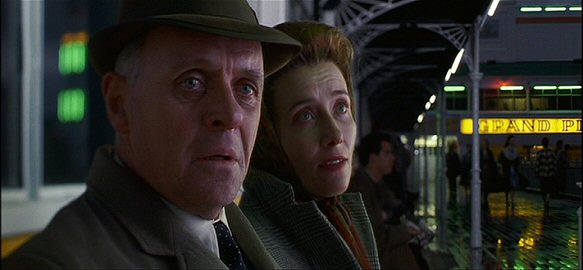
"Remains of the Day" was one of the first movies to use these lenses for a number of faux deep-focus shots:
remains2.jpg


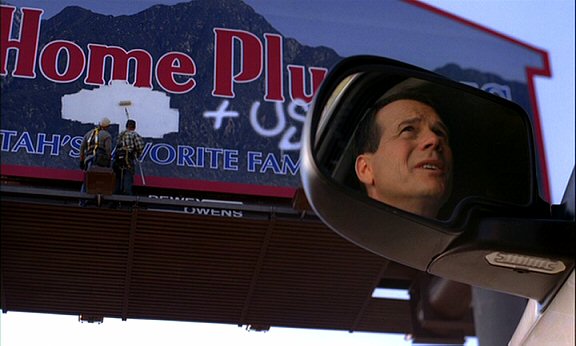
I used the 45mm Panavision version for a couple of shots in "Big Love". You can see that it works better in daytime when I had more light and could stop down:

This was shot at f/11-ish:
biglove25.jpg


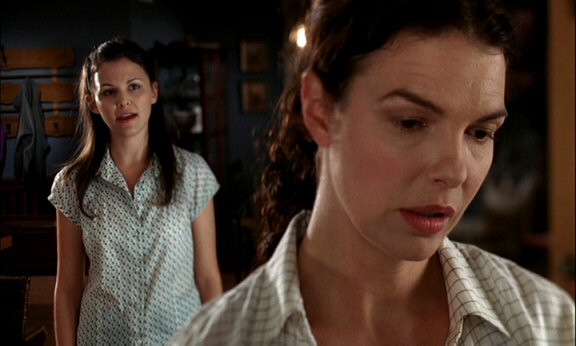
This shot was done at an f/2.8-4 split:
biglove26.jpg


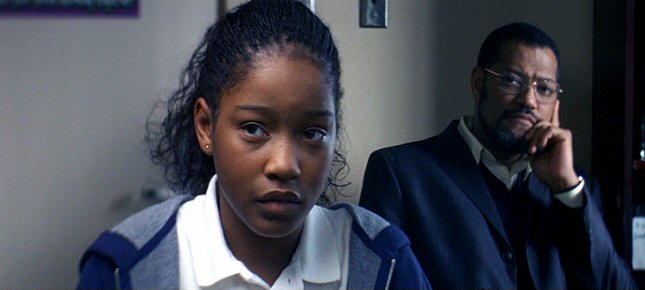
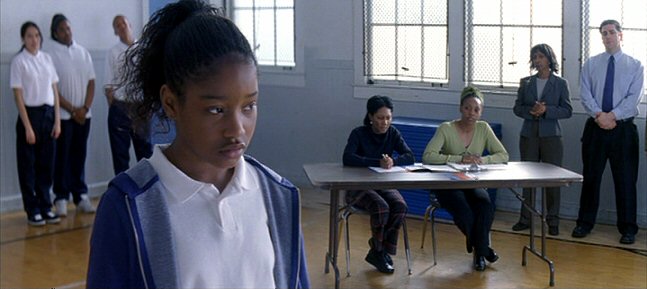
I used Panavision's anamorphic version for a few shots in "Akeelah and the Bee":
akeelah2.jpg


The tilt-focus lenses put the plane of focus on a diagonal, so if the subjects you want to hold in focus fall along that diagonal, it works well. But split-diopters work better when the two objects don't fall along a diagonal plane. This shot in "Akeelah" used a split-diopter filter:
akeelah3.jpg


The 45mm version (or the 90mm anamorphic version) tends to be the most popular since it looks more strange with a longer lenses and it's less necessary with a wide-angle lens (plus if you are trying to hold a face big in the foreground, the face looks less distorted with a 45mm than with a 24mm). However, "Six Feet Under" used the 24mm version for a lot of shots.
 
Last edited:
I've found that when using the ARRI tilt-focus lenses for deep focus effects that it still helps to light and shoot at a deeper stop.

So why is that, David? Does the ARRI system appreciate an extra depth-of-field nudge? Is the plane not broad enough, so augmentation helps?

By the way, that second shot (f/11-ish) from "Big Love" is amazingly sharp.
 
So why is that, David? Does the ARRI system appreciate an extra depth-of-field nudge? Is the plane not broad enough, so augmentation helps?

If you are trying for a faux deep-focus effect, then tilting the lens puts the plane of focus along a diagonal, and if it is shallow-focus, the effect looks more obvious since the same far background will be blurry at one side and sharp at the other. So stopping down expands the range of things that fall into the diagonal plane of focus. Even stopped down, because one side of the frame will be at minimum focus and the other side at infinity, you will still see that the object at minimum focus distance has a blurry background, just as would happen with a normal lens focused at minimum even when stopped down.

After "Remains of the Day" I started seeing what looked like a tilt-focus lens stopped down for a few deep-focus shots in some movies shot by Dante Spinotti, like "Quick and the Dead" and "Heat". Just a few shots though.
 
Thanks David. You're a wellspring of knowledge.
 
TS can be a lot of fun... I have a nice Canon FD 35mm TS lens which I'm itching to try out as soon as Jarred gives the Good Word on the Optitek FD mount...

Mike
 
I would add that in the examples I posted, there was always a reason that I wanted the deep focus effect, mainly to avoid focus-racking between two points of action or acting. Making a focus rack between two points also works as a directorial choice but it is very different, dramatically or storytelling-wise, than holding two points at the same time for a sustained cut. It's A and B versus A then B (then maybe A again). In the case of the spelling bee in "Akeelah and the Bee" we had a sequence of quick question and answer sessions between Akeelah in the foreground and the teacher in the background, so focus-racking back and forth, or leaving one out of focus, would have been less efficient and more distracting. Plus anamorphic lenses breathe a lot, so focus-racking is always a big deal because it's so noticeable.

In the other shot from "Akeelah" I wanted to establish that she is aware of being studied by the person sitting behind her as she talks to someone facing her. Also, this movie was a case where the director storyboarded every angle and of course in a drawing, everything is in focus, but in anamorphic 35mm photography, deep focus is difficult to achieve, so every set-up involved a discussion on where to place focus, when to rack, and when to create a deep focus shot to tell the story.

In the case of the kitchen scene in "Big Love" the person in the background makes a confession while the person in the foreground reacts to it.

In the car shot in "Big Love" I wanted to create the feeling that Bill feels threatened by the graffiti on the billboard as it looms over him (he has hired some workers to paint it out) -- I remember though that it get this composition, I had to drive the front of the car onto blocks and lift it about three feet in the air because the billboard was extremely high in the air (which was a problem in other scenes -- for one scene, I built a deck for the actors to stand on to get that billboard in the background behind their heads.)
 
I would add that in the examples I posted, there was always a reason that I wanted the deep focus effect, mainly to avoid focus-racking between two points of action or acting. Making a focus rack between two points also works as a directorial choice but it is very different, dramatically or storytelling-wise, than holding two points at the same time for a sustained cut. It's A and B versus A then B

Absolutely - that's why I thought this was used so well in ADM. There is no other way of doing a shot in depth that plays as a long 2-shot without telling the audience what to look at.

I think the work in ADM was done at a pretty shallow stop - I remember noticing some focus 'artefacts' quite like those in the Big Love kitchen still posted.
 
Back
Top