Welcome to our community

Be a part of something great, join today!

  • Hey all, just changed over the backend after 15 years I figured time to give it a bit of an update, its probably gonna be a bit weird for most of you and i am sure there is a few bugs to work out but it should kinda work the same as before... hopefully :)

Zeiss Compact Primes or RED Pro Primes for the EPIC?

Please, elaborate......

Everything from focal length will be off (+/- 5% or more) even on a prime! If you ever try and match CGI to real world, you would understand. It's easy enough to fix with a static camera, or analyse a moving scene with something like match mover.

The centre of the Chip is often off centre , very obvious with multi cameras.
 
There is only one FF35mm (24x36) lens that is a pretty fast:

"The Leica Summilux-M 21 mm f/1.4 ASPH. is the first and only 21mm small camera lens with this lens speed."

2010122912223.jpg


Isn't it the case that M lenses won't work with Red or other cine cameras because of flange depth issues (as M is for rangefinder style cameras)? I haven't seen any R lenses on the wide-end quite as fast. Any insight on this, Sanjin?

By that same token, does anyone know if, by some feat of design and forethought, there will be any ability to properly mount M lenses on an epic while maintaining a proper focus distances?

I'm sure it could be done with a small redesign of the inner flange block plane (just need a small hole to allow wider than 35mm Leica-M lenses that get enough flange space).
 
I'd go with the RPP's until you get to the wider end. Where the RPP lenses vignette on Epic FF.

I'd skip the 18mm altogether in either set and get the Tokina/Duclos 11-16mm PL conversion.

None of the RPP's vignette on EPIC 5KFF. Not sure what you mean by that. They all provide full coverage and are tack sharp into the corners. I don't know why you say the 18mm vignettes, it does not. 5KFF on EPIC is just the full 1.89:1 sensor area. It's hardly any bigger than 5K 2:1 -- 5KFF is 5120x2700 and 5K 2:1 is 5120x2560.

The Zeiss CP 18mm is a fantastic lens, but its dirt slow at f/3.5 (I don't remember that lenses t stop.)

Seriously, have you actually shot with it? I know popular opinion dictates that Zeiss is incapable of making a bad lens. And some people get testy when I say it, but the CP 18mm is garbage. I have heard from multiple sources, including Zeiss reps at the NAB booth, that they are working on a new 18mm design. I hope so, because the current one is a stinker. The ZF/ZE 18mm lenses in the SLR world, which share the same optics, are also considered to be rubbish once you get out away from the Zeiss worshiping zealots. The 18mm also does not cover the full 24x36 FF35 frame, which the other Zeiss CP's will cover. That is one advantage to the set. The CP lenses are using T-Stops. The SLR lens counterparts are using calculated F-Stops, or so I believe, which is essentially the same thing as a T-Stop.

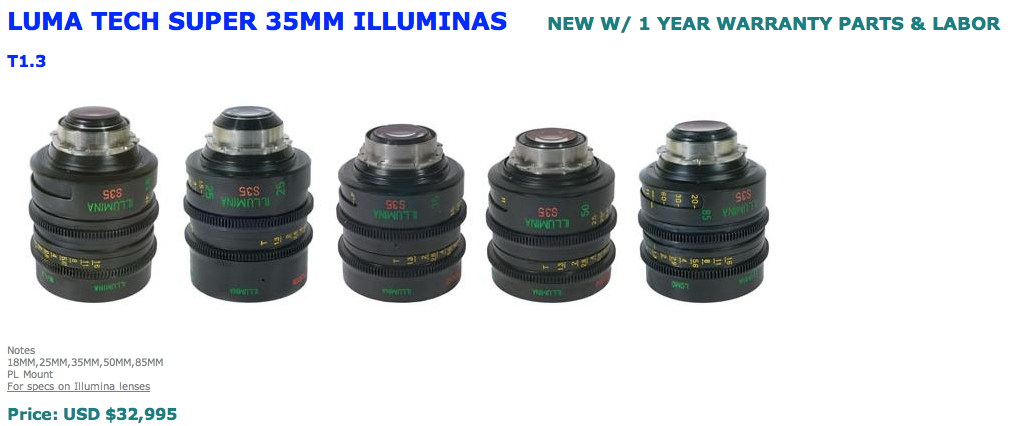
I also urge people to consider the Illumina lenses. I am NOT urging you to buy them ... just to consider them, maybe arrange a test.

Haven't been able to get my hands on them to see for myself. So, who knows. I'm interested, I've heard comments about them, both good and bad. But don't know until I use them.

Recommending a set of lenses to someone is kinda hard. People really need to test them out for themselves and see what is out there that they can fit in there budget and what will also meet their needs. Personally, I feel the Cooke 5/i's and the Leica Summilux C's are both my ideal prime sets. But I can't justify owning either one. Bummer. I own the RPP's and have been very happy with them. They are great lenses at a great price. The two biggest cons to the RPP's are the massive bulk of the 18, 25 and 35mm lenses and their reputation, or lack thereof. For anyone who is focused on renting their primes to generate revenue, I would steer them toward the Ultra Primes. Many in the industry view the RPP's as "poor man's Ultra Primes", which is not the case, but that's the reputation they have in many circles. The Ultras are nice lenses, they're more compact than the RPPs and have a T1.9 aperture across most of the set. RPP's are fine much of the time, but can be cumbersome for handheld work, as others have pointed out. The 18mm is a beast! The 18 and 25mm (18 more so) can also have the tendency to show rainbow diffraction in their flares under the right conditions, some people really don't like this. Overall, I find flares on RPP's to be much more appealing than on the CPs or a few other popular sets out there. I prefer the look of the RPP's over the Ultras in many cases. To each their own.

The RPP's are sharper across the board vs. the Zeiss CP's. The CP 50 and 85 can hang with the RPPs, but the 18mm CP definitely rounds out the bottom of the barrel and some of the others are noticeably less sharp. A lot of people still like them....
 
None of the RPP's vignette on EPIC 5KFF.

Oh, OK if you say so. I've not used them on Epic, I'm guilty of hearsay here.

If you are correct, then the RPP's would be unquestionably the lens of choice for most users, size and weight being the major limitations.

(About the Zeiss 18mm) Seriously, have you actually shot with it?

Yes.

I hate the 18mm because of its speed, or lack thereof.

It has good geometrical representation from what I recall for an 18mm, but the speed is murder.

On FF35 it vignettes very slightly. I think there are other issues that aren't as apparent on S35. I can't care ... we agree it isn't Zeiss's best effort. As you point out so does Zeiss as they claim to be redesigning the 18mm.

In any case the Canon 16-35 f/2.8 is a much better lens, and I prefer it to the Zeiss 18 for stills. Its not a fun lens to use for motion though ... at least not until Epic's Canon mount is available.

The CP lenses are using T-Stops. The SLR lens counterparts are using calculated F-Stops, or so I believe, which is essentially the same thing as a T-Stop.

F-stops are a relation between lens aperture diameter and focal length.

T-stops are related to F-stops but account for light lost due to the lens elements not being perfectly clear.

You use the f-stop when calculating DoF and other focus related stuff.

You use the t-stop for exposure.

I looked up the stop ratings for the CP lenses.

The 18mm Compact prime is f/3.5 t/3.6

The 21 and 25mm are f/2.8 t/2.9

All the other lenses are f/2 t/2.1

You'll note the f-stops are the same between the SLR and CP glass ... and you can bet the t stops are the same too.
 
Oh, OK if you say so. I've not used them on Epic, I'm guilty of hearsay here.

Curious about what hearsay you are encountering... RED has been saying from the start that ALL RPP's will and do cover 5K on the EPIC. Then again, this is RED, so there's still a lot of FUD out there, which makes no sense. In this industry, there's just too many people who like to make stuff up.

I hate the 18mm because of its speed, or lack thereof.

It has good geometrical representation from what I recall for an 18mm, but the speed is murder.

Speed is indeed a total downer. Geometry is good, as is the flaring and other aspects of the lens. It's very soft compared to the rest of the set. You actually don't see it when shooting on the Alexa or many DSLRs, even for stills. But it totally shows on the RED One and EPIC, stills shot with a higher 14MP+ DSLRs, etc.. It's not that it's bad in this regard, but the difference is night and day between the sharpness of the 18mm CP and the 50mm CP.

F-stops are a relation between lens aperture diameter and focal length.

T-stops are related to F-stops but account for light lost due to the lens elements not being perfectly clear.

T-Stops measure light transmission and are actually not related to F-Stops. The T number ratios do often line-up similarly with F numbers though. But while you can have an F number that dips below 1, to represent an aperture that becomes larger than the focal length, you can never have a T number less than one. T=1.0 represents 100% light transmission within the image cone or view frustum of the optical path. A T=0.95 lens would be a lens that would be amplifying or creating light. T numbers and F numbers often seem to coincide somewhat or relate due to how they are represented in relation to 1 and how optics generally respond, so both tend to follow the same logarithmic curve. When I said above that I thought they were using "calculated F-stops", many (actually most) current SLR lenses do this. What this means is that they are not using specific aperture diameter to determine their marked F number. They are basing it off of measured light transmission and calculating where that F number would fall along the iris range, assuming the lens had 100% light transmission. If you take many current SLR lenses and put them on a T-stop bench, you will find their F numbers correlate very closely to T-Stops, many will even line up exactly on the wide-open end of both scales. The Duclos 11-16 is an example of this. It is marked as F2.8 and registers at T2.8 at that mark. Same applies to both the Nikon and Canon 14-24 and 24-70 zooms.

The 18mm Compact prime is f/3.5 t/3.6

The 21 and 25mm are f/2.8 t/2.9

All the other lenses are f/2 t/2.1

You'll note the f-stops are the same between the SLR and CP glass ... and you can bet the t stops are the same too.

OK, noted, I had not looked it up. I've shot with the CP's on a few occasions, but it's been several months now. Actually had a shoot with them last month on my EPIC, but I was DIT and didn't get my hands on them. I analyzed and verified all the footage though. The ZE/ZF SLR models should be the same as you indicate. They have different housings and mechanics, but use the same optical elements. I used to own a set of 4 ZF primes, one being the 18mm... The more I used that lens, the more I hated it. I only shot stills with the lenses, not motion.
 
I have a compleate set of Zeiss CP.2 here for testing and going to get a RED Pro Prime set on Monday.
I will post my comperison results next week. The Zeiss CP.2 50 is not very sharp.
 
I have a compleate set of Zeiss CP.2 here for testing and going to get a RED Pro Prime set on Monday.
I will post my comperison results next week. The Zeiss CP.2 50 is not very sharp.

I've been told this by two other people in the last 24 hours... Apparently the CP.2 50 and 85 are noticeably softer than the ones included in the original CP set. It seems the aperture wasn't the only thing crippled on the 50 and 85 when moving to the CP.2 revision. Other than the possibility of interchangeable mounts, I'm having a hard time understanding what other advantages, if any, exist for the CP.2's over the original CP's?

...So, given the pricing, the CP.2's are not sitting in a bad place. You can spend $10K less and get the RPP's... Or you can spend $8K more and get the i/Panchros. $25K more buys you Ultra Primes...

RPP's are the clear winner on price/performance, but lots of people are turned off by size and their relatively poor rentability. I love the RPP's, but often wish I had bought Ultras when their price was lower a couple years back. I could have ROI'd them easily by now, even turned a profit, because so many rental customers pass on the RPP's in favor of having "Zeiss glass". I bought a set of T2.1 standards and they rented like crazy, but ended up selling them recently so I could own the Optimo DP zooms again....
 
So then...RED should design a new set of Light compact RPPs....I think that would pretty much cut off the Zeiss CP.2 option for a lot of people! :ihih:
Like you said the weight and size of the current RPPS is what is turning off a lot of people...especially when wanting to do handheld with the EPIC as they are almost heavier than the camera and end up creating a awkward balance. I love the RPP sharpness, price and performance...... but I am looking at lighter set....
 
When I was at RED I got to hold an Epic for the first time. There was a 50mm RPP on it and I was shocked by the weight, I'll admit I was expecting it be lighter. Then after taking the lens off it weighed HALF as much. Lightweight Primes from RED under 4k each would be brilliant!
 
As David says, the 17-50 RPZ does vignette slightly. You're good at 18mm and longer when shooting 5K 2:1. For 5KFF (1.89:1) it's about 18.5mm and longer for full coverage. 4.5K, 4K, etc.. do not vignette.
 
Thanks MArk,

I found this viedo on Vimeo of that glass.

http://vimeo.com/12360610

Nice bokeh. They don't look super sharp but they look like they have a nice quality toi them.

Problem is they don't seem to be to easy to find.


David
 
That's not what I've experienced with my RPZ 17-50mm. I made a benchmark that I just posted here. Feel free to share your thoughts!

Hmmm... Interesting.

I personally don't own the lens, but have shot with it on EPIC for a commercial a few weeks back. We tested 5KFF, but then went to 2:1 for the actual shoot because the director wanted 120fps for a couple shots. Corners were clipped at 17mm, but at 18 and up, I don't recall seeing it at all.
 
Thanks MArk,

I found this viedo on Vimeo of that glass.

http://vimeo.com/12360610

Nice bokeh. They don't look super sharp but they look like they have a nice quality toi them.

Problem is they don't seem to be to easy to find.


David

probably not a good idea to judge lens sharpness from a vimeo video. Just sayin. That video is also over a year old and was done with a prototype set. The production version of the lenses are significantly improved across the board. There is at least one set in LA and my set will soon to be in San Francisco. The final production version has really only been available for a relatively short time.
 
I own the CP.2's and love them.. But like everything is this business every tool has it's place within your budget.. Sometimes you can afford a screwdriver, other times you can afford the screwgun, when the day is done the job will get done as well you use those tools..

If you can afford the space and weight of the RPPs then get them, great glass. Vandal vice versa with the CP2s.

My reel on my website is mostly shot with the CP2s.. http://www.marxthespotfilms.com/reel.html

Hope this doesn't seem cryptic with my lack of knowledge of screwguns these days!

-- Justin
 
Last edited:
probably not a good idea to judge lens sharpness from a vimeo video. Just sayin. That video is also over a year old and was done with a prototype set. The production version of the lenses are significantly improved across the board. There is at least one set in LA and my set will soon to be in San Francisco. The final production version has really only been available for a relatively short time.

There was a high quality 1080p available for download to view better image quality. Even with the compression I got the sense these lenses have a warmer softer feel than the tack sharp nature of some other glass.

To many variables. Would need to evaluate a set.
 
Back
Top