Welcome to our community

Be a part of something great, join today!

  • Hey all, just changed over the backend after 15 years I figured time to give it a bit of an update, its probably gonna be a bit weird for most of you and i am sure there is a few bugs to work out but it should kinda work the same as before... hopefully :)

4K 2:1...

While we are loving standards and all, just remember that 24fps is a standard that, I think was based on the slowest film could go through the camera and still have a smooth looking image. How about if we use 4K 2:1 we use say 48fps and start to make things look real life.

I'm all for 48fps.

-michael zaletel
 
I make lots of statements when I have no idea what I'm talking about... :-)

We have seen just about every aspect ratio and feel that 2:1 is a great look... a bit more wide screen than 16:9 and very logical. We have no idea who set the 16:9 standard and what they were thinking. "Who made these rules anyway?". We all just like 2:1 better. We always have. I guess now that people are beginning to pay attention to what we say... we should voice our humble opinion.

Jim

2:1 always was my favorite for telly!
and easy to get the 2,40:1 from it,
what is THE cinema standard!
very cool, I like the red standards.
hopefully more coming up soon!
filmmakers since yesterday are the
future!
 
While 2:1 looks great on computer screens, phones, etc, it's not currently suitable for cinema. The D-Cinema standard allows only for 2.39:1 and 1.85:1, which have been the two most common cinematic aspect ratios for decades. D-Cinema projectors and screens are usually preconfigured only for these aspect ratios. Further, most screens are fixed height, some are maskable in both directions, but very few fixed width, which means 2,39:1 films are almost invariably projected on a significantly larger surface than 1.85:1 (and 2:1) films.

The D-Cinema pixel array is 2048x1080 for 2K and 4096x2160 for 4K, of which 2048x858 and 4096x1716 is used for 2.39:1, and 1998x1080 and 3996x2160 for 1.85:1, respectively. In order to predictably screen 2:1 material in a D-Cinema venue, it will have to fit within a 2.39:1 container, i.e. the somewhat odd formats of 1716x858 for 2K and 3432x1716 for 4K. Another issue is that masking is usually automated and pre-programmed. As theater automation systems generally are not configured with 2:1 presets, the 2.39:1 preset would have to be used, resulting in quite huge visible dark areas on either side of the image as projected black is actually dark grey.

I think many aspiring cinematographers make the mistake of ditching 2.39:1 in favor of 1.85:1 or even 2:1 only because 2.39:1 looks ridiculously wide on their computer screen or video monitor. When viewed on a large screen at a distance however, 2.39:1 looks great.
 
When it comes to D-Cinema/DCP frame rates, both 24 and 48 fps are currently supported for 2K, but only 24 fps is allowed for 4K material. That limitation is probably due to processing power and bitrate. The image stream bitrate is currently limited to 250 Mbps, which is sufficient for visually lossless JPEG2000 compression of 2K@48fps and 4K@24fps. 4K at higher frame rates will require higher bitrates.
 
I agree that 2:1 is the most flexible aspect ratio for acquisition. From there you can test the audience reaction from 1.85 to 2.35. 16x9 has lost its wideness as HD has proliferated.
 
I agree that 2:1 is the most flexible aspect ratio for acquisition. From there you can test the audience reaction from 1.85 to 2.35. 16x9 has lost its wideness as HD has proliferated.

Actually the formats are so different that pictures usually need to be composed specifically for one format or another to look right. There is also the issue of sound boom and equipment placement on set.
 
I have heard (can't cite it) that 16x9 is roughly similar to the aspect of our own eyes. Two eyes, with a little overlap... Kind of makes sense. Anybody else heard this before, or am I off my rocker?

though 2.4:1 may feel more natural for some....


attachment.php
 
They must not have taken 2.40:1 into account. Doesn't matter... 2:1 still seems like the best solution to me... as well as the rest of the RED team. But what do we know?

Jim

I think it's more the problem that legacy 4:3 TV was taken into account, and there was effectively "equal weighting" between the extremes of 4:3 and 2.35:1, which is somewhat of a mathy average compromise solution that ends up unnecessarily biassed towards squarer formats. It's also a solution more geared towards a fixed TV rather than projection.

Graeme
 
VITTORIO STORARO, He created the "Univision" film system, which is a 35mm format based on film stock with three perforation that provides an aspect ratio of 2:1, which Storaro feels is a good compromise between the 2.35:1 and 1.85:1 wide-screen ratios favored by most filmmakers. Storaro developed the new technology with the intention of 2:1 becoming the universal aspect ratio for both movies and television in the digital age. He first shot the television mini-series "Dune" with the Univision system.

http://www.cinematography.net/Files/univision.pdf
 
Fully agree on the 4K part...and you would know.

Curious why you prefer 2:1 over 4K HD or 16x9 in terms of devices like 40-50" flat panels, iPad HD, etc. that might seem odd at that aspect ratio?

-michael zaletel

My answer is.. its a better shape for my vision.. I think my FOV is about 100 degrees.. my eyes have to close down a little even when close to a 16:9 screen..

I don't think there should be one standard.. unless it defines a range of frame sizes.. same for frame rates, technological restraints aren't such concerns anymore, at least for digital media.

I think fsize and fps should be artistic decisions.. I like 3.142 aspect ;)

Only problem with 2:1 is.. what do you do with existing 16:9 footage ? (black bars down the side or a zoom..)
 
I think everyone is getting a little lost. I very much doupt 2:1 will become a cinema format or a TV format.

But its a really great shooting format.
For years and years I shot full gate Super 35mm, with that Neg size I could wide screen, letter box, use 4:3.. 2:35 anything I wanted, I just had a ground glass in my eye piece to give me rough guides for either 16:9 , 4:3 , 2:35 so to keep my essential action in the right area.

I doupt Jim is saying 2:1 will be a standard for what we view on screens, but rather what format we shoot at to give us room to crop, resize, move around in...

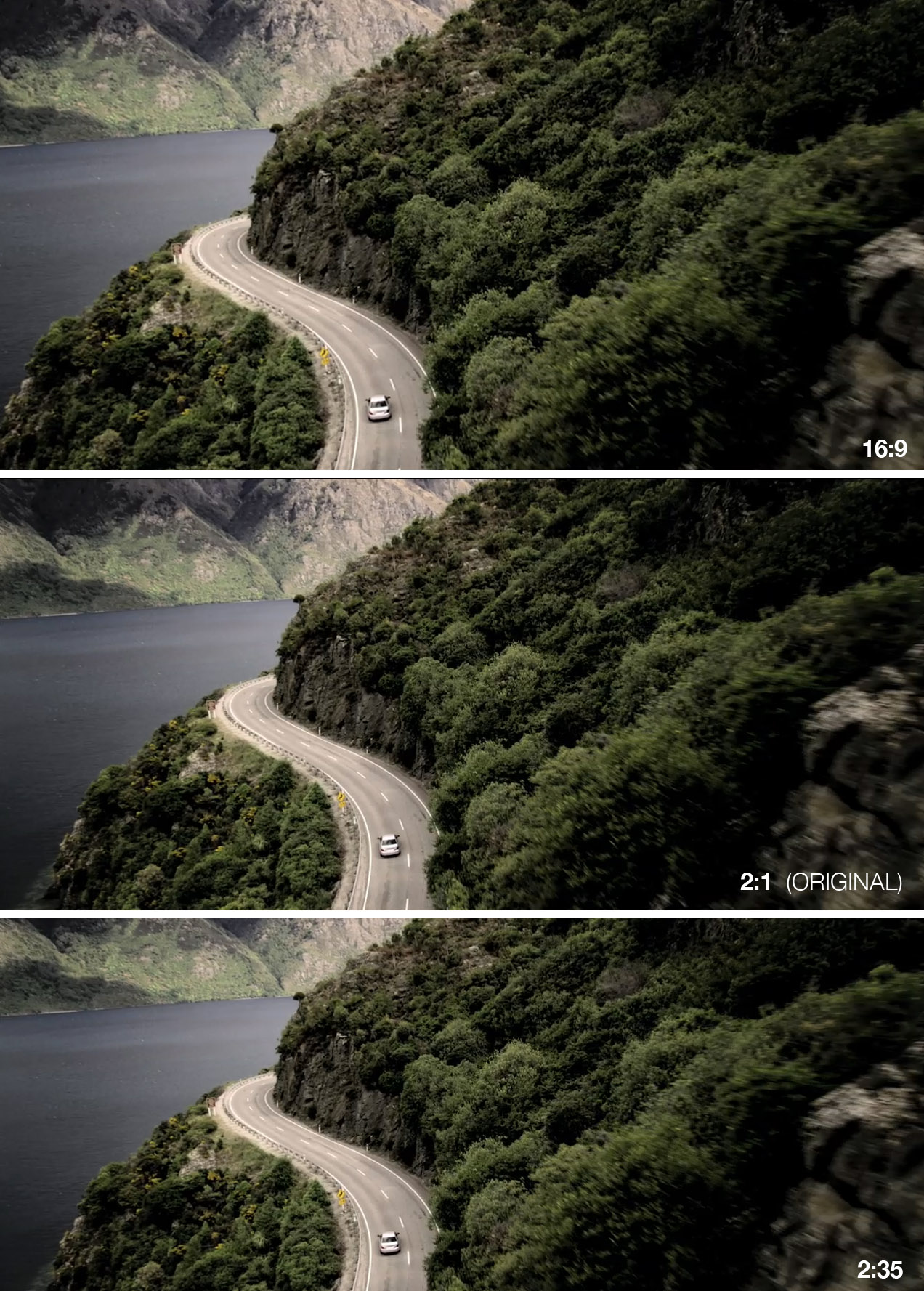
In Shooting 2:1 you get 16:9 by mealy by cutting the sides off, you get 2:35 by chopping the tops and bottoms off.
So 2:1 is just a good around in-between and as the RED chip goes it uses a really good amount of the width in the chip.

I've been shooting a lot of 5k FF on the epic... That seems to be even better for frame move arounds, etc. But over all. 2:1 is the best all rounder, giving you great good sized files, and good frame rates compared to FF and 16:9.

But people, don't get lost thinking manufactures are going to start spitting out 2:1 monitors or screening 2:1.

To resize or crop a frame takes only a minute when outputting.

for me the happy average of 2:1 looks way cool and I never get caught out when my client says can I have 16:9 or 2:35. I just dont loose my look due to extreme crops. I know I can set my frame right at the end and shoot to suit a 2:35 cinema sized ad and 16:9 TV AD.. all from the same mastered 2:1.

FORMATS.jpg
 
2:1 still seems like the best solution to me... as well as the rest of the RED team.
How, on what device, do you guys view output, in order to come up with this preference? The world is viewing on 16X9 devices.
 
I think you'll find that they settled on 16:9 because it was the biggest that they could reliably make CRT's at the time!!

CRTs were harder to make the more they deviated from circular. Look at the early CRTs - they were all circular due to that being the strongest shape to resist the air pressure against the internal vacuum.

Graeme
 
How, on what device, do you guys view output, in order to come up with this preference? The world is viewing on 16X9 devices.

16:9 is a compromise for 4:3 legacy material. For cinematic material we prefer a projected image for viewing, and projected images are not tied to a fixed aspect in the same way that a TV is. There are strong aesthetic reasons for the 2:1 format, and it's also very compatible as Mark shows above with 16:9 and 2.35:1

Graeme
 
I feel that 16:9 is quite bold and not cinematic.

A change to 2:1 or even 2:35 would be the best solution.

So Jim and the Red team, make it happen.
 
Back
Top