Welcome to our community

Be a part of something great, join today!

  • Hey all, just changed over the backend after 15 years I figured time to give it a bit of an update, its probably gonna be a bit weird for most of you and i am sure there is a few bugs to work out but it should kinda work the same as before... hopefully :)

New to Nikon

I'm really surprised to hear that you're still using the 17-35 after getting the 14-24. I suppose it could be sample variation but my 17-35 never impressed me at all and once I got the 14-24 that got multiplied by 50. I haven't touched it once since.

I also was never blown away by the 28-70. Although back when I owned it I didn't know about autofocus microadjustment, I'm now realizing...

The 14-24 is an excellent lens no doubt. For the mobile genres I usually work in I've always preferred to us 35mm still lenses with screw-on filters on Red One and now Epic. For lightness and mobility me and my crews don't use matte boxes or follow focus units. Unfortunately though I love the 14-24 optically, there is no way to put a screw-on filter on the front of the lens, and in what I feel is a mistake by Nikon there is also no way brackets on the rear of the lens so that gel filters could be used. My Nikon 14mm 2.8 has those rear brackets for gel filter use - but the 14-24 doesn't. I still use the 17-35 in the focal lengths that overlap the 14-24 (17mm to 24mm) so that I have the easy option to simply use screw-on filters.

The 28-70 has worked well for me on Red One as a mid-focal range interview lens. Its not a "world beater", but optically it generates quite pleasing results on Red One. It does not hold focus on a zoom, but I'm not worried about that - I use it as a variable prime anyway. The barrel telescoping when its zoomed isn't a problem for me because I simply use the lens with screw-on filters.
 
Hey Gibby is one of your 80-200s the AF-S version? For some reason that one, which I think is the best one until the latest 70-200 II, was really short lived. Maybe they intentionally wanted to make it a collector's item...

The three versions of the Nikon 80-200 I own and use on Red One are:

80-200 f2.8 AF (push/pull zooming), which was built from 1988 to 1992

AF-s 80-200 f2.8D ED-IF, which was built from 1994 to 2004

AF 80-200 f2.8D ED, which was built from 1997 to the present.

I bought each of them used. Each is very good optically and solidly built. Surprisingly the oldest version (AF push/pull) has the least hoops to jump through in filed use. It holds focus throughout a zoom and is particularly useful for tracking shots of sports and wildlife - because the zooming and focusing are all in on easy motion of pushing/pulling the barrel while simultaneously twisting it to rack focus. The AF-s version does not hold focus throughout a zoom and is nowhere as fast to use because of the need to operate multiple rings. The AF ED version also does not hold focus throughout a zoom and requires the operation of multiple rings. Again, all three lenses generate excellent images on Red One, but for the quick, mobile, frequently tracking of objects work I do, the older AF version is my favorite of the three.
 
The Nikon ED 180 f2.8 AIS is very crisp, with excellent contrast and bokeh...one of the better primes Nikon has ever made.

Since I use a lot of zooms in the hybrid/EFP genres of production I work in, the Nikon 17-35, 28-70, and three versions of the 80-200 are in my Nikon lens kits, along with the Tokina 11-16 (Nikon mount), 14-24, and 200-400. I was up to 28 Nikon lenses at one point, but now down to "only" 18 Nikon lenses - 12 zooms and 6 primes.

I've loved both Nikon and Canon lenses on Red One, and love the one Canon I've used on Epic so far.

I love the Canon 150-600 you suggested a couple years ago. For mid range wildlife, I've tried the Nikkor 80-400, which I do not love, and the Canon 100-400, which I sort of like. Is the Nikkor 200-400 worth the $7K price tag? How does it compare to the 150-600? I know you also have a 50-300, which I've never tried.

ps 19 Nikon, 9 Canon, 2 Tokina, 1 Sigma, 1 Voightlander, and lensbaby
 
I love the Canon 150-600 you suggested a couple years ago. For mid range wildlife, I've tried the Nikkor 80-400, which I do not love, and the Canon 100-400, which I sort of like. Is the Nikkor 200-400 worth the $7K price tag? How does it compare to the 150-600? I know you also have a 50-300, which I've never tried.

ps 19 Nikon, 9 Canon, 2 Tokina, 1 Sigma, 1 Voightlander, and lensbaby


Glad the stock Canon 150-600 has worked out for you James. Love that lens :)

The Nikkor 200-400 f4 is really an excellent lens for nature, sports, etc. As you mentioned it is pricey - about $7k USD new. Once in a while you can find a used one in real good condition for around $5.5k. Throughout the focal range the lens is crisp, with nice contrast. Also when you need it, using a 1.4x extender gets you a 288-560mm f5.6 zoom.

As you know, the stock Canon 150-600 is really easy to quickly zoom and focus when shooting wildlife and sports because the combined push/pull/twist lever works real well for zooming and focusing - no multiple rings to manipulate like on the 200-400. As far as images on Red, the 150-600 is crisp, but also filmic and "warm". The 200-400 is very sharp. also somewhat filmic, but a little "cooler" in look. Both are top-quality long zooms on Red or Epic for that matter. I've shot the 150-600 with PL mount on Epic, but because of a lack lack of a Nikon mount for Epic, I haven't used the 200-400 on Epic yet. I'm guessing it will be excellent on Epic too though.

BTW - as soon as I get a Canon mount for Epic the L series zooms I own and regularly use on my Canon 5D will all be used on Epic - the 16-35 f2.8 MKII, 24-70 f2.8, and 70-200 f2.8 IS MKII. Above that in focal length in Canon mount zooms I'm going to be testing out the Sigma 120-300 f2.8, and the Sigma 300-800 f5.6. I've heard very good things about both of those zooms.

Once the Red electronic zooms and mount are ready I will immediately get each of those zooms and use them heavily. I think the glass will be optimized for Epic's sensor, and the motors will be real beefy. My guess is that those lenses will be seriously good on Epic.
 
... Unfortunately though I love the 14-24 optically, there is no way to put a screw-on filter on the front of the lens....

Hey Steve this looks like a possible solution. I don't have it yet; the reviews are good but its a new release and hard to find.

http://www.leefiltersusa.com/camera/products/finder/ref:C4BA23B4F81D79/

http://www.youtube.com/watch?v=fMX5p9Iwx3Y

http://www.bhphotovideo.com/c/product/693472-REG/LEE_Filters_KIT_SW150_SW150_Filter_Holder_Kit.html
 
Excellent...that looks like an interesting solution. Thanks for the links :)

I believe Century also now has a similar snap-on filter holder like that, but I don't know if it specifically fits the 14-24.

There are no problems...only solutions :thumbup1:
 
Glad the stock Canon 150-600 has worked out for you James. Love that lens :)


BTW - as soon as I get a Canon mount for Epic the L series zooms I own and regularly use on my Canon 5D will all be used on Epic - the 16-35 f2.8 MKII, 24-70 f2.8, and 70-200 f2.8 IS MKII. Above that in focal length in Canon mount zooms I'm going to be testing out the Sigma 120-300 f2.8, and the Sigma 300-800 f5.6. I've heard very good things about both of those zooms.

They call the 300-800 the "Bigma". I'm curious how that monster performs. Thanks as always for all the information.

BTW, I've had to lease out my R1 and shoot a 5D on a very remote shoot here in Patagonia. I prefer the Nikon wides, but some of the Canon longer lenses are incredible. My favorite so far is the 70-200 f/4, which has the best contrast of any longish zoom I have seen, at half the weight and price of the 2.8.
 
Is the Nikkor 200-400 worth the $7K price tag?

Personally if I had that kind of money I'd buy a $9k 400 2.8 instead of the $7k 200-400 4.

The 200-400 is fabulous, better than anyone has any right to expect from a crazy-ass zoom range like that (especially imagining how an equivalent cine lens would be priced), and surprisingly lighter than the 400 2.8, but the level of perfection I expect when I'm blowing that kind of money just only comes from primes.

Hey Steve this looks like a possible solution. I don't have it yet; the reviews are good but its a new release and hard to find.

I thought about buying this guy but I decided it wasn't any less hassle than an actual matte box.
 
Personally if I had that kind of money I'd buy a $9k 400 2.8 instead of the $7k 200-400 4.

The 200-400 is fabulous, better than anyone has any right to expect from a crazy-ass zoom range like that (especially imagining how an equivalent cine lens would be priced), and surprisingly lighter than the 400 2.8, but the level of perfection I expect when I'm blowing that kind of money just only comes from primes.

Yup...except both James and me work a lot in the genres of action sports, adventure travel, and wildlife. In those genres getting up and carrying a camera rig to the next framing results in bad things like 1) It can actually get you killed or eaten 2) It will inevitably cause you to miss a bunch of the critical shots you need. Shooters in those genres almost always use zooms rather than primes for those reasons. In those genres we simply use zooms as variable primes most of the time - frame, shoot, re-frame, shoot, etc. Then when we need to track during a shot an animal, person, or object coming closer or going away from us we have the option to progressively keep it framed throughout the shot - something thats impossible to do with a prime. Horses for courses...


I thought about buying this guy but I decided it wasn't any less hassle than an actual matte box.

In the real mobile genres of production shooting in hybrid and EFP styles, every bit of bulk and weight are really critical. The more bulk and weight, the more mobility is reduced, and thus the more shots you miss. For mobile genres of production with lenses like the 14-24 which won't accept screw-on filters, that clip-on filter holder makes great sense - and a full on matte box really doesn't. Again - horses for courses. Narrative and more stationary genres of production are a totally different story.
 
Agreed...and I've been posting opinions like that for a long time here on Red User and elsewhere. Since August 2007 when I received my first Red One camera I've used almost all Nikon (and one Canon) lenses on my four Red One cameras. At one time my kit of Nikon lenses I kept for use on Red One was 28 lenses. Now since receiving my first Epic (0008) almost three months ago I've been using a Canon lens (with PL mount because Canon mount isn't ready yet). Once the smart Canon and Nikon mounts for Epic are ready I'll probably never use the PL mount or PL lenses on my Epics again - ever. Once the new Red Electronic Lenses and Red mount are ready I'll also acquire those and use them heavily. Then before each shooting day or shot sequence using Epic I'll simply decide on the mounts (Red, Canon, Nikon) and lenses I want to use for the shots I want to get. On Epic changing mounts is quick (4 bolts), and then adjusting flange focal distance (FFD) is also quick.

If someone does indie production and the many shooting genres and styles (hybrid, EFP) outside of narrative cinema I'd strongly advise using 35mm still lenses on Epic. If the production you do isn't independent, and/or is heavily cine style, then PL lenses will probably need to be your choice.

I think all too often newcomers to the industry get caught up in the "be like the big boys" syndrome where things like peer pressure, wanting to look like a "real cinematographer", and unfamiliarity with the many lens options brings them to buying lens types and accessories on their camera setups that may not need to be there to work in the genres and styles they really want to work in. They learn a very expensive lesson in the process.

My approach has always been to only put on a camera setup exactly what absolutely needs to be on the camera to get the needed shots. Its an "indie minimalist" setup. In truth there are nuances and workarounds to using stock (non-cinevised) 35mm still lenses on Red One and Epic. But top-level 35mm still optics are remarkably close to PL optics in the images they can generate on Red One and Epic, so IMO the nuances and workarounds are more than justified by the drastically lower price paid and greatly decreased accessory needs and weight/bulk of 35mm still lenses over PL lenses. Less bulk/weight equals increased mobility, which enables a wide range of shots you simply can't get with bigger and heavier camera setups.

Bottom line - if you work union, and/or do a lot of narrative cinema work, then you'll need to go the PL route. But if you work indie, don't do a lot of narrative cinema, work in the myriad of non-narrative production genres, and also do 35mm stills work too, then IMO using 35mm stills lenses on Red One and Epic easily makes the most sense. Epic and Scarlet are DSMC cameras (digital stills and motion cameras). Only modern electronic 35mm still lenses in tandem with smart mounts will enable the broad spectrum of stills and motion work on Epic and Scarlet. PL lenses and mounts on Epic and Scarlet will be specialty setups for specialty work, in essence non-indie narrative cinema work. The still photo and combined hybrid/EFP production industries dwarf the cine industry in terms of number of workers, equipment buyers, and productions each year.

To each their own - but I'd say to newcomers that they closely analyze what their production goals, genres, and styles will be before deciding on what type of lenses and accessories to choose for Red One and Epic. This advice is coming from someone (me) who has owned four Red One cameras since they first started delivering in August 2007, an Epic M for three months now, and shortly has two Epic X coming - someone who works extensively in the hybrid and EFP industries and genres of production that really call for the lenses and setups I've described. Its advice worth considering for newcomers and veterans in transition to DSMC equipment.

In closing let me add that I deeply respect all genres and styles of production. Everyone should choose the cameras, lenses, and accessories that best suit the work they do. That said, IMO too many people in this industry repeatedly try to fit round pegs into square holes - and really suffer financially for their choice. Its a tight economy and a very competitive industry - spend wisely my friends.


I have totally been on the fence on this, thanks Steve, you make a compelling argument, which sounds like the best path for someone like me. I have been trying to come up with ways to afford, and justify, cine glass, but for the price of one cine lens, I can afford a whole set of still primes, and more... I have been a Nikon shooter for years, and have an odd assortment of lenses which I plan on selling to invest in a set of G primes, since I have been hearing great things about them.

What is your view on the rental of a package with still primes, instead of cine primes? Is that something that I should feel is a detriment to the marketability of a rental package? I am sure that I would miss out on some of the "big boys," but I do live in Wisconsin, so not sure if it will be as much of an issue - may rent to students, indy productions, etc... %99 of my reason for planning on an Epic-S purchase is for personal use, but I would like to make some money on rentals if possible...
 
Re: the Sigma 120-300. I have one and have been very pleasantly surprised by its image quality. Great performance from a decent sized lens. Changed my opinion of Sigma.
 
I have totally been on the fence on this, thanks Steve, you make a compelling argument, which sounds like the best path for someone like me. I have been trying to come up with ways to afford, and justify, cine glass, but for the price of one cine lens, I can afford a whole set of still primes, and more... I have been a Nikon shooter for years, and have an odd assortment of lenses which I plan on selling to invest in a set of G primes, since I have been hearing great things about them.

What is your view on the rental of a package with still primes, instead of cine primes? Is that something that I should feel is a detriment to the marketability of a rental package? I am sure that I would miss out on some of the "big boys," but I do live in Wisconsin, so not sure if it will be as much of an issue - may rent to students, indy productions, etc... %99 of my reason for planning on an Epic-S purchase is for personal use, but I would like to make some money on rentals if possible...


By the work you describe, and the location you're in, if it were me I'd definitely go the Nikon or Canon route. If you do, since you have a Nikon background, that would probably be the way to go.

If rentals to cine style shooters is someone's business plan, then by all means a good set of cine primes, MB, FF, and filters are essential. If you rent to other indies who work in the huge array of hybrid and EFP genres of work, then having Nikon lenses isn't a liability at all - in fact most times that would be a plus because they'd expect equipment like that and they aren't flush with cash for rentals either.

Whatever equipment you invest in, try hard to keep it busy, whether in your own productions or those of others. A word of caution: people tend to beat up rental equipment. If you do rent your kit, I'd suggest that you work yourself into their budget as a "tech rep" or something so you can go along and ensure they take good care of your stuff.
 
Thanks for that report Paul. I've heard several of my respected associates say the same thing about the Sigma 120-300 f2.8 - good build, and excellent optics.
 
Nikon on Epic

Nikon on Epic

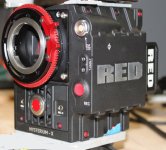
Here it is- first proto of Prolock for Epic and Scarlet.
No need to wait with Epic "m" purchase to use Nikons...:yesnod:
 

Attachments

  • on epic1.jpg
    on epic1.jpg
    71.5 KB · Views: 0
The three versions of the Nikon 80-200 I own and use on Red One are:

80-200 f2.8 AF (push/pull zooming), which was built from 1988 to 1992

AF-s 80-200 f2.8D ED-IF, which was built from 1994 to 2004

AF 80-200 f2.8D ED, which was built from 1997 to the present.

I bought each of them used. Each is very good optically and solidly built. Surprisingly the oldest version (AF push/pull) has the least hoops to jump through in filed use. It holds focus throughout a zoom and is particularly useful for tracking shots of sports and wildlife - because the zooming and focusing are all in on easy motion of pushing/pulling the barrel while simultaneously twisting it to rack focus. The AF-s version does not hold focus throughout a zoom and is nowhere as fast to use because of the need to operate multiple rings. The AF ED version also does not hold focus throughout a zoom and requires the operation of multiple rings. Again, all three lenses generate excellent images on Red One, but for the quick, mobile, frequently tracking of objects work I do, the older AF version is my favorite of the three.

Steve,
I was testing a new AF 80-200 f2.8D ED today at the photo store.
I noticed something weird;
when pulling focus one way to the other, the image jumped slightly from left to right.

Obvious this isn't usable, so we tried another Nikon (some zoom to 400mm with VR) it had the same jump left to right!
I do have a lot of nikon and canon glass, but none of them have this issue.
Have you seen something like that with any of these Nikon lenses?
 
Steve,
I was testing a new AF 80-200 f2.8D ED today at the photo store.
I noticed something weird;
when pulling focus one way to the other, the image jumped slightly from left to right.

Obvious this isn't usable, so we tried another Nikon (some zoom to 400mm with VR) it had the same jump left to right!
I do have a lot of nikon and canon glass, but none of them have this issue.
Have you seen something like that with any of these Nikon lenses?


Yes, the AF 80-200 f2.8D ED has that image jump when focusing that you noticed. As mentioned in my previous post you quoted, at one point I owned three different versions of Nikon 80-200 - the 80-200 f2.8 AF (push/pull zoom, twist to rack), the AF 80-200 f2.8D ED (the one you tested), and the AF-S 80-200 f2.8D ED IF. I had the same problem you mentioned with the AF 80-200 f2.8D ED you mentioned, so I sold it off. As I mentioned, the AF-s 80-200D ED IF version didn't image shift when focused, but it also doesn't hold focus throughout a zoom. The older 80-200 f2.8 AF (push/pull) version has no image shift when focused, holds focus throughout a zoom, and is the fastest to use because pushing/pulling to zoom and twisting to rack focus are all in the same quick move. Its also the cheapest of the three versions to buy used. If you're someone who feels the need to use a follow focus, that lens can't be used with one due to its push/pull/twist operation.

All the versions of Nikon 80-200 f2.8 zooms are excellent optically and equal to each other in optical performance.
 
Richard,

Ah ha, that's excellent...:)

Either you got a good one, or I got a bad one, because mine would wander off focus when zooming. As you know, with 35mm still lenses there can sometimes be variances in individual lens performance. Sometimes I've gone through two or three lenses of a particular model before I found the one that had exactly the performance I was seeking.
 
I have also Steve. But it is so worth it when you get that set that is just so, because the Nikon glass can be so fine.

BTW, we shoot in different worlds, as I basically do commercials and narrative, but I really have learned a lot from you and have been awed by your work that I have seen.

Thanks for your generosity in sharing.
 
Back
Top