Welcome to our community

Be a part of something great, join today!

  • Hey all, just changed over the backend after 15 years I figured time to give it a bit of an update, its probably gonna be a bit weird for most of you and i am sure there is a few bugs to work out but it should kinda work the same as before... hopefully :)

Ext. Forest - night

agree with maxi-brut for kicking the back ground.. side/high-down
for the scene itself.. try a big ultra bounce table topped and raised above the scene (experiment with height)
from there kick a 2.5/4k (or 2) into it.. (it really depends on the scene)

if you dont want the light so topsy, just give the bounce a tilt and off to the side. (might work better for motivation if you have the maxibruts in back hitting at an angle

also.. if you can.. sit in with production and schedule the shoot during a full moon, or close to a full moon, just to help ease the darkness
 
I'm.... hoping to do some very wide landscapes with characters in them. I have some budget to scale up my G+E for these dates, but it's still pretty limited. So in any case, just curious about your experiences and how you've approached this.

I Bloom, if your budget is "pretty limited" can you really afford the expense of a Musco or even the generators, cable, and manpower to distribute the power necessary to run 9 light maxi-brutes deep in the woods? If you can give us a sense of what you can afford we can be of more help. Are we talking about Muscos or CFL China Balls?

Eileen Ryan, Boston
 
At the end of the day your going to get as much light as you can afford. That's not really the question here. For me the real question is how to shape the light you have and create a night exterior that doesn't feel fake.
 
At the end of the day your going to get as much light as you can afford. That's not really the question here. For me the real question is how to shape the light you have and create a night exterior that doesn't feel fake.

Sure, but tips for a $50,000 lighting budget won't be much good on a $500 lighting budget...

Ballpark idea? 3 figures? 4? 5?
 
Sure, but tips for a $50,000 lighting budget won't be much good on a $500 lighting budget...

Ballpark idea? 3 figures? 4? 5?

Most of what has been discussed applies to low-budget movies and above. For something like a short film, I've found layering to be best way to get the bang for you buck. In a wide shot you would take as many small lights as possible and hide them behind trees with creative black wrapping to pick up small areas. It's surprising what a couple 1k's will do at 800iso T1.4.
 
One consideration in creating a night exterior that doesn't feel fake that hasn’t been addressed yet is the color balance of your lights whatever they may be. Even though it is something of a convention held over from the theatrical stage, I still find a mix of warm lamplight and cool moonlight to be the most realistic approach. But this requires a different approach to lighting the scene than is traditional if you are lighting for the Red’s native color balance of 5000K. In the past, it was customary to use 3200K light sources for night shooting because most high-speed films and video imaging systems were balanced for 3200K. With this traditional approach HMIs were used to create blue moonlight and tungsten lights were used to create white or slightly warm lamplight. In this approach CTO gels are used to either make the HMIs less blue or the tungsten warmer.

Using tungsten light sources like Nine Light Max Brutes for a night scene when the Red’s native color balance is 5000K doesn’t make a lot of sense. Balancing tungsten to 5000K is not very efficient because full CTB cuts the output of the light by 70% in converting it to 5000K. A 1000W 3200K light becomes a 300W 5000K light when you put Full CTB on it. A 400 W HMI will give you considerably more lumens/watt than a color corrected Tungsten 1k, and use up a lot less power available from your generator.

It makes more sense to use HMIs to light for the Red’s native color balance of 5000K because they provide more lumen/watt and require less filtration with gels. In this approach raw HMI light would provide white light, Half CTB gel would provide moonlight, and Half CTO gel would provide warm lamp light. I personally believe you should always combine color temperatures in a frame. You can shift your overall color balance to the cool side in the camera or in post to create moonlight, but without a white light or warm light reference in the frame, your audience will subconsciously adjust and filter out your moonlight effect. Putting white light in the frame gives your audience a reference point and they will not filter out a color effect like moonlight.

One of the downsides to lighting for the Red’s native color balance of 5000K is that it requires an all 5000k balanced lighting package and HMIs are considerably more expensive to buy or rent. A cost effective alternative to HMIs are Kino Flo florescent light fixtures because they can use either 3200K or 5500K tubes. When using 5500K tubes to light for the Red’s 5000K native color balance, you can warm the lights without losing output to CTO gels by simply mixing in 3200K tubes with the 5500k tubes. The drawback to using flourescent light fixtures to light night scenes is that they generally have a very broad soft light output that drops off rapidly which means the units need to be positioned close to the subject they are lighting. This characteristic makes them better suited to lighting documentary interviews than dramatic night scenes. The one exception to that rule are the Kino Flo ParaBeam fixtures.

The Kino Flo ParaBeam fixtures use computer aided designed (CAD) parabolic reflectors that focus the light output at about 16 feet (5 meters). This feature makes the Kino Flo ParaBeams well suited for dramatic set lighting, because it doubles the light output of the lamps where it is needed most for lighting dramatic scenes - at a medium distance. Compared to the Kino Flo Diva-Lite, which uses the same four 55 Watt compact lamps and the same ballast, the ParaBeam 400 is twice as bright at 12' – making them a suitable key source for lighting dramatic scenes. Kino Flo also makes available for the ParaBeam fixtures a number of innovative accessories that enhance their production capabilities for HD Digital Cinema. Accessories include barndoors, a gel frame, a diffusion panel, and Honeycomb Louvers. Honeycomb Louvers are available in 90, 60 and 45 degrees and provides beam control similar to that of swapping lenses on an HMI Par.

So that you can power more lights off your generator, I would recommend a lighting package that consists of HMI Pars to light your deep background, Kino Flo Parabeams to key your talent, and a traditional Kino Flo 4’ bank to fill. Though it will be harder to find at your local rental house in smaller heads, I would also recommend using HMI electronic ballasts with Power Factor Correction (PFC.) Formerly only available in the higher wattages, this advanced electronics reduces current spikes and harmonics in the power line and contributes to a more economical use of power. 800 & 1200 Watt ballasts with PFC use considerably less power than conventional electronic ballasts, and enable you to operate not only more smaller HMI lights off of portable generators, but also larger HMIs lights off of portable generators than was possible before.

While not a tremendous advantage when plugging into house power, the power efficiency of PFC ballasts can make a huge difference when powering a lighting package off of portable generators. For example, where a Kino Flo Parabeam 400 draws only 2 amps, the 8 Amp difference between using a PFC 1200W electronic ballast and standard non-PFC 1200W electronic ballasts, can mean the difference between running four additional Parabeam 400s on your portable generator or not – I think you would have to agree that is a major boost in production capability. And when you start to add up the incremental savings in power over multiple HMI ballasts in a lighting package, add
to it the energy efficiency of light sources like LEDs and Kino Flos, and combine it with new distribution technology that provides 7500W of power in a single 120V circuit from a modified Honda EU6500is portable generator, you have a very effective low budget approach to lighting night scenes.

HD_PP_DemoWS.jpg

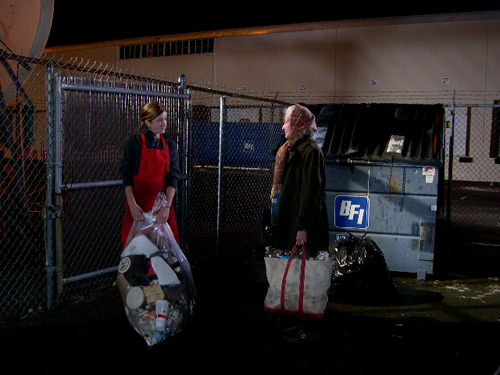
Wide Shot of Night exterior scene lit with our HD P&P Pkg.

For example, on a recent independent short I used a modified 7500W Honda EU6500is Generator to power a lighting package that consisted of a 2.5kw, 1200, & 800 HMI Pars (with PFC ballasts), a couple of Kino Flo Parabeam 400s, a couple of Parabeam 200s, and a Flat Head 80. Given the light sensitivity of the Red Camera, this was all the light we needed to light a large night exterior.

HD_PP_Demo_SetUp_Night.jpg

The PFC 2.5 & 1.2 HMI Pars, PFC 800w Joker HMI, Kino Flo Flat Head 80, 2 ParaBeam 400s, and a ParaBeam 200 of our HD P&P Pkg. powered by our modified Honda EU6500is through our 60A Full Power Transformer/Distro

The scene takes place behind a mall, rather than the woods, but the principles are the same: we used the 2.5 HMI par to light the deep background, the 1200 HMI par to light the near background, and the 800 Joker was mounted on a Source 4 Leko with a bug-a-beam adapter to create a window pattern on the ground from a building that doesn’t exist but you don’t see that in the movie. We used two Parabeam 400s to key the talent and a Kino Flo Flathead 80 to fill the entire scene.

HD_PP_Demo_Transformer-Distro.jpg

A Distro System consisting of a 60A Full Power Transformer/Distro, 2-60A GPC (Bates) Splitters, 2-60A Woodhead Box distributes power from a modified Honda EU6500is. Even though the generator is 100' away to reduce noise, plug-in points remain conveniently close to set.

We balanced the color temperature of the lights to the Red’s native 5000K color balance as follows: the 2.5 & 1200 Pars were gelled with ½ CTB for moonlight. We put half CTO on the Joker 800 to create warm window light. We mixed 3200K tubes into the Parabeam 400 on the “window” side to create a warm key source motivated by the window. The Parabeam on the other side was gelled with ¼ CTB to create a cool key source motivated by the moonlight. Finally, we lamped the Flathead 80 with only 5500K tubes to create a slightly cool fill. To see the final results, use this link - www.screenlightandgrip.com/html/hdfilmstrip4lg.html - to our website where we have posted more detailed information on the lighting package we used along with production stills from the movie.

- Guy Holt, Gaffer, ScreenLight & Grip, Lighting and Grip Rental in Boston
 
musco.jpg


This Musco is a beast. I learned something new today.
 
Back
Top