Welcome to our community

Be a part of something great, join today!

  • Hey all, just changed over the backend after 15 years I figured time to give it a bit of an update, its probably gonna be a bit weird for most of you and i am sure there is a few bugs to work out but it should kinda work the same as before... hopefully :)

Epic and doc shooting

Since almost 3 years now I'm using my Canon 8-64 with the RedOne shooting in 3K 2.1 mode. We crop the 3K 2:1 image in RedCineX to 2.500 x 1406 which is necessary to get rid of the strong portholing of the S16 lens. With 2.500 x 1406 pixels RAW I get full resolving 1080p RGB when one counts in a debayer factor of 0.8. IMHO, 2K is not an option.

Hans
How did you fit the 8-64 on the RED ? with a B mount to PL adapter ?
(with enlarging lens inside the adapter)
I find this adapter a bit "soft", maybe I should take off the lens inside this adapter, even if the image is smaller ?

I realise you are talking about the S16 lens and you certainly have it in a zeiss mount so a simple adapter to PL is enough.
i just happen to have the same Canon lens for 2/3 video, 6-48, it does cover a smaller area, too bad !
 
Last edited:
How did you fit the 8-64 on the RED ? with a B mount to PL adapter ?
(with enlarging lens inside the adapter)
I find this adapter a bit "soft", maybe I should take off the lens inside this adapter, even if the image is smaller ?

I realise you are talking about the S16 lens and you certainly have it in a zeiss mount so a simple adapter to PL is enough.
i just happen to have the same Canon lens for 2/3 video, 6-48, it does cover a smaller area, too bad !

The Canon 8-64 came (comes? I don't know if it's still made.) in a PL mount. (or an Aaton mount.) It's a great S16 lens, no adapter required.
 
As Steve Gibby points out.....i also have been using the RED ONE for doc work for a few years now and been on several nat geo shoots; nature, discovery and various indipendent docs. That said, it is NOT ALWAYS the best tool. but not every camera is.....Took it to Africa with Ken Corben to shoot TigerSharks and got great images. Then to Botswanna to shoot on the Okavanga Delta--in late 2007 or early 2008. We also brought along an ex1 i believe and between two reds and the sony.....worked beautifully. BUT, i don't envy not would i want to run across the delta chasing a lion on the hunt with it again.....quite heavy. The small sony became that tool. BUT, scarlet seems like it will fit that piece of kit next......like the sony and all BUT.......RAW RULES!

Just got off a 3d shoot with panasonic. AND boy do i miss shooting/editing in RAW.
 
I shoot docs, mostly adventure sports and lifestyle, all the time on our MX, with some advertising and other gun for hire studio work thrown in there about 30% of the time. We've shot for over 2 years on our R1 mostly this type of work, and I'm proof as are others, its a great doc camera, but we cannot WAIT for EPIC's light weight. Like Johnny and others, we carry an EX and 5D for roles where the R1 is too awkward. But 80% of the time, its red, and we're deadly spoiled by the image quality and post options. Would not have it any other way. yeah, its heavy. Wah.
 
Good points covered by David, Hans, and Meryem in this thread...

For high-end work we usually shoot 4k, but for documentaries we shoot 3k. The DOF we can achieve in 3k is right for docs, the data rate is lower for longform work, and 3k down-rezzes and down-samples to beautiful 1080p for our usual delivery mediums. We check footage each night using a Mac Pro laptop, and back up dually to a drive and LTO.
...

For super mobile work, my crews are usually just two people - the operator and a production assistant. For more stationary work the crews sometimes grow to three when I add on a dedicated sound person.
...

Steve, I've been looking forward to Epic for doc shooting for a long time. I completely agree with your thoughts on using it in light-weight setups in the field. But data management is going to get heavier as the camera gets lighter.

I take it from your post that you don't really do data management in the field, that you do all of your data backup at the end of the day. Is that true? It certainly is one way of avoiding the extra time and equipment weight in a small-crew shoot. I hadn't really seriously considered that, but it could be an answer. Thoughts?
 
sorry if this is off topic but we are talking about portability of dsmc systems in run and gun/ doc settings so I figure this would be ok

I am trying to plan a run and gun dsmc package and don't know if this would be a reasonable amount of gear to throw in a carry on size backpack

- Scarlet 2/3" cinema (i know its not epic just think smaller) with PL mount, side handle, rear ssd module, small HD dp6, and with a shotgun mic either plugged into a beachtek adapter or the audio inputs on the front of the brain

- Angenieux 9.5-57mm short zoom, Angenieux 12-240mm long zoom, and Angenieux 5.9mm wide angle prime all converted to pl mount

- PC Laptop (w/ esata port + express card adapter with 2 esata ports for a total of 3 e sata ports)

- 1.8" Red Station

- 2 G-Tech 1TB Harddrives for offloading 2 copies of data

- power inverter for car

- a minimal lens support system for the 12-240

- perhaps the red gunner for hand held shots?


I am planning on shooting another surf flick when the scarlet cinema comes out or when I can afford it...whichever comes first. While shooting my last surf movie I needed to be mobile, and worked alone so I could only could bring what I could carry.

I shot the last movie on MiniDV tape. The need to offload footage is new to me this time around so I will have to get used to carrying around a laptop. In addition to the above listed equipment I will be carrying around a 10-15 pound tripod. I would probably want to keep the camera built in the backpack with the 9.5 to 57 with the exception of the lcd monitor for quick setups.

Does this seem like a reasonable amount of gear to try to carry alone? Is it too much? Am I missing something?

any feedback would be appreciated

p.s. for those of you that would be interested in an east coast surf film you can check it out here http://www.peterosinski.com/joyridefilm.html
 
Well, crap... I had a post in here and don't know what happened to it, if I didn't actually hit submit or what. Anyway, I think all my points have been covered. Meryem's comments in regards to the cost of ownership with the cameras are spot-on. It's not really pertaining to or specific to this thread, but just professional camera systems in general. I too find myself shaking my head at a lot of comments I read; usually in regards to Scarlet -- Oh Noes!!! The price$ just went up another $1000!!! The sky is falling and there's no way I can justify the camera now!!!. Yeah, whatever. If $1K makes or breaks your camera decision, then how do you intend to actually use the camera? $1K doesn't even buy a set of O-Grips with a bridge mount.

For the super-budget-conscious shooter, the best bet is to go for the fixed lens Scarlet and pick up a bunch of used 16GB CF cards that people will start unloading as they shift over to SSD's and EPIC... But it's still going to cost some money. I would equate buying the fixed Scarlet in 2011 to buying an HVX200 in 2006, in terms of TCO. Lots of independent guys struggled with the HVX and managing data, finding ways to store it if they shot with it regularly, etc..

As for the Doc shooting topic. Most mobile doc style productions don't have the luxury of narrative cinema style DIT setups. The RED SSD's with EPIC will be a godsend. I'm looking to the 256GB SSDs. They're the lowest cost per GB of all the RED media. I can buy 9 256GB SSD's for the price of 16 of the 128GB. Think about that for a second. And I know some people are probably instantly thinking "OMG, 9 SSD's!!!!" Yes... But think about that again... How much is a mobile DIT cart setup with Mac Pro and/or PC tower, among other things? How much does it cost to have the crew / power / etc.. to support it? A laptop setup is not going to cut it with EPIC shooting 5K @ 5:1. I can't run a DIT cart on the side of a mountain with a snow storm looming overhead. No, I want the media. 256GB RED SSD's are going to sell for the same price as 16GB P2 cards when they were introduced. I had two HVX200 cameras when I was shooting them and, IIRC 10 8GB P2 cards and 6 or 8 of the 16GB.

I took enough media to get me through the day, maybe two of full shooting. If I needed, I spot-checked on a laptop and/or played back in-camera.. But the actual offload and logging, backup, etc.. of the footage would happen later. There is a huge misconception on these forums, and regarding RED workflow in general, that a DIT is always needed right there with the camera. On cinema-style productions with a proper crew and budget, that is ideal, yes. But there are times it's best to just suck it up and have adequate media, go shoot and work with it later. ...Just as you would shooting doc style with film or DVCPROHD or HDCAM tape or...

Anyway, I have two Stage-2 EPIC-X cameras coming and I will be buying a fixed lens Scarlet, possibly two of them. All will be running SSD media and I will buy enough media so each EPIC-X can have at least 3, probably 4 256GB SSDs and each Scarlet will get 2, maybe 3 x 256. And I will add more as needed and as the budget allows. This also gives me the ability to pull and pool media to one camera if I go off on a remote backpack nature shoot and need enough media to get me through a couple days.

There are going to be times that I'll want to throw the EPIC in a backpack with a few Nikon zooms and maybe a prime or two and just take a road trip for a few days. So lots of media, probably the Macbook Pro and an eSATA RAID-1 with 2x2TB mirrored drives just in case I need some extra, but I would only offload what I absolutely had to.
 
Great post, Jeff. A very good look at the new landscape of things and how they're evolving. I think your points are spot on. More akin to film style of shooting, I like it! We didn't always have the luxury of checking our shots when shooting on film, had to get it right the first time. Maybe a Polaroid to check for lighting. Protect that film bag with your life. Process in batches in case the lab screwed up. There were some positives to watching how you ran things that way and good to keep them in mind for the future, whatever it might bring. Sure it's always better to leave with multiple backups, but some scenarios will not allow for such. Establish best methods practices for a given set of circumstances.

Well, crap... I had a post in here and don't know what happened to it, if I didn't actually hit submit or what. Anyway, I think all my points have been covered. Meryem's comments in regards to the cost of ownership with the cameras are spot-on. It's not really pertaining to or specific to this thread, but just professional camera systems in general. I too find myself shaking my head at a lot of comments I read; usually in regards to Scarlet -- Oh Noes!!! The price$ just went up another $1000!!! The sky is falling and there's no way I can justify the camera now!!!. Yeah, whatever. If $1K makes or breaks your camera decision, then how do you intend to actually use the camera? $1K doesn't even buy a set of O-Grips with a bridge mount.

For the super-budget-conscious shooter, the best bet is to go for the fixed lens Scarlet and pick up a bunch of used 16GB CF cards that people will start unloading as they shift over to SSD's and EPIC... But it's still going to cost some money. I would equate buying the fixed Scarlet in 2011 to buying an HVX200 in 2006, in terms of TCO. Lots of independent guys struggled with the HVX and managing data, finding ways to store it if they shot with it regularly, etc..

As for the Doc shooting topic. Most mobile doc style productions don't have the luxury of narrative cinema style DIT setups. The RED SSD's with EPIC will be a godsend. I'm looking to the 256GB SSDs. They're the lowest cost per GB of all the RED media. I can buy 9 256GB SSD's for the price of 16 of the 128GB. Think about that for a second. And I know some people are probably instantly thinking "OMG, 9 SSD's!!!!" Yes... But think about that again... How much is a mobile DIT cart setup with Mac Pro and/or PC tower, among other things? How much does it cost to have the crew / power / etc.. to support it? A laptop setup is not going to cut it with EPIC shooting 5K @ 5:1. I can't run a DIT cart on the side of a mountain with a snow storm looming overhead. No, I want the media. 256GB RED SSD's are going to sell for the same price as 16GB P2 cards when they were introduced. I had two HVX200 cameras when I was shooting them and, IIRC 10 8GB P2 cards and 6 or 8 of the 16GB.

I took enough media to get me through the day, maybe two of full shooting. If I needed, I spot-checked on a laptop and/or played back in-camera.. But the actual offload and logging, backup, etc.. of the footage would happen later. There is a huge misconception on these forums, and regarding RED workflow in general, that a DIT is always needed right there with the camera. On cinema-style productions with a proper crew and budget, that is ideal, yes. But there are times it's best to just suck it up and have adequate media, go shoot and work with it later. ...Just as you would shooting doc style with film or DVCPROHD or HDCAM tape or...

Anyway, I have two Stage-2 EPIC-X cameras coming and I will be buying a fixed lens Scarlet, possibly two of them. All will be running SSD media and I will buy enough media so each EPIC-X can have at least 3, probably 4 256GB SSDs and each Scarlet will get 2, maybe 3 x 256. And I will add more as needed and as the budget allows. This also gives me the ability to pull and pool media to one camera if I go off on a remote backpack nature shoot and need enough media to get me through a couple days.

There are going to be times that I'll want to throw the EPIC in a backpack with a few Nikon zooms and maybe a prime or two and just take a road trip for a few days. So lots of media, probably the Macbook Pro and an eSATA RAID-1 with 2x2TB mirrored drives just in case I need some extra, but I would only offload what I absolutely had to.
 
As for the Doc shooting topic. Most mobile doc style productions don't have the luxury of narrative cinema style DIT setups. The RED SSD's with EPIC will be a godsend. I'm looking to the 256GB SSDs. They're the lowest cost per GB of all the RED media. I can buy 9 256GB SSD's for the price of 16 of the 128GB. Think about that for a second. And I know some people are probably instantly thinking "OMG, 9 SSD's!!!!" Yes... But think about that again... How much is a mobile DIT cart setup with Mac Pro and/or PC tower, among other things? How much does it cost to have the crew / power / etc.. to support it? A laptop setup is not going to cut it with EPIC shooting 5K @ 5:1. I can't run a DIT cart on the side of a mountain with a snow storm looming overhead. No, I want the media. 256GB RED SSD's are going to sell for the same price as 16GB P2 cards when they were introduced. I had two HVX200 cameras when I was shooting them and, IIRC 10 8GB P2 cards and 6 or 8 of the 16GB.

I took enough media to get me through the day, maybe two of full shooting. If I needed, I spot-checked on a laptop and/or played back in-camera.. But the actual offload and logging, backup, etc.. of the footage would happen later. There is a huge misconception on these forums, and regarding RED workflow in general, that a DIT is always needed right there with the camera. On cinema-style productions with a proper crew and budget, that is ideal, yes. But there are times it's best to just suck it up and have adequate media, go shoot and work with it later. ...Just as you would shooting doc style with film or DVCPROHD or HDCAM tape or...

Anyway, I have two Stage-2 EPIC-X cameras coming and I will be buying a fixed lens Scarlet, possibly two of them. All will be running SSD media and I will buy enough media so each EPIC-X can have at least 3, probably 4 256GB SSDs and each Scarlet will get 2, maybe 3 x 256. And I will add more as needed and as the budget allows. This also gives me the ability to pull and pool media to one camera if I go off on a remote backpack nature shoot and need enough media to get me through a couple days.

I think this really is the answer, Jeff. I've gotten used to frequent off-loading via laptop when shooting docs. It's a PIA, but it's been the workflow I've come to know. Brook's "Laptops are Dead" post started me thinking about that. My original post wasn't about cost, it was about how you operate in the woods or with a tiny crew anywhere. That's what I like about the method you've described here -- in many ways, it'd be nice to just shoot and not have to screw around with data with a tiny crew.
 
David,

I have to echo what you said about Jeff's idea to just load up on SSD media. It's probably a better investment than a cart and the media will last beyond the life of the camera for sure.

The weight and compactness of CF media is so nice. I could carry 15 CF easily without a big weight constraint and a simple managment system of shot media in one pouch and clean medis in another.

Offloading later.

With SSD replacing this, it would be a bit heavier, but not so much.

_______________________________________________
As a PS and hoping to continue the thread emeerging about shooting styles...


Thanks for starting this very useful thread. I think it covers a lot of RED situtaitons and is helpful to many DOP's.

Not everything is studio, data cart, big budget, commercial production. I did a very small personal shoot recently with my R1 and I know that it would not have been the same feel as a big set environment which creates a kind of energy of it's own.

With RED (and especially EPIC, now) it means I can just grab a camera and go film something. I want to do that more now, and I want to do it the way I would on 16mm.

Sometimes I just want to go out with some CF cards and a battery because the light is really good that day and capture footage. I think that is going to be much more doable with EPIC, where the R1 weight and size makes it a bit more difficult. And with DOC work, things often are unplanned and you need a bag handly and some charged batteries and just go.

I love that. I'm a filmmaker all the time, not just on "shoot days" and 5K in my hand is a very, very appealing idea. SSD will make it all that much better.

David
 
Red in the wild

Red in the wild

Documentary productions dictate their working conditions based on their budgets and the reality of the locations and they always have. We have been producing documentaries on film and tape and now on the Red for over 20 years, sometimes in very remote locations and the trade off has always been production values vs physical realities, and the budget.

In all that time there have been very few times where a hotel room with power was not available at the end of the day (sometimes not much of a hotel, but still). The only times that I can think of that we were really out of reach of a room with power were remote camps in Antarctica and northern Ethiopia and in both cases we were shooting film, so it was mostly a battery issue.

The truth is that the Red system delivers the highest potential production value for documentary production, but it requires some trade offs. There are lots of smaller simpler camera systems to use for shooting documentaries, but the images are going to be the best on the Red system (not to mention the most forgiving for post-production work).

So in the end it really becomes a matter of money. What can you afford to bring, how are you going to bring it and how many people can you afford on your crew. If it’s two people and they are carrying everything, then the limits are pretty severe. If you can afford three Land Cruisers and six guys, then things open up.

It’s more about the do-re-me than the technology, IMHO.
 
The truth is that the Red system delivers the highest potential production value for documentary production, but it requires some trade offs. There are lots of smaller simpler camera systems to use for shooting documentaries, but the images are going to be the best on the Red system (not to mention the most forgiving for post-production work).

Yes,

And compared to film, the only one that also can improve over time. Which we have already seen. Anyone "documenting" something has to love this.

David
 
The ideal would be a RED station (battery) version that could offload from the 1.8" REDmags to commodity 2.5s so you could get by with a couple of REDmags and offload to the 2.5s when necessary.
 
You don't want to get TOO carried away with the whole "offload later" thing. Unless you are just shooting your personal projects. Then you can do what you want.

But if there is an actual client behind the thing, you still have to make certain that you are delivering at a very high level and that means bomb-proofing their investment.

I may walk away from the day with one full drive in my hand but I won't actually END the day until two drives are copied off and visually checked, using a 3-point check system, before I can sleep. Or re-format the drive the next day.

And if you're a 2-person crew or even single operator, that makes for a very long day. With a RED ONE and 10 hours of shooting, that means you return to your data station, set up drives for copying, eat something while they copy, and either you or the PA or both, in shifts, log and check data until bedtime. Rinse and repeat. These are long days. But it isn't so easy to find doc clients, at least not around here, who would pay for a DIT on top of an operator and a PA -- as Steve says, if they're gonna pay for a 3rd person, it will be for dedicated sound, not data checking.

The 18-day job that I just completed had a big change in weather involved in it and on day 13, the conditions were perfect for the worst case of IR pollution to the data that I had ever seen. It didn't look like any of the examples which I had seen posted here, but it was the correct diagnosis - still, it took me awhile to figure out what it was and where in the chain it occurred, because the issue did not show up in the histogram or during monitoring. Only in the footage. It looked like I had a bad sensor, but the camera tested fine indoors.

We lost half of day 13 data, which was shot in the toughest part of the lighting environment, but if we had not spent the night checking and trouble-shooting and running camera experiments to resolve the issue, day 14 would have been toast, as well. You don't want to spend day 14 diagnosing and trouble-shooting on the client's dollar. It's not that easy to say, to someone paying you good money, "we lost a half day" even if your reasons are impeccable. They don't care about reasons, they care about results. As it should be.

This can make for some long weeks, stamina-wise.

In terms of short, one- or two-day commercial shoots or personal pet projects, EPIC changes nothing, really, about my bomb-proofing process.

But the whole question of how EPIC will change my data-checking workflow, in practical terms, for long-form commercial documentary, remains to be seen.

One of the great features of RED ONE was being able to bomb-proof data, in the field, with a battery-powered laptop or two with FW800 and a pile of portable G-Tech drives.

EPIC will require a few adjustments. "Adjustments" always mean either time or money.

MONEY adjustments

- bring a DIT, do more frequent data dumps through the day, keep the existing system, but remove pressure from the small crew for long days by adding personnel

- replace older systems with faster systems


TIME adjustments

- shoot lower resolution

- better pre-planning, have tower systems with RAID available, or at least AC-dependent laptops with eSata and RAID.

I take Michael Cioni's advice that FW800 is over, fairly seriously, even for doc work. The question is, do we give up our days of battery-operated data management systems and portable drives, shoot lower resolutions, or buy new, more expensive systems as they're released? Or run bigger crews?

Those are the real, practical considerations for long-form commercial documentary work.

For everything else, even with an EPIC, there is still, still, still a laptop, FW800, and a portable drive or two for fieldwork...NICE! Your copies will take longer. You'll need more drives. That is all. Relax.
 
Steve, I've been looking forward to Epic for doc shooting for a long time. I completely agree with your thoughts on using it in light-weight setups in the field. But data management is going to get heavier as the camera gets lighter.

I take it from your post that you don't really do data management in the field, that you do all of your data backup at the end of the day. Is that true? It certainly is one way of avoiding the extra time and equipment weight in a small-crew shoot. I hadn't really seriously considered that, but it could be an answer. Thoughts?

Yes, in view of the mobile doc style production me and my crews have always done with RED, we've always done our data management in the evening at the end of the work day. That has kept the crew smaller, and equipment loads we need to carry much smaller. We've never used a dedicated DIT - each of us has done the DIT work in the evening after the field production work is done. Our backpacks have a compartment for a laptop. That allows us during periodic breaks in the shooting to spot check footage quickly - plus I've never been real big on leaving laptops in the motor-home, or in the hotel for a maid to steal.

With Red One we've always carried enough batteries and recording media (usually Red Raid on an ET Shock Mount, but sometimes Red RAM) for the day's field production. That will not change with Epic and Scarlet - same modus operandi - carry enough camera recording media for the day's field production. But for Epic and Scarlet it will be SSD for us. In my initial post on this thread, which was posted before Jeff's post, I used the term "several SSD" when referring to the recording media component of my Epic and Scarlet kits. Then others on this thread posted in essence "Yeah, great idea Jeff, a lot of SSD" :) For its longer uninterrupted recording times and higher data throughput, SSD will lend itself much better than CF to long-form programming field production.
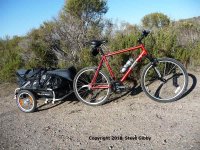
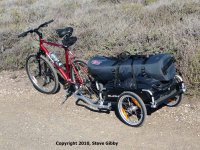
Where safe (not on dangerous wildlife productions!) and permitted, for remote production when we need more equipment than its easy to backpack with and/or we need to stay remote for multiple days, we often travel in via mountain bikes pulling specialty cargo trailers loaded with our gear. Still - the lighter the load the better. See the pics I've attached below of one of my Red One kits on one of our bike/trailer rigs.

The RedCode level needed for TV-delivery documentaries will necessarily be less than that needed for big screen deliveries. There will naturally be many RedCode levels to choose from. We will select the RedCode level best suited for the project delivery needs - and quite often for docs that will be a medium level to at once achieve the quality we're looking for, and to save SSD space and backup time in the process. Most times there's no need to kill a fly with a baseball bat :)

IMO mobile EFP (including docs) will be the single largest sales market for fixed lens Scarlet, and also quite possibly also the largest sales market for Epic X. In terms of sheer numbers of productions worldwide, and numbers of workers involved, the mobile EFP style production industry dwarfs the other sub-industries within the motion media industry. People can talk all they want about Epic being a cinema camera - but in reality the camera is enormously EFP-friendly in terms of features and utility - and will be used widely for a variety of non-hardlined EFP productions, including docs. For EFP style production with Epic and Scarlet, simply keep the rig as light as possible, plan your recording, power, RedCode level, and data processing needs - and go for it!

Documentaries have been one of the heavy concentrations of my production work for the 30+ years I've worked in the motion media industry. Throughout my career I've dreamed of cameras with the quality, utility, and mobility of Epic and Scarlet. Those dreams are being fulfilled...
 

Attachments

  • Trailer-1.jpg
    Trailer-1.jpg
    95 KB · Views: 0
  • Trailer-2.jpg
    Trailer-2.jpg
    96.3 KB · Views: 0
The RedCode level needed for TV-delivery documentaries will necessarily be less than that needed for big screen deliveries. There will naturally be many RedCode levels to choose from. We will select the RedCode level best suited for the project delivery needs - and quite often for docs that will be a medium level to at once achieve the quality we're looking for, and to save SSD space and backup time in the process. Most times there's no need to kill a fly with a baseball bat :)

I agree Steve. It seems that the nice thing SSD will offer in EPIC and SCARLET configs is the ability to "bump up" quality in certain situations. Where HDR mode woud come in very handy, for some high detail shots, etc,.

I have long suggested a mode that would be handy for interviews for example, where only the audio could be recorded or a high compression REDCODE (REDCODE 10) because often a long interview is recorded with minimal onscreen usage.

As it stands RC 28, 36,42 will be plenty for documentary filming and I have exactly the same method you describe, shoot then offload/back up/check media in the evening.

The next gen will be even more flexible tools.


I am also very pleased at how much it improves the quality of the filmmaking. Here is what I mean by that statement:

The RED is allowing us to watch more footage as we go and plan shoots and pickups, etc, in a more interactive way. We are interacting with our footage before we capture the next day of footage. Digital has helped with this, not just RED, but the back up and review process keeps us more engaged and allows for more ideas to develop and emerge.

It's far superior to capturing on film or tape and watching weeks later.
 
I have long suggested a mode that would be handy for interviews for example, where only the audio could be recorded or a high compression REDCODE (REDCODE 10) because often a long interview is recorded with minimal onscreen usage.

I have been forced to use dual system sound out of necessity, but I am curious - if there was to be a large portion of an interview which didn't require any screen time, why not just use an inexpensive recorder like the H4n or an entry-level SD? Roll the camera when you need and get a scratch track, along with the external recorder. The stop the camera whenever you need to. Syncing back 10 or 12 clips to the continuous audio stream shouldn't be a problem, even without slates or markers. And it gets even easier if you just make a note of the audio-timecode whenever you start shooting.

In my experience, doing that saves tons of shooting time making media management and battery management much lighter tasks.
 
Michael,

I carry an H4 ZOOM for this exact reason. I find that some times it's just much better to put a microphone on the tabel and extract the audio when dynamics dictate. The camera brings a different dynamic. Radio style is important.

Very good point though Michael, i'd rather NOT see a RC 10 (lowend Redcode) but audio only might be cool, because it is a 48K 24 bit recorder in the RED.

David
 
Back
Top