Welcome to our community

Be a part of something great, join today!

  • Hey all, just changed over the backend after 15 years I figured time to give it a bit of an update, its probably gonna be a bit weird for most of you and i am sure there is a few bugs to work out but it should kinda work the same as before... hopefully :)

Anyone used the Arri 1800w Baby Max yet?

Eileen Ryan

Banned
Joined
Jan 10, 2009
Messages
35
Reaction score
0
Points
0
Age
66
Anyone used the Arri 1800w Baby Max yet? I'm considering using one for an indie project so that I don't have to rent a tow generator. According to the Arri website it is the brightest light that you can plug into a 20A circuit. I'm curious if anyone has had a problem plugging this kind of amperage draw into a wall outlet. Arri also claims that it has 70% more output than a 1200w - but I have heard the output is comparable to a 4k, which would be impressive. Does anyone have any first hand experience they can share with me.
 
Yes, used it a couple times an just wrapped a 5 day job with it. It's a damn fine light. Just awesome on all fronts, well built, great output, convenient size. The only negative I've heard is cost for the unit and bulbs.
 
Anyone used the Arri 1800w Baby Max yet? I'm considering using one for an indie project so that I don't have to rent a tow generator. According to the Arri website it is the brightest light that you can plug into a 20A circuit. I'm curious if anyone has had a problem plugging this kind of amperage draw into a wall outlet. Arri also claims that it has 70% more output than a 1200w - but I have heard the output is comparable to a 4k, which would be impressive. Does anyone have any first hand experience they can share with me.

Before I prattle on, I've only tested this at a rental house- I have not used it for production yet.

I'm sure whoever told you it matched a 4k was mistaken.

Remember that most 4K's are 2.5k/4k. So... I bet there was a 2.5k installed when they compared.

Even if the candles/watt are identical, it can be hard to tell the difference between 1.8k and 2.5k under a lot of circumstances by eye.

Now if the new fixture is slightly more efficient... it could be a very fair replacement for a 2.5/4 that you were going to run with a 2.5. Especially if you have room to nudge it a touch closer now and again.

Arri's 70% greater output claim would support the notion that its more efficient. Basically Arri is claiming its as powerful as a Mythical 2K Arrisun would have been.

The light seems great, its going on my rental list whenever I need a big gun that can potentially run off of house or a put put.

UPDATE: I didn't consider the possibility that the original report might be about a 4K fresnel- sorry.
 
I shot a one day job with two M18 lamps. Is that the same thing? Two M18 lamps through 6x6 lite grid felt about the same as a 4k par with stipple, but I haven't actually compared or metered.

We had a few shots with one M18 as a back/kicker with no diffusion, the Gaffer and I independently commented on the light quality being "different" than what we were use to with a par.

On the day EXT shots I wasn't able to get the spot punch I'm use to from a 1200w par with a med & spot lens. Next time I want to try out the AS18 as the lens set gives a greater range of spot to flood and a light quality consistent with the other HMI Par lamps on the truck.
 

Attachments

  • photo-11.jpg
    photo-11.jpg
    83.1 KB · Views: 0
... I have heard the output is comparable to a 4k, which would be impressive. Does anyone have any first hand experience they can share with me.

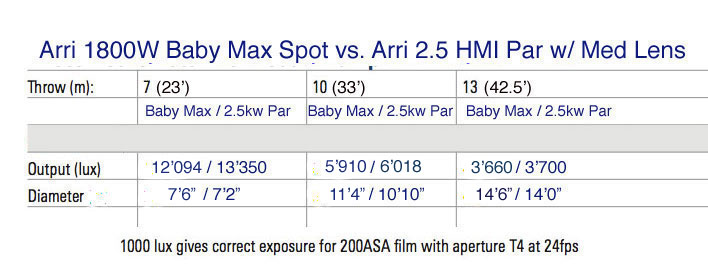
I just posted on this same topic in another thread, but since Eileen seemed to have missed that post I will post here as well. There is a lot of hyperbole like this flying around regarding the output of the new Arri M18 "Baby Max." As a Gaffer, Rental House Owner/Operator, and Arri dealer I have had the opportunity to work extensively with these heads. While it is difficult to compare a Par, Fresnel, and a Baby Max because they are such different lights, to shed some light on this debate I undertook tests using a common denominator (the beam diameter to 50% drop off) to compare the photo-metrics of these heads and here is what I found.

Arri1800_2.5ParComp.jpg

Comparison between 2.5 Par w/ 20 deg. Med Lens (left), 1800 Baby Max in 20 deg. Spot (Center), and 1800W Par w/ 20 deg. Med Lens (Rght) ​


A med lens in a 2.5 Par is about equivalent to the spot of the Baby Max - 20 degrees. So I took photo-metric measurements of those two (see fist table below.) Where there is no easy way to find the 20 degree point on the spot/flood of a 4k Fresnel, what I did is find the point on the 4k Fresnel spot/flood where the beam diameter to 50 percent drop off was the same as on the Baby Max and took measurements there (see 2nd table below.)

ArriBabyMax_2.5_Comp.jpg

What I found was that 1800W Baby Max has a comparable output to a 2.5kw Par and 4k Fresnel, but with a light distribution and quality closer to a Fresnel than a Par. For instance, if you were to spot down the Arri 1800W Baby-Max to the same beam diameter as the 2.5kw Par with Medium Lens in the photometric table above, it would achieve an output comparable to that of the 2.5k Par. But, as is evident in the picture above and the photometric table below, the light distribution is more similar to that of a 4k Fresnel.

ArriBabyMax_4k_Comp.jpg

What accounts for the even light distribution is the Baby Max’s unique reflector which creates diverging rays to produce a crisp shadow from an open face fixture. And, since there is no light lost to a lens, the Baby Max has considerably more output than that of a par – but not nearly the output of a 4k Par.

ArriBabyMax_4kPar_Comp.jpg

Still, to have the output of a 2.5kw Par with the light quality of a Fresnel from an instrument that you can operate on a 20A circuit* is impressive. With a beam angle of 20 to 60 degrees, the Baby Max doesn’t have the long throw of a par with narrow lens, but then how often do you use a narrow lens. Most of the time I find I am using the wide or super wide lens and in that regard the wide of the Baby Max is considerably wider a field angle than the widest par lens (60 degrees vs. 40 degrees.)

While definitely not a substitute for a 4k par, the Baby Max’s unique reflector design enables it to achieve an output comparable to that of a 2.5kw Par, but with a light quality and spread comparable to a 4k Fresnel.

Guy Holt, Gaffer, ScreenLight & Grip, Lightng & Grip Rental in Boston

* There is also a lot of hyperbole flying around regarding plugging 1800w Baby Maxs into wall outlets. But, I will have to address that issue in a later post.
 
The only negative I've heard is cost for the unit and bulbs.

The new Arri 1800W ballast is expensive because it is Power Factor Corrected (PFC.) Since PFC is not mandatory in this country as it is in Europe, you will encounter many non-PFC HMI, Kino, CFL, & LED power supplies. And, since the adverse effects caused by a poor Power Factor (PF) go beyond an inefficient use of power, it is well worth understanding PFC and why it is worth paying extra to have it corrected. Besides, it explains how the Arri 1800W ballast is able to operate on a 20A circuit, and why it is so much more expensive than other electronic ballasts, and worth every penny.

To understand PF lets first compare the PF of a CFL bulb, and its’ effect on the power supply, to that of an incandescent bulb. While not as sophisticated as an expensive HMI ballast, the ballasts of CFLs operate on the same basic principle. The AC power supply is first converted to DC by a diode-capacitor circuit and then back to AC by a switch converter. In contrast, an incandescent light is a simple resistive load. The high resistance of its tungsten filament creates heat until the filament glows - creating light. As we see in the oscilloscope shot below of a 25W incandescent bulb, the current is always proportional to the voltage (current is represented on the scope as the voltage drop on a 1 Ohm resistor.)

Incan_Waveform.jpeg

Current and Voltage Waveform of a ACEC 25W Incandescent bulb ​

If the applied voltage is sinusoidal, the current generated is also sinusoidal. That is, the current increases proportionately as the voltage increases and decreases proportionately as the voltage decreases. Since the peak of the voltage corresponds to the peak in current, the voltage and current are also in phase and so have a unity PF (PF of 1.)

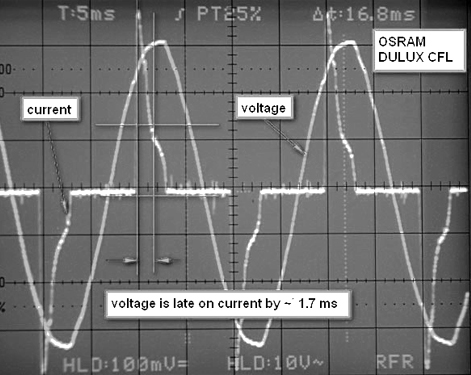
The voltage and current waveforms below of a CFL bulb are very different from that of the incandescent light above. The most noticeable difference is that the current, generated by the CFL bulb, no longer proportionately follows the nice smooth sinusoidal voltage waveform supplied to it. Rather, it has been distorted by electrical components in the ballast of the CFL bulb so that it instead consists of sharp spikes in current that quickly drop off. Also, the peak of the voltage no longer corresponds to the peak in current. The current now “leads” the voltage by 1.7 micro seconds. The voltage and current are no longer in phase as in the case of an incandescent bulb, but instead exhibits what is called a “Leading Power Factor.”

CFL_Waveform.jpg

Current and Voltage Waveform of a Brelight 25W CFL Bulb​

The distorted current waveform and leading PF exhibited here are also characteristic of non-PFC HMI ballasts because they operate on similar principles. When it converts the AC supply to DC, an electronic HMI ballast likewise uses only a portion of the voltage waveform, draws current in quick bursts, and then returns the unused portions as harmonic currents that stack on top of one another, creating harmonic distortion similar to the CFL. Put simply, non-PFC HMI ballasts place a disproportionately larger load on the peak values of the power waveform and draw current in similar high amplitude short pulses ( use this link for more details.) As such, the ballast draws more power than it uses to create light. For this reason, non-PFC electronic ballasts draw more current then quartz loads of the same wattage.

If, in the case of a non-PFC electronic HMI ballast, you were to measure the current (using a true RMS Amp Meter) and voltage (using a Volt Meter) traveling through the cable supplying the ballast and multiply them according to Ohm’s Law (W=VA) you would get its’ “Apparent Power.” It is important to understand that this greater Apparent Power consists not only of the high amplitude short pulses of current drawn by the ballast. A non-PFC electronic ballast also returns the unused portion of the voltage waveform into the distribution system as harmonic currents. That is, if you were to, use a wattmeter to measure the actual amount of energy being converted into real work (light) by the ballast, rather than into the generation of harmonic currents, you would get the “True Power” of the ballast. The ratio of “True Power” to “Apparent Power” is a measure of the “Power Factor” (PF) of the ballast. Where a typical 1200W non-PFC electronic HMI ballast takes 18.5 Amps at 120 Volts to generate 1200 Watts of light the PF is .54 (18.5A x 120V= 2220W, 1200W/2220W= .54). Which means the ballast has to draw 40 percent or more power than it uses.

The favorite analogy electricians like to use to explain PF is that if apparent power is a glass of beer, PF is the foam that prevents you from filling it up all the way. When using lights with a poor PF (HMIs, Kinos, CFLs, & LEDS), you must size your distribution system and generator to supply the Apparent Power (beer plus foam.) In other words, all the circuitry in the ballast as well as the supply chain (the generator plant, distribution wiring, circuit breakers, etc) must be capable of carrying this higher constant current.

This greater Apparent Power is not the only consideration when using lights sources like HMIs, Kinos, CLF lamp banks, and even LEDs, that have a poor Power Factor. In addition to kicking harmonic currents back into the distribution system, where they stack on top of one another, a non-PFC electronic HMI ballast also puts current and voltage out of phase with one another (they cause current to lead voltage.) Both factors contribute to the creation of unusually high returns on the neutral of the distribution system; and, when its’ power is generated by a conventional portable generator, the harmonic currents may also lead to severe distortion of the voltage waveform in the power distribution system (called “Harmonic Distortion” and illustrated below.)

waveform_harmonic_distortion.jpg

For example, the power waveform below is typical of what results from the operation of a 2500W non-PFC load (electronic HMI & Kino ballasts) on a conventional portable generator (a Honda EX5500 with a Barber Coleman Governor.) This voltage waveform distortion can cause overheating and failing equipment, efficiency losses, circuit breaker trips, and instability of a generator's voltage and frequency, in addition to excessive current on the neutral return.
CFL_FlatTop_Waveform.jpg

The pulsed current consumed by electronic ballasts produce voltage distortion in the form of flat- topping.​

Fortunately, the new Arri EB1200/1800 for the 1800W “Baby Max,” incorporates PFC circuitry that realigns voltage and current and induces a smoother power waveform at the distribution bus. It’s PFC circuit successfully increases its’ PF to .98, making it a near linear load. As a result, the ballast uses power more efficiently (which accounts for why the 1800W Baby Max can operate on a 20A circuit), minimizes return current and line noise, and also reduces heat, thereby increasing its’ reliability. For the sake of comparison, if you were to lamp the new Arri Baby Max head with a 1200W globe, the EB1200/1800 ballast would draw approximately 11.5 Amps.

When using a lighting package with low PF (like the pkg. of non-PFC electronic HMI & Kino ballasts depicted above), the conventional wisdom in the past has been to not load the generator beyond 75% for more than a short period. Where the maximum recommend continuous load on a 6500W generator is 5500W, the de-rated continuous load rating would be roughly 4000 watts. By de-rating the load capacity in this fashion, the Gaffer minimizes the adverse effects of high Harmonic Distortion so that both the generator and the loads placed upon it operate more reliably. However, this conventional wisdom no longer holds true if the HMI & Kino ballasts are PFC and powered by an inverter generator.

wwaveform_pkg_comp_AVR_In.jpg

Left: Conventional generator power w/ pkg. of non-PFC Elec. HMI Ballasts & Kino Flo Wall-o-Lite. Right: Inverter generator power w/ Pkg. of PFC Elec. Ballasts & Kino Flo Parabeam 400.​

For example, the power waveform above on the right, is the same 2500W load but with PFC operating on our modified Honda EU6500is Inverter Generator. As you can see, the difference between the resulting waveforms is startling. Even though the load is the same, the fact that it is Power Factor Corrected, and power is being generated by an inverter generator, results in virtually no voltage waveform distortion. What this means is that an inverter generator can be loaded to capacity with PFC HMI and Kino Flo ballasts. The substantial reduction in line noise that results from using PFC ballasts on the nearly pure power waveform of an inverter generator creates a new math when it comes to calculating the continuous load you can put on a portable gas generator. And if the generator is one of our modified Honda EU6500is inverter generators, you will be able to run a continuous load of up to 7500W as long as your HMI and Kino ballasts are Power Factor Corrected.

As the oscilloscope shots above illustrate, PFC can be of tremendous benefit when operating HMIs on portable gas generators. While it adds to the cost of the ballast, PFC is what makes the Arri EB1200/1800W ballast worth the extra money.

Guy Holt, Gaffer, ScreenLight & Grip, Lightng & Grip Rental in Boston
 
Last edited:
Awesome post Guy! Thanks for the time and effort!

Thanks for the feedback. It is nice to see someone appreciates my efforts to make a very complex topic comprehensible. For a more detailed explanation of Power Factor and how it effects what we do, I would suggest you read an article I wrote “The Use of Portable Generators in Motion Picture Production.” Harry Box, author of “The Set Lighting Technician’s Handbook” has cited it in the just released Fourth Edition of the handbook. In addition, he has established a link to it from the companion website for the Fourth Edition of the Handbook, called “Box Book Extras.”

BoxBookForumLinkGenSetMed.jpg

Of the article Harry Box states:

"Great work!... this is the kind of thing I think very few technician's ever get to see, and as a result many people have absolutely no idea why things stop working."

"Following the prescriptions contained in this article enables the operation of bigger lights, or more smaller lights, on portable generators than has ever been possible before."​

You can log onto the Box Book Extras site at http://booksite.focalpress.com/box/setlighting/ with our pass-code "setlighting." Or, use this link for my news letter article on the use of portable gas generators in motion picture production.

If you haven't yet read the article, or looked at it in a while, it is worth reading. I have greatly expanded it to be a comprehensive resource on portable power generation for motion picture production. Besides explaining these issues in more detail, I have included links to a You-Tube video that clearly demonstrates the adverse effects that lights with a poor Power Factor can have on generators and other equipment operating on the same power. I have also included a section on how to reliably operate the 1800W Arri Baby Max on house power (no you can not just plug them into the wall.)

Guy Holt, Gaffer, SceenLight & Grip, Lighting and Grip Rental in Boston.
 
Thanks for the feedback. It is nice to see someone appreciates my efforts to make a very complex topic comprehensible.

You're welcome, of course.

For a more detailed explanation of Power Factor and how it effects what we do, I would suggest you read an article I wrote “The Use of Portable Generators in Motion Picture Production.” Harry Box, author of “The Set Lighting Technician’s Handbook” has cited it in the just released Fourth Edition of the handbook.

I had read the other article before, but I found your presentation here more accessible. Might have been the oscilloscope... or it may just be that I was exposed to it before.

I've been of two minds about getting the 4th edition Box book. I'm not really working in G&E as much as I used to. I've definitely been turning to the ASC manual and manufacturers sites for planning data more.

I don't have a good sense of what I'd get from updating the Box book.
 
I've been of two minds about getting the 4th edition Box book. I'm not really working in G&E as much as I used to. I've definitely been turning to the ASC manual and manufacturers sites for planning data more.

I don't have a good sense of what I'd get from updating the Box book.

You may be right, since the new sections in the 4th Edition include topics that only electricians need to know, such as:

  • planning, running and troubleshooting DMX512 networks
  • Operating wireless DMX systems
  • RDM and Ethernet Networks
  • using Moving Lights
  • Pixel-mapping and media servers
  • Electrical Rigging Practices
  • Dealing with line loss and harmonic currents
  • Wet locations and GFCIs
  • 480V transformers for long feeder runs

But it also includes new sections on topics that would appeal to DPs such as:

  • What every lighting technician, gaffer and DP needs to know about LED lights
  • Light plots and lighting previsualization software
  • As well as an expanded section on the use of portable generators based upon the modifications we have made to the Honda EU6500is generators.

I would think the section on portable generators would be particularly valuable to DPs because if they are using a portable genny it probably means that they don’t have an experienced electrical crew working under them that can design a system that will mitigate the adverse affects that the harmonics generated by HMIs, Kinos, CFL, & LEDs will have on electronic production equipment operating on the same power. In which case, I would think the DP would want to make sure they rent a system that is not going to be problematic. But you don’t need to buy the 4th Edition to get that information because Harry Box has posted our newsletter article on the use of portable generators in motion picture production in the “Box Book Extras,” section of the companion website to the book.

The “Box Book Extras,” site is also worth checking out because it includes other source material used for the handbook, articles by Harry Box published in other periodicals, related websites, a list of production oriented i-phone apps, as well as more in depth discussion of topics touched upon in the handbook. You can log onto the Box Book Extras site at http://booksite.focalpress.com/box/setlighting/ with our pass-code "setlighting." Use this link for my news letter article on the use of portable gas generators in motion picture production.

- Guy Holt, Gaffer, ScreenLight & Grip, Lighting & Grip Rental in Boston
 
Back
Top