Welcome to our community

Be a part of something great, join today!

  • Hey all, just changed over the backend after 15 years I figured time to give it a bit of an update, its probably gonna be a bit weird for most of you and i am sure there is a few bugs to work out but it should kinda work the same as before... hopefully :)

Shooting in a salt mine with red one

Joined
Apr 27, 2007
Messages
6
Reaction score
0
Points
0
I am planning on taking my red into a salt mine this week. I am pretty apprehensive about the possibility of destroying my camera with corrosion. I will be under ground for about 3 hours and plan on sealing camera in a plastic bag as best I can. Does anyone have experience with shooting in a salt mine. Any and all suggestions are greatly appreciated!
 
Ironically, many of Hollywood's most treasured negatives are in storage in salt mines. No specific experience, but I haven't heard of excessive corrosion resulting from minimal exposure. I think you may be fine as long as you seal the ports with tape. Leave the airways open at the bottom for venting. After you're done-- not kidding: lick the camera to see if its salty-- if its not, no worries.
 
The humidity is so incredibly low, the air has no material ability to transport and hold particulates, and the air is quite still, preventing air transport by turbulence. I would bet money that the air in a salt mine is less corrosive and problematic than in any urban area, or area of high humidity. They store important things in salt mines for this reason.
 
I've shot in Salt Domes on numerous occasions and never had any issues. The mine shafts are huge and the air is dry and still....nothing like shooting in sea air.
 
I thought salt mines are the absolute best possible environment for electronic equipment. That's why so many former salt mines are converted into storage facilities and data centers. Cool temperatures, zero humidity?
 
Salt mines are VERY safe for electronics.

They can be very bad for metals though.

Note: it is unlikely that salt will get on or into your gear... but the damage it can do is more insidious.

So... cover and protect any unused ports. Take extra care with any lens changes. (In sandy conditions I prefer to use zooms to eliminate as many changes as practical. I think the same advice would follow here.)

Once you are out of the mine clean your gear thoroughly. Use the lick test Jeff mentioned. You want to get all the detectable salt off.

You also want to check the various moving parts of your gear. You may need to clean and re-lubricate it similar to a beach/desert shoot. Its less likely that salt will get into your gear than sand... but it can be more harmful if it does.

I don't think you need a rain cover... but it won't hurt either.
 
Not having shot in a salt mine myself, I asked a friend of mine who is a well-known corporate shooter to share some of his thoughts. Here's what he said:

"I shot in a deep salt (Potash) mine in Saskatchewan. Of all the mines I was ever in, a salt mine is the prettiest and easiest to work in.

As in most mines, there is a residual dust in the air. In a salt mine this fine diust won't hurt much inless you're near the face of the mine where cutting is happening. The dist will blow off most everything that's a hard surface, like camera bodies and tripods and stands.

There's no sspeccial precaution I can think of except to keep stuff in ziplock bags when not being used. If you're opening camera hatches to remove cards, I'd do that inside a freshly unzipped gallon or extra large bad to keep micro salt dust off components.

Here's a hint that I wish I had heard first. Do not shave your face or bare legs before working in the mine. The salt dust will sting like hell from the freshly scraped skin. (Like salt on a wound.)

---Good luck."
 
I have never shot in salt mines but have shot in coal mines on several occasions. Salt mines should be pleasant by comparison.

Just be aware of the lighting. Although the mines I have been in were lit, they were quite dark and power is not always plentiful.
 
I have never shot in salt mines but have shot in coal mines on several occasions. Salt mines should be pleasant by comparison.

Just be aware of the lighting. Although the mines I have been in were lit, they were quite dark and power is not always plentiful.

Salt domes have white walls...it allows for some pretty dramatic images.
But you will need to supplement the lighting.
 
Salt mines are VERY safe for electronics.

They can be very bad for metals though.

Those two statements are quite the paradox, don't ya think???


Salt mines are consistently cool and dry, that's how crystalized salt deposits can exist there. Depleted salt mines are desirable for storage purposes because they tend to remain cool and dry and temperatures remain very consistent all year round. Same can be said about other types of mines, but salt mines tend to be located where water won't seep into them. That staying dry part is pretty important.

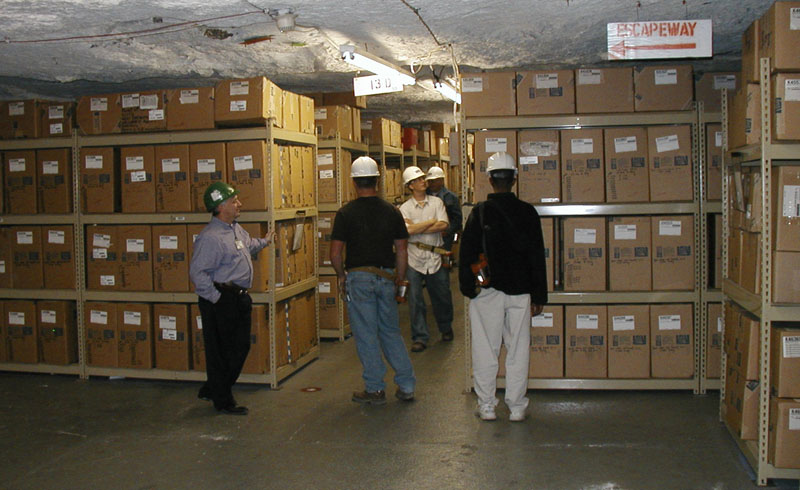
Most things that are stored in salt mines are items which are not highly reactive to sodium compounds or salt. Over time, salt particles do migrate through calm air, so salt is always a risk for certain items. Storage areas of the mines are often over-excavated and then lined to mitigate the salt exposure. Often the lining is with "gunnite" or "shot-crete" where they literally just blow concrete all over the cavern walls to stabilize and seal them off and then the floor areas are concreted or covered with a tight-compacting fill like a class-1 sand or road base. There are different types of salt mine storage. Many storage areas do leave exposed salt deposits as the salt itself acts as a natural desiccant and this can be very desirable for stored goods that are not particularly vulnerable to salt. This leads to the white walls mentioned by Greg and the white salty ceiling shown in the picture I linked. Notice the concrete floor. Salt mines used for storage are typically very calm, dry, cool and clean.

A lot of salt mine storage looks like this:
hutch037.jpg


If you're going into an active salt mine, especially near areas of active mining, there will be lots of dust, which will have very high salt concentrations. You will want to bag your camera just as you would if you were in any other seriously dusty or dirty environment. The bad thing about salt dust is that it's salty and you will need to make sure it's all cleaned from your camera after the shoot and definitely before you take the camera anywhere with increased humidity. Machinery used in active salt mines corrodes very fast.

If the mine is depleted and being used for other purposes, typically storage, the dust and salt levels should be well managed and you should be just fine. Just be sure that if the camera does get dusty/dirty that you take care of it as the salt content in that dust can be very high. If water has started to seep into the mine, then chances are no one is going to be using it for anything and you probably don't need to be in there.
 
Thanks for the suggestions and confirmation

Thanks for the suggestions and confirmation

Thanks for all the information!
 
@ Jeff C : "After you're done-- not kidding: lick the camera to see if its salty"

I lol'ed - I would say the same sorta thing.. Glad that it not just me...
 
Originally Posted by Alexander Ibrahim
Salt mines are VERY safe for electronics.

They can be very bad for metals though.

Those two statements are quite the paradox, don't ya think???

I missed some connections you actually drew.

So long as the camera is in the salt mine and dry, its really just dust.

Once you get into the world where humidity is an issue... corrosion starts.

So, in the salt mine is safe.

But salt is bad for metal.

So you have to make sure and clean the gear thoroughly.

Does that make better sense now?
 
Cover the camera and exposed ports with 2 inch wide electricians tape. It leaves no residue an is air/water tight and does not conduct current.


Cross contamination could be more of an issue. ie salt transferring from say tripod to hands to camera, or from bottoms of flight cases into your vehicle.


Mike Brennan
 
Back
Top