- Banned
- #1

Ken Corben
Banned
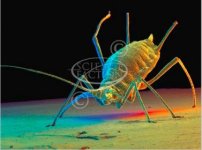
Inspired by the lighting on an electron micrograph of an aphid (attached),
I tested a new lighting technique for a 3D IMAX MICRO project at the USC marine lab yesterday.
The Challenge:
How to save money filming the micro critters of the sea while telling the story of how they generate 1 in 2 molecules of oxygen we breathe each day with no CGI or composites - if possible.
The film will be shot on EPIC's utilizing a custom designed 3D micro system here on a sound stage in Hollywood.
Methodology:
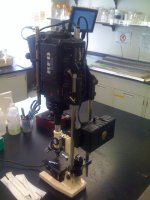
I configured a RED ONE on a PL mount microscope and worked with Dr. David Caron's marine lab at USC as my "microbe wranglers." The project solution concept is to utilize 2 EPIC cameras shooting tangental to the subject through a prism to capture the microscopic image in stereo pairs.
A custom turntable (3 dimensions) will be used as the adjustable stage for the "actors" controlled by Preston Cinema Technology's HU3 FIZ control. FIZ simply becomes X, Y and Z movement on the turntable. Elegant and repeatable - thanks Howard.
Lighting:
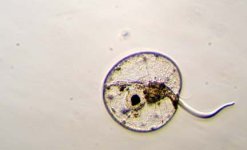
We all know the blown out microscope image from high school ("before" r3d screenshot example attached). The keying, tracking and compositing POST issues of this narrow focal plane cinematography is costly in 2D let alone for stereo pairs.
"Off the shelf" advanced lighting technologies from the biomedical industry applied in traditional stage lighting were applied. These narrow focused beams provided digital controlled beam focus and color temp control - sweet.
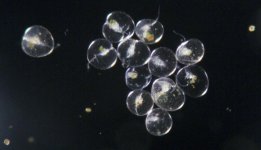
The miniature KEY, FILL and BACK LIGHT were all fully controllable for positioning with their standard fiber optic flex arm and yielded very cool potential 3D results from these R1 2D test results. ("after" r3d screen shot example attached).
FIndings:
The results exceeded expectations. As seen from the before and after photos (r3d screen shots) the lighting results provided real time filming of a microscopic predation event with out image manipulation in POST - sweet.
These little microscopic wolves of the sea (Noctiluca) are seen gobbling up the phytoplankton (Lingulodinium) in the screen shots. On an 80 foot screen in 3D the predation event will entertain and amaze.
Sharky