Welcome to our community

Be a part of something great, join today!

  • Hey all, just changed over the backend after 15 years I figured time to give it a bit of an update, its probably gonna be a bit weird for most of you and i am sure there is a few bugs to work out but it should kinda work the same as before... hopefully :)

Prime Lenses.....what can't you live without?

Rick Burnett

Well-known member
Joined
Jan 20, 2009
Messages
896
Reaction score
0
Points
0
So I've been getting ready to explore prime lenses used on a S35 sensor. I shoot many of my shots with a 30mm F1.4 as I absolutely love this lens size. Lately, I want to add some more primes to my set and I am trying to decide what would be good and why.

I am thinking of adding a 85mm F1.4 and I do have a 50mm F1.8 right now.

Where else would you go? These lens are for two purposes. (1) Shooting action/sci-fi films and (2) Events at night. The events at night are why I go for 1.4 speed, but in terms of primes, just not sure what else to use.

I also have
11mm to 26mm zoom
28mm to 135mm zoom
70mm to 300mm zoom

I love the super wide angle, the second two are just not used that often.

Thoughts? What can't you live without in the prime world on the Red?
 
50mm in terms of optical performance is one the best focal lengths in many ways

where it can be possible to achieve the fastest speed available at FF35mm

like in the case with Leica Noctilux-M 50mm f/0.95 ASPH or Voigtlander Nokton-M 50mm f/1.1 aspherical.

I do have 50mm F/1.4 (Canon EF and Leica Summilux-R) and 50mm F/1.2 (Canon FD L) with a plan to get Noctilux 0.95 as soon as I can.

Also have Canon FD 24mm L f/1.4 and Canon 85mm f/1.2 FD L.

Still struggling to find a good fast 35mm below f/2.0 and it could be probably the latest version of Leica Summilux M 35mm f/1.4 asph.
 
Yup, have the 30mm and 50mm. Is there any good references on what lens are good to shoot what?

For instance, I felt the 85mm would be good for shooting over the shoulder since I wouldn't have to be up on top of the people AND the B-cam can be doing a 2-shot with a wider lens.

I guess I need to try out a 24mm and see how it looks. Trying to feel out where I would want to use this over the 30mm. I realize for wider shots, I just have to wrap my head around it.

Do you use anything in the 100mm+ range? (other than wild life).

And, thank you all so much for the information. I really appreciate it.
 
If you have a 30/1.4 and a 50/1.4 and you're looking for wider I would go for Canon's 24mm/1.4 (as I'm sure Tom Lowe would tell you :)) and Tokina make a very nice 11-16/2.8 zoom that can be used as a variable prime. I'm struggling to find a good 18mm prime - it doesn't seem to be a very popular focal length with still glass; there's an old Nikkor and a Zeiss ZE, but both are pretty pricey for f3.5.
 
There are many:

Leica R 15mm f.2.8 expensive and difficult to find.

Leica R 19mm f/1.2 version 2, also a bit expensive and difficult to find.

Leica R 28mm f.2.8 excellent

Leica R 35mm f/2 affordable and relatively easy to find

Leica R 50mm f/1.4 affordable and relatively easy to find

Leica R 80mm f/1.4 expensive but excellent

All manual focus, metal enclosures, mechanically smooth and superb, FF35mm usable also for HDDSLR or Epic FF35mm.
 
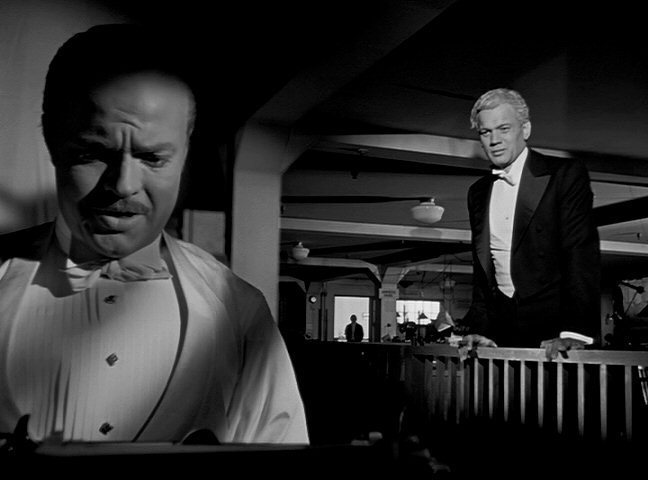
The practical reason for something wider than 30mm is just that some spaces are too small to get a wider shot without a wider-angle lens. The aesthetic reasons, well, that's a matter of taste... wide-angle lenses exaggerate 3-point perspective, causing the background to recede more rapidly. This also makes forwards/backwards motion more dynamic (where as lateral motion is often more dynamic on a long lens because of how it makes the background blur by.)

The practical reason for a lens longer than 50mm, as you guessed, it's easier to fit multiple cameras and get them out of each others' view if the lens is not taking in so much of the space. And of course, there is the increase in compression of space. You can find great compositions either way, wide-angle or telephoto.

I've posted these frames many times, but here's an example of a wide-angle (25mm) shot, staged in depth:

citizenkane1.jpg


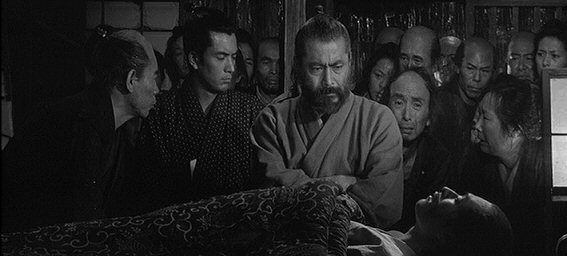
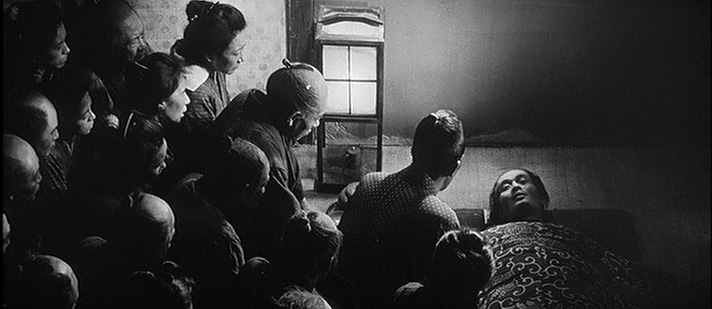
And here are examples of telephoto shots. You'll note that even though there is crowd of people, the nearer heads are not much larger in frame than the further heads. Of course, to get this look, Kurosawa used a ton of light to stop down the lens:

redbeard1.jpg


redbeard2.jpg


onald Ritchie has claimed that a lot of "Red Beard" was shot with a 500mm anamorphic lens, with the cameras at the other end of the soundstage, to get this compression. Not sure if that was the lens in these shots, but keep in mind that in spherical photography cropped to 2.35, you'd use something like a 250mm lens to match a 500mm anamorphic lens.

No right or wrong way here, mostly an aesthetic choice.

You get conflicting opinions on whether wide-angle lenses up close are more "intimate" than telephoto lenses shooting close-ups.

Long lenses are also useful to give the actor some room to navigate through a space without having to do as much tracking back with them, through furniture, etc. while keeping a generally tighter frame. A wide-angle lens would force you to move with the actor to maintain a close size.

The compression of telephoto lenses, and how they make the background softer, can look "prettier", especially when shooting through foreground objects. When I did "Jennifer's Body" it was mainly a wide-angle movie but we used a long lens to shoot a shot of Amanda Seyfried walking through a crowd of people at the prom, the camera panning through foreground Christmas tree lights. All those out of focus points of light would not have been as pretty on a wide-angle lens. However, often compositions are more dynamic with wide-angle lenses due to the exaggeration of receding space.

Yup, have the 30mm and 50mm. Is there any good references on what lens are good to shoot what?

For instance, I felt the 85mm would be good for shooting over the shoulder since I wouldn't have to be up on top of the people AND the B-cam can be doing a 2-shot with a wider lens.

I guess I need to try out a 24mm and see how it looks. Trying to feel out where I would want to use this over the 30mm. I realize for wider shots, I just have to wrap my head around it.

Do you use anything in the 100mm+ range? (other than wild life).

And, thank you all so much for the information. I really appreciate it.
 
28mm..

its wide enough, can be wider if you just step back..

but you can also get pretty close with it.. (just push in)

anything wider or longer and your pretty much stuck...

32 would work too...

but if I could just have one it would be 28

if I could have 3 it would be 16, 28, 65
 
28mm..

its wide enough, can be wider if you just step back..

but you can also get pretty close with it.. (just push in)

anything wider or longer and your pretty much stuck...

32 would work too...

but if I could just have one it would be 28

if I could have 3 it would be 16, 28, 65

I use a 30mm, which is pretty close to 28mm, but I will tell you, for fight scenes, it is not the best of lens when you need to get up close and legs are flying around! :) (I shoot Kung Fu)

But, my 30mm is my favorite lens.
 
I remember Owen Roizman, ASC once talking about lenses - he said something about preferring the "normal" unexaggerated lenses for narrative work but the extreme ends for commercial work. It strikes me as true, that it is more "stylish" to use the extreme ends, and therefore you see it done more often in genre movies that are mostly about style. Michael Bay is a good example, he shoots a scene on both the widest-angle lens he can find and the most telephoto. It has a very slick, commercial look -- because it looks like a commercial!

But for drama, and a subtle directorial touch, working in the middle focal lengths helps to not call attention to the mechanics of filmmaking.

Like I said, there is no right or wrong answer. Just the application of personal taste. Polanski, Welles, Kubrick, Gilliam, etc. tend to prefer the wide-angle lenses but Kurosawa, Ridley & Tony Scott, many others prefer telephoto lenses. Hitchcock, Ozu liked the 50mm...
 
No right or wrong way here, mostly an aesthetic choice.

Thanks for those excellent examples. One thing I need to do is go out and shoot the same scene with different lenses so I can really feel the effect the long focal lengths have which I have not done yet.

I think the 85mm is definitely going to be the next purchase. After that, I cannot say. The more I shoot, the less I feel I need 5 million lenses, and with this information here, I'll probably come down to maybe 4 or 5 lenses I shoot all the time, and maybe a couple other speciality lens for creative purposes.

Again, thanks very much for taking the time to go through these examples. There is so much subjective feeling in art, sometimes it's hard to get the right angle to go with.
 
With a 50 and an 85, I could shoot a film. Those are our everything lenses. I don't have a lot of use for lenses wider than 35. . . too much expansion of space with those (even though we own them) for my taste.

Stephen
 
While not a prime, I use my Tokina at 11mm solely I find. Not for a lot of stuff, but if a scene is real tight or I want a stylistic distortion, it's nice to use.

I need to start using my 50 more, and not just my 30 and see how it differs to my eyes.

Still waiting to pick up an 85mm as I think this lens will get A LOT of use from me.
 
The lenses I find myself reaching for:

~16
~25
~50
~85

I don't find myself pulling out the 35 much. I think I would like a 40mm instead of a 50, but haven't had one out yet. Outside of those four, I will occasionally grab a 200 or a 10 for a special effect. My ideal four lens package - 16, 25, 50, 85. Five lenses, I would add 10mm. And six lenses I would add a 200.
 
I remember Owen Roizman, ASC once talking about lenses - he said something about preferring the "normal" unexaggerated lenses for narrative work but the extreme ends for commercial work. It strikes me as true, that it is more "stylish" to use the extreme ends, and therefore you see it done more often in genre movies that are mostly about style. Michael Bay is a good example, he shoots a scene on both the widest-angle lens he can find and the most telephoto. It has a very slick, commercial look -- because it looks like a commercial!

But for drama, and a subtle directorial touch, working in the middle focal lengths helps to not call attention to the mechanics of filmmaking.

Like I said, there is no right or wrong answer. Just the application of personal taste. Polanski, Welles, Kubrick, Gilliam, etc. tend to prefer the wide-angle lenses but Kurosawa, Ridley & Tony Scott, many others prefer telephoto lenses. Hitchcock, Ozu liked the 50mm...

This is a very good point - by the way, take all the posts from David on Reduser together and you might learn more than in many Uni film programs!

I find very wide and very telephoto can be heavy-handed, to the point where they take you out of the story as you notice all the 'fancy filmmaking". In non-narrative (docos) I think one has more room to get jiggy with lenses, as there is often no suspension of disbelief plot to hold the viewer connected to. In non-fiction we use wides and telephotos all the time to show environments in ways that emphasize certain aspects of them (to make a big building look BIG for example), and also because some pieces can be a tad talk-heavy, and we like to spice things up with really high-sucrose eye candy in the b-rolls. In fiction, in my opinion, this would overwhelm.

I personally am not a fan of "over-directing" in fiction films, preferring Hitchcock's close-to-story often almost transparent approach. This is what I saw in Jennifer's Body - the shots were always so close to the feel of the moment in the fiction that you never said "hey gee, I wonder what lens they're using".

That said, the two lenses we take most out of the case seem to be the 28 f2 (Zeiss) and 50 f1.4 (Zeiss)
 
Back
Top